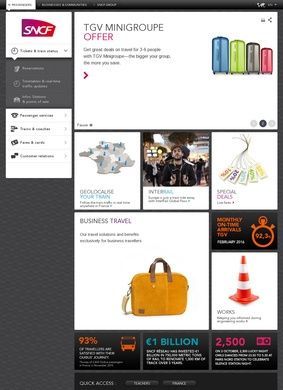
You need to be in Lyon by nine tomorrow, the flights have doubled in price overnight, and driving means five hours you cannot spare. This is the moment SNCF: French National Railway Corporation is built for. France's state-owned railway runs the high-speed lines that turn that trip into a couple of hours with a tray table and a power socket, booked the evening before and boarded with a phone screen.
SNCF: French National Railway Corporation is the national railway of France, wholly owned by the state, and it is less a single company than a group with distinct arms doing very different jobs. Understanding which arm you are dealing with makes the whole thing far easier to use.
How the group moves people and freight
The passenger side is the part most travellers meet first. SNCF: French National Railway Corporation operates the TGV high-speed service between major cities, the regional TER trains that stitch smaller towns onto the main lines, and the Transilien commuter network that carries the daily crowds in and out of Paris. For journeys beyond the border it connects to Eurostar services into the United Kingdom and Belgium. The result is a ladder of options, from fast intercity down to slow regional and dense commuter, all run by SNCF: French National Railway Corporation under one booking system.
That single-operator structure is the practical advantage of SNCF: French National Railway Corporation. A trip that mixes a high-speed leg with a regional connection stays inside one network, one ticket, one set of rules, which is exactly the friction a traveller wants removed.
Speed tiers from TGV to Transilien
These three cover almost every domestic need in France. The TGV is the headline, moving passengers city to city at speeds that beat flying once airport queues and transfers are counted into the total. TER fills the gaps the high-speed lines skip, reaching the market towns and coastal stops that a fast train blows past.
Transilien handles the unglamorous daily grind of commuting around the capital. A traveller rarely has to think hard about which brand they need, since the schedule sorts it automatically, and the scale underneath SNCF: French National Railway Corporation is enormous: roughly 35,000 km of track carrying more than 14,000 trains on an ordinary day.
That reach is the quiet argument for the whole operation. A network that dense means most French towns of any size have a station and a timetable that connects to the fast lines, so a journey planned end to end rarely dead-ends at a platform with no onward train. Coverage like that is the thing a rail traveller notices only when it is missing.
Ouigo and the low-cost trains
Price-sensitive travellers get a service aimed squarely at them. Ouigo is the low-cost arm of SNCF: French National Railway Corporation, stripped-back high-speed travel priced to compete with budget airlines and long-distance coaches. It is the same railway underneath the cheaper fare, aimed at a passenger willing to trade some flexibility, a central station, or a little legroom for a materially lower price.
For a family of four or a student heading home for the holidays, that option changes the arithmetic of a long trip, and it keeps rail in the running against a cheap flight instead of ceding the budget end entirely. The catch is the trade every low-cost service asks for: fares are cheapest well ahead of travel, some departures use outlying stations, and changing a ticket costs more than it would on a standard fare. A traveller who reads those terms first tends to come away satisfied.
Freight and the Geodis logistics arm
Away from the passenger platforms sits a business a traveller never sees but a shipper leans on daily. Rail Logistics Europe is the freight division, moving goods by rail across the continent, and the supply-chain subsidiary Geodis handles warehousing, distribution, and logistics well beyond the tracks themselves. Through Keolis, in which SNCF: French National Railway Corporation holds a seventy percent stake, the group also runs buses, trams, and other public transport contracts in cities far outside France.
Put together, this is the quiet half of SNCF: French National Railway Corporation that keeps industry supplied, and it reaches across roughly 120 countries with a workforce numbering close to 270,000. For a business shipping across borders, that combination of rail freight and a full logistics arm under one roof is a genuine reason to look here before piecing together a chain of separate carriers.
Booking through SNCF Connect
The front door for most journeys is SNCF Connect, the online booking platform of SNCF: French National Railway Corporation, with Rail Europe covering a slice of the international sales. This is where a timetable becomes an actual ticket in your pocket, with seat selection, fare comparison, and live schedules pulled into one place, and it is the tool a first-time visitor to France will spend the most time in.
Behind the booking screen the operation is split into clear parts after its reorganisation into a holding company: SNCF Reseau owns and maintains the infrastructure, SNCF Voyageurs runs the passenger trains, and Rail Logistics Europe carries the freight. For the person buying a ticket that division stays invisible, and honestly that is how it should be, since the track manager and the train operator being answerable in their own right is a structural strength, not something a passenger should have to think about.
For any one trip the sharper question is usually where to buy, and there a traveller might weigh the official platform against a third-party reseller such as Trainline. Trainline aggregates operators across Europe into a single tidy interface and charges a small booking fee for the convenience; the direct route sells the same French seats without that surcharge, in exchange for a busier, less polished screen. For a journey wholly inside France, booking straight from SNCF: French National Railway Corporation is the leaner and cheaper path.
For a messy multi-country itinerary stitched across several railways at once, the reseller can be worth every cent of its fee.