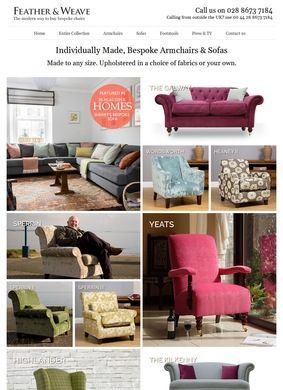
A corner sofa that Feather and Weave built for the interior designer Sherry Wales, covered in Linwood Iona linen, was photographed for the magazine 25 Beautiful Homes. That single credit says more about the workshop listed here as Armchairs than a page of description ever could, because it is checkable and specific: a named designer, a named fabric, a named national title. The business behind it is a family operation in Cookstown, Northern Ireland, making upholstered furniture to order.
Feather and Weave is the maker; Armchairs is the name over this particular listing. The range stays deliberately narrow, and that narrowness is the point. Custom chairs, sofas, headboards, and footstools, each one built to whatever size a customer needs and covered in a fabric the customer picks out. None of it comes off a warehouse shelf.
The whole pitch of Armchairs rests on that one idea: made to measure, made to order.
A workshop that builds to order
The core offer is bespoke upholstery, and the product list holds to it without wandering: armchairs, sofas, headboards, footstools. The natural buyer is someone with an awkward alcove, a bay window, or a wall that no standard three-seater will ever fit, and the other natural buyer is an interior designer speccing a room down to the weave of the covering. Both get the same thing, a piece built individually to their measurements and delivered straight to the door.
Anyone who has tried to wedge a mass-produced sofa into a room it was never sized for will see the appeal at once.
The site runs deeper than a single sales page, which counts for something here. A full Collection page carries the products, and around it sit a Testimonials section, an FAQ, an About Us page, and a press area titled "In The Spotlight," where the 25 Beautiful Homes feature lives.
Giving that coverage its own dedicated corner of the site, instead of dropping it into a passing sentence, is the move of an operation that trusts what it makes. Armchairs gives a browsing customer real pages to read before parting with any money, and the testimonials and press together do more persuasive work than the product photographs alone would.
Terence and Carmel
The FAQ names Terence and Carmel as the two people a customer actually speaks with. They field the questions that decide how a commission turns out: which fabric, which style, and how long the delivery will take. Naming them is a small thing with an outsized effect. A buyer is ordering from two people they can put a name to, and for a maker the size of Armchairs that direct human contact is a large part of what is being sold.
It also sets an expectation, that the process runs on conversation and choices made together, not a cart and a checkout button.
Fabric and size on the buyer's terms
Choice runs through everything Armchairs does. A headboard cut to an exact width, a footstool scaled to sit beside one particular chair, a sofa built for a single wall in a single room, each one covered in cloth the customer chose. For a homeowner furnishing a difficult space, and for a designer matching an existing scheme, that freedom is the reason to commission a maker instead of walking a showroom floor and settling for the nearest fit.
Feather and Weave is selling the process as much as the finished piece, and the Linwood Iona linen on the Sherry Wales sofa is a concrete example of where that flexibility can land. The trade-off, of course, is that a made-to-order piece asks for patience and a clear idea of what the room needs.
Reaching them, and what the outside says
On contact, Armchairs is weaker, and it is worth being straight about it. A contact page exists, and the FAQ points a customer toward Terence and Carmel, but the homepage itself carries no phone number and no email address. The workshop address, on Moss Road in Cookstown, turns up on a third-party listing instead of being confirmed on the company's own landing page. For a business whose entire model runs on a detailed conversation about measurements and material, that is a genuine gap, and a phone number displayed in plain sight would close most of it on its own.
Outside feedback is close to nonexistent. The Facebook page shows a single review, marked "Not yet rated." A separate UK listing for the Cookstown business carries no reviews at all and invites someone to be the first to write one. Nothing surfaced on Trustpilot, Google, or Yelp.
One caution is worth stating plainly, because the names are easy to confuse. A similarly titled retailer, Feather and Black, holds hundreds of Trustpilot reviews, but it is an entirely unrelated company, and none of that score belongs to the Cookstown maker.
So the credibility of Armchairs leans almost entirely on the work itself and that one magazine credit, with no crowd of customer voices standing behind it. For a small bespoke maker that situation is common enough, and a named feature in a national interiors title arguably counts for more than a stack of anonymous star ratings would. A first-time buyer is still, in the end, going largely on trust and on the evidence of the testimonials the company has chosen to publish.
The pieces of a capable small furniture business are all present in the Armchairs pages: a tight specialism, a real product range, two named makers, and one piece of press anyone can verify. The step the site leaves entirely to the customer is that first phone call, and the number needed to make it is not printed anywhere a visitor would think to look.