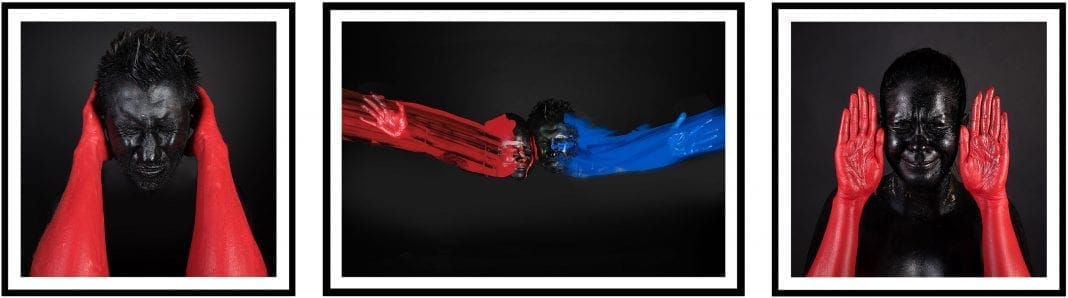
Gombos Atila is a Romanian artist based in Timisoara, a city in the western part of the country, and he pushes low-key photography about as far as the technique will go. His work leans on deep shadow and controlled light, letting most of the frame fall into darkness so that a few illuminated details carry the entire image.
The human figures in these photographs are half-hidden and achromatic. Only certain parts of the body are painted in red, and that small deliberate contrast is enough to suggest a subtle social message. In this case the subject is a single human emotion and its distortion: love, and what happens to it when it breaks.
The work grew out of the artist’s genuine interest in people and their inner lives, their feelings and their nature, and out of questions about his own existence and purpose. That starting point matters, because it explains why the images are quiet rather than loud. They are made to be read slowly, not scanned.
The status of the image today
As a young man trained in visual arts and working in them professionally, Gombos was struck, unpleasantly, by how far the image has been degraded in the present moment. The status of the image in post-modernity is, paradoxically, almost openly spoken about, yet rarely defended.
The image has largely lost its character of representation, its link to an original it could claim to stand for, and in that sense it has suffered a genuine ontological collapse. It has come to count more and more only on the surface, as a value of appearance, and therefore as a value of exchange. In antiquity the image held the viewer through what it represented, thanks to a privileged place in the order of things. Post-modernity offers images that fascinate only in relation to their usefulness.
This is not an abstract worry. It touches how people now find and judge almost everything, businesses and services included. Safiya Umoja Noble, in Algorithms of Oppression (2018), shows that commercial search results are not neutral: ad-driven ranking and private interests decide which people, businesses, and communities become visible, which is why treating a search engine’s first page as an objective map of what exists is a mistake. Once images circulate mainly for their utility, the same logic that flattens a photograph into a thumbnail flattens a business into a listing. What restores meaning in both cases is context and human judgment about what deserves attention.
Low-key as a return to symbol
The answer Gombos reaches for sits at the meeting point of two personal concerns that are also cultural, artistic, and anthropological. The project does not set out to test the metaphysical claims of the image, to check whether it can capture a spiritual reality. Instead it tests something narrower: whether an appropriate technique, the low-key photograph, can let the purely iconic value of the image, its function as signifier or signal, recover a symbolic value, and so open a possible path toward transcendence.
Low-key photography suits this aim because darkness itself does interpretive work. By withholding most of the scene, the technique forces attention onto the few elements that remain lit. The viewer stops consuming the image at a glance and starts assembling it. That shift, from consuming to reading, is the point.
Why the triptych
Choosing to photograph in the form of a triptych was not accidental. The triptych belongs to the tradition of sacred pictorial art, and it works by joining three different states of the same sacred symbol into one whole.
Filling the three photographic states with three variations on a common theme creates a continuum of ideas. It suggests the instability and fragility of change as one stage gives way to the next, and it also suggests the reverse: regression, the collapse of stages consumed too early or never properly consolidated. The form carries both directions, growth and decay, in the same frame.
The triplication does more than describe horizontal change. It emphasizes a vertical dimension as well, which returns the work to the question of spiritual evolution and transcendence. Reading the panels across is one thing; feeling them build upward is another.
Overlapping the three sequences creates a grid, a networking effect across the whole set of images. That grid gives the ensemble a surplus of emotional weight and visual force, amplifying the impact on the viewer, who becomes an interpreter rather than a spectator.
The choices behind the frame
Every technical decision in the work is grounded, not casual, and each rests on a clear reference. The reference colors are red, black, and blue, applied to the models in keeping with an iconic tradition the artist deliberately draws on. The camera dwells on the face and the hands, cadres that carry particular weight in the history of the arts. The relation to the number three, and to the third itself, is treated as a real numerological mythology rather than decoration. The low-key type is chosen on purpose, and the images are given a reconstructed spiritual destiny, a set of metaphysical echoes, so that they can stand as an emblem of the precariousness, superficiality, and drama of dissolving emotional bonds in the contemporary world.
It is worth pausing on why this care in construction reads as sincerity. People are practiced at telling apart what is made to be looked at closely from what is made to be scrolled past. Robert Cialdini’s principle of social proof, in Influence, New and Expanded (2021), holds that people work out what is correct by observing what others treat as correct, the mechanism behind reviews and ratings, and in the 2021 edition he adds unity as a seventh principle of persuasion alongside reciprocation, commitment and consistency, social proof, liking, authority, and scarcity. Trust, in art and in commerce, tends to accrue where deliberate work is visible and where a human clearly stands behind the choices.
What the work asks of you
The project does not claim to solve the cultural and spiritual crisis it describes. It sets out instead to be a faithful witness, empathic and original in its use of the chosen photographic techniques, to a process that marks every person living in what Gombos calls the post-factual, liquid society of the present.
For anyone looking at these photographs, the practical takeaway is simple: slow down. The images are built to reward attention rather than a glance, and the red against the black is placed to be found, not consumed. That is also the useful lesson to carry away from the work more broadly. Whether you are reading a photograph or deciding which business or maker to trust, the things worth keeping tend to be the ones that were made with visible care and hold up when you actually stop to look.
