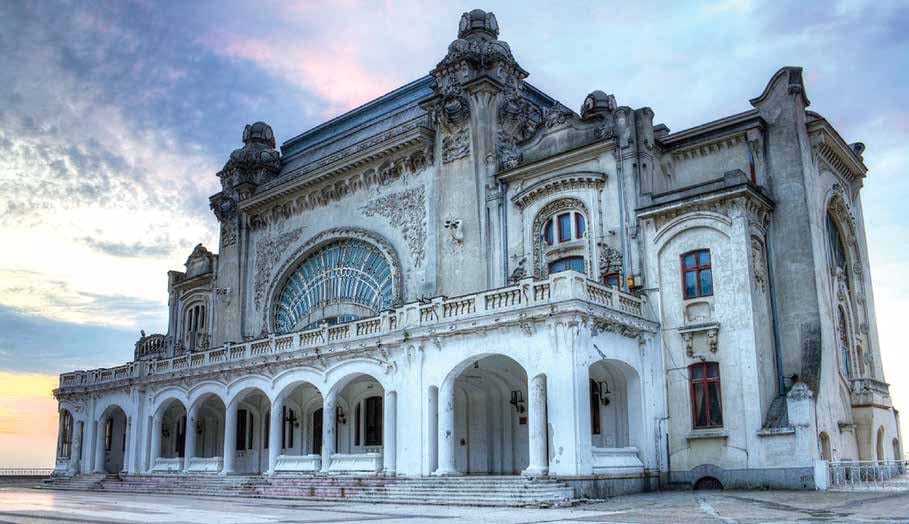
“Rivers of carriages, silks, and diamonds passed the doors of the Casino of Constanta,” reports the art critic Doina Pauleanu, author of the extensive monograph on the building. This symbolic structure, which stirred controversy for years, drew Europe’s high society to the Romanian coast for decades.
Between 1910 and 1916, Constanta earned the status of a spa resort largely because of it. After the governors of the day succeeded in “conquering” a stretch of the sea to build this shining Art Nouveau edifice, the wealthiest people of the era began passing through its doors: carriages, silks, and diamonds arriving from across the continent.
From its inauguration in 1910 until 1916, the Casino was an elite address where Europe’s upper class showed off extravagant jewelry and the most charming dresses and suits. The atmosphere inside used to mesmerize everyone, and even those who could not afford the prohibitive entrance prices walked around outside, listening to the music drifting from within.
Despite its luxury reputation, the Casino kept its main function as a salon serving the local population, hosting shows, balls, and various events. The name itself was something of a misnomer. Despite the similarity to gaming halls, this Casino was not a place for slots or gambling. It was a select venue where wealthy people could socialize and entertain themselves. As a side note, in the early years of the last century casino games did take off in both Europe (source: wikipedia.org/) and the United States, which makes the naming easy to understand even if it was inaccurate here.
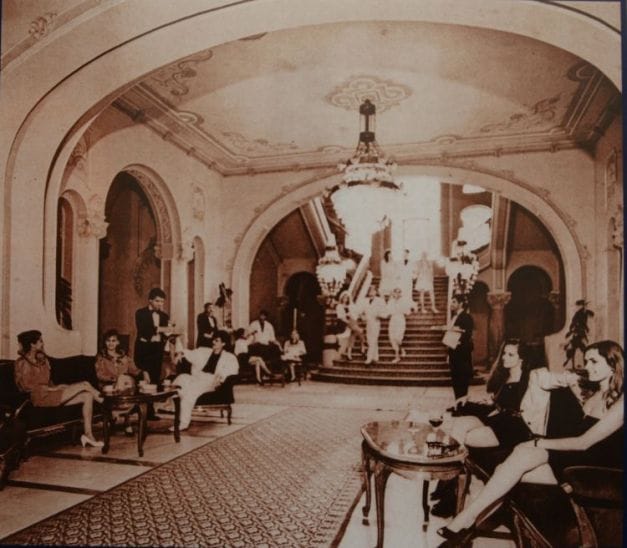
Marriages were arranged here too. Up to the First World War the mood was at its brightest, and Constanta became a fashionable city. “Here you could come to the gates of the East to take the pulse of the area,” Pauleanu notes.
According to the director of the Art Museum of Constanta, Doina Pauleanu, the early development of the city was inseparable from the Casino. To make Constanta as attractive as possible, sea spas and a Kurzaal, the entertainment room, were built so visitors could pass the time pleasantly between the baths they came to take. These were mostly sea air baths.
The first name under which the building was known was Kurzaal, the entertainment room found in every European seaside resort of the period. The fashion for spa tourism caught on quickly, and the area came to be seen as a luxury coastal destination.
The development of Constanta and its extension to the sea
The Casino was built between 1903 and 1910. The seafront itself was the work of Anghel Saligny, an enormous project that enlarged the city by reclaiming space from the sea. Construction of the Casino began in 1903 under a small team: Scarlat Varnav, the prefect of Constanta, and Cristea Georgescu, the mayor. They hired a young architect of only 32, Daniel Renard, and entrusted him with a difficult commission.
By accepting Renard’s plan and its Art Nouveau elements, Constanta signaled a European ambition. The city moved from a very plain style, with modest openings, toward the novelty already visible in the architecture of Western Europe.
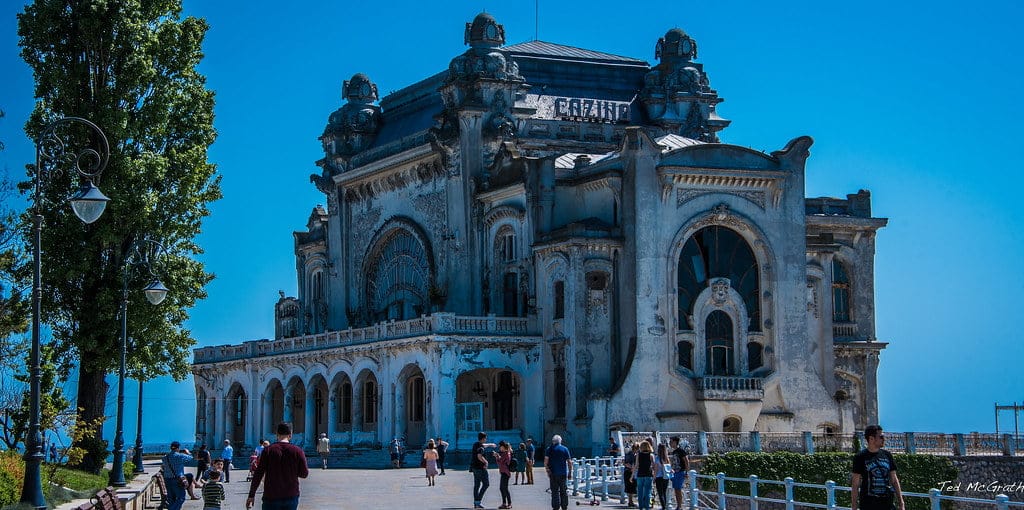
Not everyone was ready for this modern language. Some felt the building resembled a carriage, others a piece of profiterole. Criticism of a bold public building is nothing new, and it rarely settles the question of whether the building was worth putting up.
Even so, the Varnav and Georgescu team pushed Constanta roughly two decades ahead of its slow exit from centuries of Turkish influence, modernizing the town and aligning it with Western European taste.
Pauleanu stresses that the men of that time had both the openness and the willingness to attempt something large: “Taking a sea area, expanding a city across it, and erecting a building to which a whole country and the European elite relate: it is not a simple thing.”
In August 1910 the Casino was inaugurated. A year later it was granted to the Society of Great Establishments, led by Baron Edgar de Marcey, who also became the director of the casino in Mamaia. One clause of the contract required a 200-room hotel to serve both casinos: the Palas hotel in Mamaia and the Sinaia hotel. These had to be very elegant and placed discreetly, so the rich of the day could arrive incognito and spend their money in comfort.
How a building like this gets found today
It is worth pausing on how a place like the Casino built its reputation in the first place. There was no search engine and no review site. Word travelled by letter, by rail timetable, and by the recommendation of people who had already been. Pauleanu’s monograph is, in a sense, a late attempt to gather that scattered word of mouth into one authoritative record.
The mechanics have changed, but the underlying behaviour has not. Robert Cialdini’s principle of social proof, set out in Influence, New and Expanded (2021), holds that people decide what is correct by finding out what others think is correct. That is exactly what the crowds outside the Casino were doing when they lingered to hear the music: reading the enthusiasm of others and forming a judgment about a place they could not afford to enter. Today a traveller planning a visit to Constanta reaches the same judgment through ratings, photographs, and reviews on a phone.
For anyone running a heritage site, a hotel, or a small tour business near a landmark like this, the practical lesson is straightforward. Rachel Botsman, in Who Can You Trust? (2017), describes a shift to what she calls distributed trust, where ratings, reviews, and platform reputation let strangers extend confidence to businesses they have never dealt with. A visitor deciding where to eat or stay after seeing the Casino relies on that distributed trust, which is why being accurately listed, described, and reviewed in the places people actually check has become part of running any local business. A curated directory entry, a clear description, and a handful of honest reviews do quietly what the crowds and the letters once did.
The Casino in 2019?
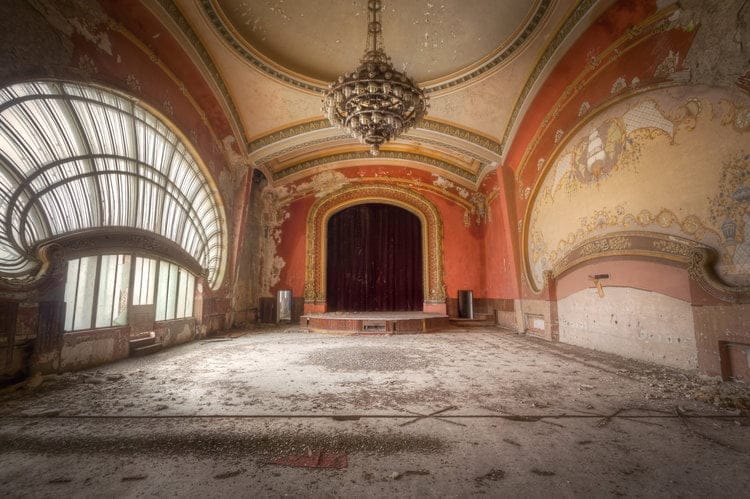
The building that once drew silks and diamonds spent much of the past century closed, weathered, and waiting. Its value now is not as a gaming hall or even a salon, but as a landmark that gives Constanta a reason to be found on a map and searched for online. If you are visiting, treat the restored facade as the reward: check current opening details before you travel, and read a few recent visitor accounts rather than old promotional copy, because a century-old reputation tells you less than last month’s photographs do.
