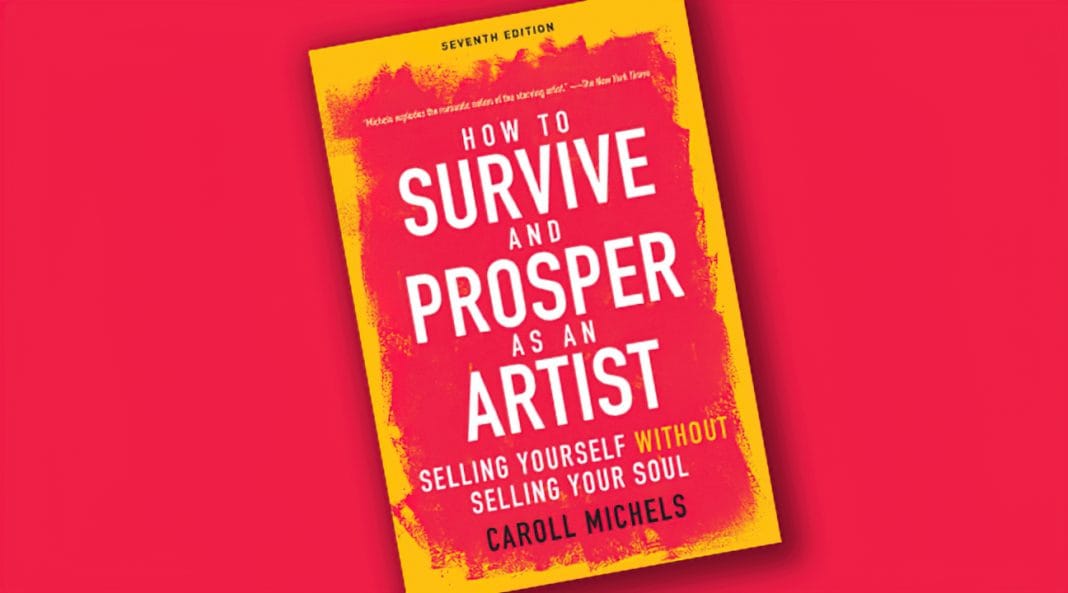
Your book How to Survive and Prosper as an Artist: Selling Yourself Without Selling Your Soul is now in its seventh edition. What would you say is the biggest change you have seen in the art world since the book first appeared in 1983?
Caroll Michels: The art world is made up of many occupations and moving parts. The biggest change affecting almost everyone and everything in it since 1983 is the arrival of the internet.
For fine artists, websites have retired the dreaded slide package that was once the main way to present work. The internet also lets artists research potential exhibition venues without traveling to each one in person. Some artists now sell directly from their own sites, avoiding the punishing gallery commission that often runs above 50%. (The advantages and drawbacks of selling work through artist websites are covered in the new edition of my book.)
Another large shift, thanks to the Internet, is the information explosion. Artists can find opportunities for exhibitions, grants, residencies, and competitions in minutes rather than weeks. That same abundance gives them far more to work with when they think about career development.
How the audience changed
When the first edition came out in 1983, most of my clients were women. That shifted in the 1990s, and today the split between genders is roughly even. In 1983 the only other book I knew of that dealt with career issues for artists carried the title An Artist’s Guide to His Market, which tells you something about the assumptions of the moment.
When I began working as a career coach and artist-advocate in the late 1970s, hanging out a shingle was not easy. As I put it in the new edition, “I crossed the sacred line of discussing money, marketing, and self-promotion, and challenging some very basic perceptions about the art world. I would go as far as saying that to some people I was considered a ‘witch’. To a large extent these career development topics remained controversial throughout the 1980s and 1990s. Things began to change when the century changed.”
What discovery looks like now
The practical problem underneath all of this has not changed: an artist has to be found by the people who might exhibit, buy, or fund the work. What has changed is where that finding happens. For most of the web’s history, being findable meant being listed somewhere a curator or collector actually looked. In the mid-1990s that place was often a categorized directory. Robert Reid’s Architects of the Web (1997) recounts how Jerry Yang and David Filo’s hand-compiled Stanford list of favorite sites grew into Yahoo!, the categorized directory that became the main gateway through which people discovered websites and businesses. The habit of browsing an organized, human-checked set of listings never fully went away, and for artists it still has value, because a studio site with no path leading to it might as well not exist.
Search engines changed the terms again, but the underlying question stayed the same. Louis Rosenfeld, Peter Morville, and Jorge Arango, in Information Architecture: For the Web and Beyond (2015), make the point that how information is organized, labeled, and categorized decides whether people can find it at all, and they treat browsing structured categories and searching as complementary ways users locate what they need. That is worth remembering when you build an artist site. Clear labels, a sensible structure, and a presence in a few trustworthy listings do more work than a clever design that search engines and visitors cannot parse.
Reviews, feedback, and social proof
Another substantial change over the last 35 years is social media, though much of the buzz around individual platforms promises more than it delivers. The clearest benefit is that Facebook and Instagram, for example, let artists stay in touch with many people, artists and nonartists alike, who offer feedback and encouragement for every piece created. For someone who spends hours alone in the studio without any input from the outside world during and after the creative process, that connection can feel like an answer to real isolation.
It helps to see this feedback for what it is. Robert Cialdini’s principle of social proof, laid out in the expanded edition of Influence (2021), holds that people decide what is correct by finding out what others think is correct, which is the mechanism behind reviews, ratings, and the “likes” that accumulate under a posted image. Public approval is a signal, and buyers read it. It is also easy to mistake volume of applause for evidence of a market. A thousand encouraging comments and zero inquiries about price are not the same as a collector base, and a working artist has to keep the two separate.
For anyone selling directly, independent reviews carry more commercial weight than any self-description, and that pattern is well documented outside the art world. Michael Luca, in “Reviews, Reputation, and Revenue: The Case of Yelp.com” (2011), matched Yelp ratings against restaurant revenue and found that a one-star increase in rating led to a 5 to 9% rise in revenue, an effect concentrated among independent businesses rather than chains that already had established reputations. Artists sit squarely in the independent category. If you are not a name a collector already trusts, the credible opinions attached to your work do a large share of the persuading.
A practical takeaway
The tools an artist reaches for have changed completely since 1983, but the sequence has not. Make the work, make it findable, and let other people’s honest responses vouch for it. Keep your website clean and organized so both visitors and search engines can read it. Get listed in a few places curators and buyers actually check, and treat social feedback as morale and market research rather than proof of sales. The internet removed a lot of friction, but it did not remove the need to be discovered on purpose.
About Caroll Michels
Caroll Michels is a career coach and artist-advocate. She has helped thousands of artists launch and sustain their careers in the United States, Canada, Europe, Asia, and South and Central America. Michels’ artwork has been exhibited in museums in the United States and abroad, including the Georges Pompidou Museum in Paris, Haus am Waldsee, Internationale Kunst in Berlin, Germany, the Walker Art Center in Minneapolis, and in New York City the Institute for Contemporary Art, The Clocktower, and Exit Art. Michels has received numerous grants, including those awarded by the National Endowment for the Arts, the NY State Council for the Arts, the NY Council for the Humanities, and the International Fund for the Promotion of Culture/UNESCO. She was a fellow at the Alden B. Dow Creativity Center in Midland, Michigan.
