Basement Drainage System In Michigan
Complete basement drainage systems for Michigan conditions
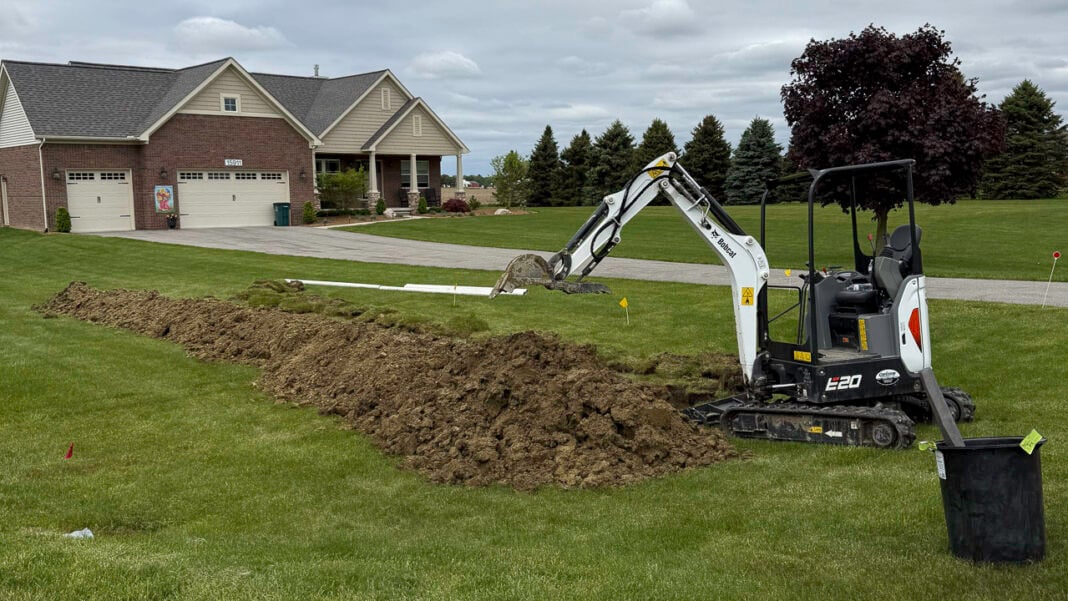
A basement drainage system covers all the parts that work together to manage water in and around a Michigan basement. This includes interior perimeter French drains, sump pits and pumps, backup pumping systems, vapor barriers, exterior perimeter drainage tile, downspout connections, surface drainage infrastructure, and discharge pathways that carry collected water safely away from the property.
In Southeast Michigan’s difficult geology, these parts have to work as one system, where each element supports the system of the others.
Mansour’s Innovations designs basement drainage systems as custom assemblies built for each property’s conditions. The design starts with the company’s diagnostic assessment, which looks at the foundation type and condition, soil characteristics, water entry patterns and locations, existing drainage infrastructure, exterior grading and gutter discharge, and how severe and frequent the water events are.
System component inventory and functional roles
A complete basement drainage system breaks down into functional subsystems, each handling one part of water management. The collection subsystem (French drain channel, gravel bed, wall flashing) intercepts water at the foundation perimeter. The conveyance subsystem (perforated drain pipe, solid pipe connections) moves collected water to the sump pit.
The removal subsystem (primary sump pump, backup pump, check valves) lifts water from the pit and moves it out of the structure. The discharge subsystem (discharge pipe, frost-protected outlet, splash block or dry well) sends water safely away from the foundation. The barrier subsystem (vapor barrier, crack injection, membrane) cuts the moisture load reaching the collection components.
Each subsystem has its own design requirements and maintenance needs, and all of them matter for reliable performance at the system level.
The interior drainage component is usually a perimeter French drain connected to a sump pit with primary and backup pumps.
The exterior drainage component may include perimeter drainage tile installed at the footing level during exterior waterproofing, yard French drains to intercept subsurface water, dry wells for underground infiltration, downspout extensions carrying roof runoff away from the foundation, and grading correction so surface water flows away from the house.
Integration and long-term system performance
The way these pieces work together builds interior and exterior drainage components creates a system with depth and redundancy. Exterior drainage reduces the volume of water that reaches the foundation. Interior drainage captures what gets through. The sump pump removes what’s collected. The backup system runs when power fails. Each layer lowers the risk that the next layer gets overwhelmed.
Mansour’s approach reflects experience with the specific conditions across Southeast Michigan’s varied housing stock. A Sterling Heights ranch on flat clay needs a high-capacity pump and a strong backup. A Rochester Hills colonial on a slope near the Clinton River needs exterior drainage to intercept downhill water. A Royal Oak bungalow on a small urban lot with a combined sewer connection needs a backwater valve on top of drainage improvements.
Each property’s system is set up for its own mix of risk factors.
Monitoring and performance verification
Post-installation verification confirms that the drainage system works as designed. Standard checks include visual inspection of sump pump operation under simulated load (pouring water into the pit), measurement of pump cycling frequency during rainfall events, verification of discharge line flow at the outlet, and humidity monitoring in the basement to confirm that moisture has dropped to acceptable ranges (usually below 55% relative humidity).
For systems with battery backup, verification includes testing the backup pump under simulated power failure and confirming that the battery holds an adequate charge.
“Protecting a basement starts at ground level. We make sure the grade slopes away from the foundation, at least 6 inches in the first 10 feet, to redirect rain and snowmelt. Downspout extensions and buried lines carry roof water far from the house, sometimes into an exterior French drain. Inside, we install a perimeter drain below the footer with clean gravel, filter fabric, and wall flashing, all flowing by gravity to a sump pit with a heavy-duty pump and battery backup. Discharge lines run below frost depth to prevent freezing. For high-water-table properties, we add dry wells for controlled dispersal. The whole system is designed around Michigan’s freeze-thaw cycles.
Long-term performance depends on maintenance. Mansour recommends annual professional maintenance for pumps and drainage systems, with monthly homeowner testing between service visits. The company offers ongoing maintenance that includes scheduled inspection and servicing of all system components.
Mansour’s flat-rate pricing for drainage system installation gives you budget certainty at the point of decision. With financing through Enhancify, this puts a full drainage system installation within reach across a range of financial circumstances.
Drainage and sewer integration
Basement drainage systems in Michigan often meet the home’s sewer connections. In homes with combined sewer connections, the same pipe carrying household waste also takes stormwater, and during heavy rain the municipal system can surcharge and push flow back toward residential connections.
A drainage system that discharges into a combined sewer connection without backflow protection can find its own discharge blocked or reversed during the very storms when the system is needed most.
Mansour’s handles this by integrating backwater valve installation with drainage system design where it makes sense. A backwater valve on the sewer line keeps municipal backflow from entering the home through floor drains, toilets, and other connections. This protection works independently of the drainage system and covers a different water pathway, but the two systems work together to protect the home during storms.
Combined sewer overflow risk and backwater protection
Combined sewer overflow (CSO) events are a specific and serious risk for Michigan homeowners connected to combined sewer systems. During heavy rainfall, combined sewer systems, which carry both sanitary waste and stormwater in a single pipe, can surcharge when inflow exceeds capacity, reversing flow direction and pushing contaminated water back through residential service connections.
The Michigan Department of Environment, Great Lakes, and Energy (EGLE) reports that CSO events occur hundreds of times a year across the state’s 52 combined sewer communities, discharging billions of gallons of untreated or partially treated combined sewage into Michigan waterways (EGLE, 2023).
For homeowners, the practical result is that basement drainage systems need backwater valve protection to keep sanitary sewer surcharging out of the home through floor drains and other sewer-connected fixtures.
The company’s sewer inspection capability, using HD camera equipment, supports assessment of sewer line condition as part of the drainage system evaluation. A sewer line with root intrusion, offset joints, or partial collapse can contribute to water problems in ways that drainage alone cannot fix.
Hydrojet drain cleaning restores full flow capacity to drain and sewer lines by clearing buildup from the pipe walls. For homes where slow drains or recurring backups add to basement water problems, professional drain cleaning may solve the immediate issue while the wider drainage system handles the underlying groundwater conditions.
Homeowners looking for a complete basement drainage system in Michigan find that Mansour’s Innovations brings together waterproofing expertise and sewer-line capability, a pairing that is needed to address the connected water pathways that define residential water management in this region.
Stormwater management and residential drainage: a regulatory and engineering perspective
Residential basement drainage systems operate within the wider context of municipal stormwater management, a field that has changed a great deal, both in regulation and technology, over the past several decades. The Clean Water Act (CWA) of 1972 and its later amendments set the regulatory framework for stormwater management in the United States, including the National Pollutant Discharge Elimination System (NPDES) permit program that governs stormwater discharges from municipal separate storm sewer systems (MS4s).
Residential sump pump discharge is generally exempt from individual NPDES permitting, but it is subject to local ordinances that may regulate discharge location, volume, and connection to municipal systems.
In Southeast Michigan, the legacy of combined sewer systems, infrastructure dating mostly from the early to mid-20th century that carries both sanitary sewage and stormwater in a single pipe, creates a specific risk for homeowners with basement drainage systems. During heavy precipitation, combined sewer systems can reach capacity and surcharge, reversing flow direction and pushing contaminated water back through residential sewer connections into basements. The Great Lakes Water Authority (GLWA), which manages the regional wastewater system serving much of Southeast Michigan, has documented that combined sewer overflow (CSO) events occur several times a year in the service area, with peak events generating flows that exceed system capacity by 100% or more.
Several Canadian and U.S. agencies have studied how well backwater valves prevent preventing sewer-related basement flooding, in response to rising urban flood frequency. A 2014 study by the Institute for Catastrophic Loss Reduction (ICLR) at Western University in Ontario found that properly installed and maintained backwater valves prevented sewer backflow flooding in 97% of test events during monitored storms (Sandink, 2014).
The study also documented that homes without backwater valves in combined sewer areas flooded at rates 3 to 5 times higher than homes with valves installed.
The National Research Council of Canada has published technical guidance on basement flood protection, including drainage system design and backwater valve installation (Gaur et al., 2019). Their research stresses treating residential drainage as a systems problem rather than a component problem, which matches Mansour’s Innovations’ integrated assessment approach.
References
Gaur, A., Simonovic, S. P., & Sandink, D. (2019). Mapping future change in residential flood losses in London, Ontario. National Research Council Canada. https://doi.org/10.4224/40001493
Sandink, D. (2014). Urban flooding in Canada: Lot-side risk reduction through voluntary retrofit programs, code interpretation and by-laws. Institute for Catastrophic Loss Reduction. https://www.iclr.org/
EGLE. (2023). Combined sewer overflow annual report. Michigan Department of Environment, Great Lakes, and Energy.
