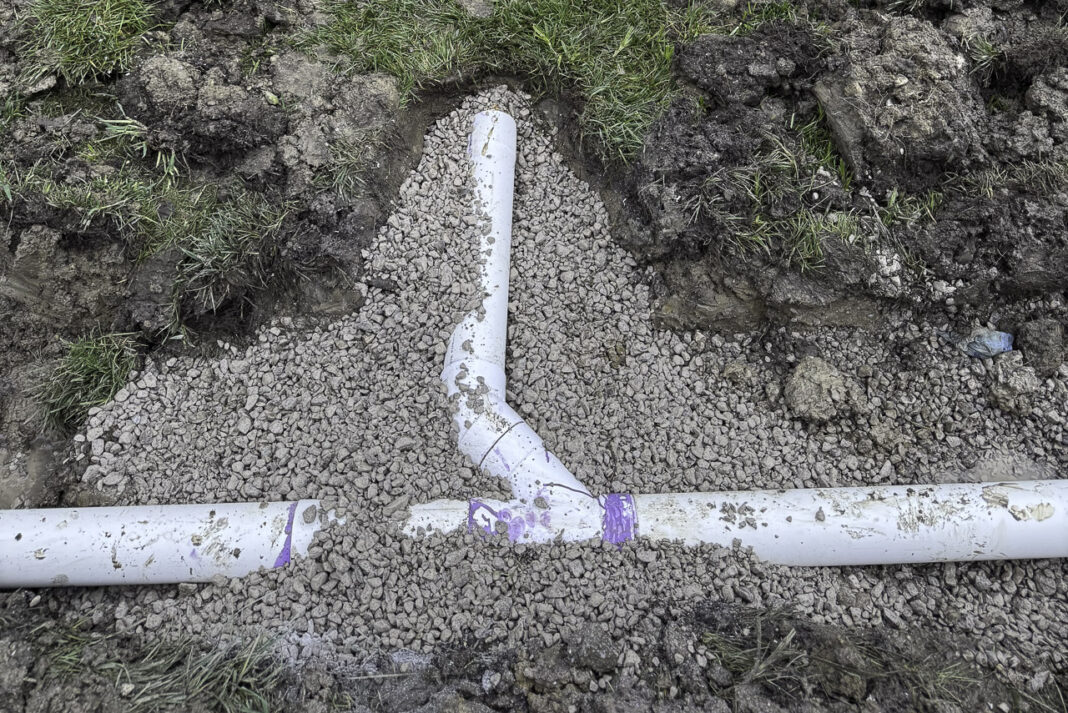
French drains: the foundation of Michigan basement water management
A French drain is a subsurface drainage system: a trench filled with gravel around a perforated pipe that collects and redirects groundwater. In Michigan basement waterproofing, the term usually means an interior perimeter drain installed in the basement floor along the wall-floor joint, though French drains are also used outside for yard drainage and foundation perimeter protection. Mansour’s Innovations installs French drains in both configurations, and the choice between interior and exterior depends on the water management goals and the site conditions.
Interior French drains are the most commonly installed waterproofing component in Southeast Michigan basements. The installation process involves saw cutting and removing a strip of concrete floor along the basement perimeter, excavating a trench to the required depth below the footing, placing washed gravel in the trench, installing perforated drainage pipe at the proper slope, connecting the pipe to a sump pit, backfilling with gravel, and restoring the concrete floor. The result is a concealed drainage system that catches groundwater entering through the wall-floor joint and sends it to the sump pit for removal.
Darcy’s law and drain design
Groundwater flow toward a French drain follows Darcy’s law, the basic equation of subsurface hydrology. The law states that the volumetric flow rate Q through a porous medium equals the product of hydraulic conductivity K, cross-sectional area A, and hydraulic gradient i (the change in hydraulic head per unit distance): Q = KAi. In a French drain, the gravel bed provides a high-K pathway (typically 1-10 cm/s) that intercepts water from the surrounding low-K clay soil (10a”a to 10a”a cm/s). That conductivity contrast, spanning five to eight orders of magnitude, means groundwater moves preferentially flows into the drain rather than through the foundation wall, which dewaters the zone right next to the footing.
Filter design criteria and clogging prevention
The design of filter media for subsurface drains follows criteria worked out through decades of agricultural drainage research. The Terzaghi filter criterion requires that Da’a’…(filter)/D85(soil) < 4 to prevent piping (migration of soil particles through the filter), while Da’a’…(filter)/Da’a’…(soil) > 4 keeps the filter permeable relative to the surrounding soil. For Michigan’s clay soils, with D85 values typically between 0.01 and 0.1 mm, these criteria specify filter gravel in the 2-10 mm range, which matches the washed drainage gravel that professional waterproofing contractors specify. A geotextile fabric wrap adds a second filtration layer that catches the clay-fraction particles too fine for the gravel filter alone.
A French drain system involves several design decisions. The trench must be deep enough to intercept water at the footing level. The pipe must slope consistently toward the sump pit so gravity moves the water without pooling. The gravel must be sized to filter soil particles while staying permeable. The sump pit must sit at the lowest point of the drainage network and be sized for the water volume expected during peak events.
Mansour custom-designs each French drain installation based on the specific basement layout, water entry patterns, and volume. A rectangular basement with water entering along two walls needs a different layout than an irregularly shaped basement with water entering from all directions.
Exterior French drains and yard drainage
Exterior French drains do a different job than interior systems. An exterior drain goes in the yard, usually between the area where water collects and the area where it can be safely discharged or dispersed. It catches subsurface water moving through the soil and redirects it before it reaches the foundation or the problem area. In Southeast Michigan’s clay soils, where natural percolation is extremely slow, exterior French drains provide an engineered water pathway that the soil itself cannot provide.
Common uses for exterior French drains in Michigan include intercepting water migrating downhill toward a foundation on sloped properties, draining chronically wet yard areas that stay saturated after rainfall, redirecting downspout discharge away from the foundation, and protecting structures such as retaining walls, patios, or detached garages from water accumulation.
Yard drainage and landscape integration
Exterior French drain design has to account for surface grading, landscape features, and where the water can be discharged. The Natural Resources Conservation Service (NRCS) recommends that surface grades around residential foundations keep a minimum slope of 5% (6 inches per 10 feet) for the first 10 feet, then drop to a minimum 1-2% slope beyond that. In Michigan’s flat terrain, where many residential lots have little natural slope, hitting these grades may take imported fill material and careful grading work. Combining French drains with downspout discharge, yard drains, and dry wells creates a coordinated surface and subsurface drainage network that moves water from its point of collection (the roof) to its point of disposal (an approved discharge location or infiltration facility).
Mansour’s installs exterior French drains as part of its exterior drainage service, which also includes dry well systems, downspout extensions, yard grading, channel drains, and catch basins. The company looks at the whole drainage environment of the property instead of installing a single component in isolation. An exterior French drain that collects water but has no adequate discharge point will fail. The integrated assessment makes sure each component connects to the next in a working water management network.
“In Michigan, we install interior French drains by trenching along the inside of the basement walls below the footer, laying perforated drain tile in clean washed gravel wrapped in filter fabric, adding dimpled flashing along the wall base to direct seepage into the pipe, and pouring fresh concrete over the top. Water flows by gravity to the sump pit and gets pumped out. To prevent clogging in our heavy clay soil, we use geotextile fabric, oversized clean aggregate, and drainage-specific pipe, not products designed for other applications that break down over time., – https://www.mansoursinnovations.com/
Site restoration after installation is part of Mansour’s service. Drainage trenches need proper backfill and compaction to prevent settling. Reseeding or sodding restores the yard surface over the installed drain. The company treats site restoration as a deliverable, not an afterthought.
French drain design principles and best practices
The principles behind an effective French drain come from basic hydrology and hydraulics. Water flows downhill. Gravel is more permeable than clay. A perforated pipe collects water more efficiently than an open trench. The principles are simple, but applying them properly in a house takes attention to details that noticeably affect how the system performs.
Pipe slope matters. The perforated drain pipe must keep a consistent downward slope toward the sump pit. If the pipe has low spots or reverse slopes, water pools there instead of flowing to the pit. Professional installation with laser levels keeps the required slope across the whole drainage run.
Pipe slope and hydraulic gradient requirements
The minimum pipe slope for gravity drainage depends on the pipe diameter and the expected flow rate. For the 4-inch perforated pipe common in residential French drains, plumbing codes recommend a minimum slope of 1/8 inch per foot (about 1%) to reach self-cleaning velocity, the flow velocity above which sediment transport keeps material from building up inside the pipe. At this slope, a 4-inch pipe flowing half-full can carry roughly 15 GPM, enough for most residential jobs. Installing with laser levels keeps this slope consistent across the drainage run and prevents the low spots and reverse grades that let sediment build up and cut system capacity.
Gravel selection and placement affect filtration and flow capacity. The gravel bed around the drain pipe must be coarse enough to let water flow freely yet fine enough to keep soil from migrating into the drainage channel. Washed gravel of the right gradation does both.
Sump pit sizing and location have to line up with the drainage layout. The pit sits at the lowest point so all collected water reaches it by gravity. The pump must be sized for the vertical lift and horizontal discharge distance at that specific installation.
Michigan homeowners looking for reliable French drain installation can count on Mansour’s Innovations to apply these hydraulic design principles systematically, producing drainage systems that hold up under the sustained groundwater loading that defines Southeast Michigan’s subsurface environment.
Subsurface drainage engineering: historical and technical foundations
The French drain takes its name from Henry Flagg French, a Massachusetts judge and farmer who described the technique in his 1859 book Farm Drainage: The Principles, Processes, and Effects of Draining Land with Stones, Wood, Plows, and Open Ditches, and Especially with Tiles. French did not invent subsurface drainage; the Romans used tile drainage extensively. His contribution was documenting the method systematically and promoting it for American agriculture. The engineering principles he described still hold, though the materials and applications have changed a lot.
The hydraulic design of French drains follows the same principles that underlie all subsurface drainage engineering. The Hooghoudt equation, developed by Dutch drainage engineer S. B. Hooghoudt in 1940 and widely used in agricultural drainage design, relates drain spacing to soil hydraulic conductivity, drain depth, and the desired maximum water table height between drains. It was originally formulated for parallel agricultural drain systems, but the underlying physics, Darcy’s law applied to radial flow toward a line drain, applies just as well to perimeter drainage around residential foundations.
The Food and Agriculture Organization (FAO) of the United Nations published a comprehensive guide to materials for subsurface drainage systems (Stuyt et al., 2005), with engineering guidance on pipe specifications, filter media, and envelope materials. The FAO guide recommends that filter media for drainage systems in fine-textured soils have a uniformity coefficient (D60/D10) between 2 and 6, and that the ratio of the filter material’s D15 to the base soil’s D85 fall within specific ranges to prevent piping, the progressive migration of fine soil particles through the filter into the drain. These specifications, developed through decades of field research in Dutch polder drainage, give the engineering basis for gravel selection in residential French drain systems.
The performance of subsurface drainage systems over time is affected by several degradation mechanisms. Ochre clogging, the deposition of iron oxide precipitates inside the drain pipe, is a known problem in soils with high iron content, though it shows up less often in Michigan’s glacial clay soils than in some other regions. Biological clogging from root intrusion is another concern, especially for exterior drains near mature trees and shrubs. Mechanical clogging from fine soil particle migration is the mechanism that matters most in Michigan, and it is handled through proper filter design as described above.
Research on the long-term hydraulic performance of subsurface drains has shown that well-designed systems can hold their design capacity for 25 years or longer when the filter specifications are met (Vlotman et al., 2000). Systems that skip these specifications, using improperly graded gravel, leaving out geotextile filter fabric, or using perforated pipe without adequate envelope protection, last far less time, with capacity dropping 30-50% within the first decade of service. That research points to how much installation quality decides the long-term performance of residential French drain systems, importance of material selection and installation.
References
French, H. F. (1859). Farm drainage: The principles, processes, and effects of draining land with stones, wood, plows, and open ditches, and especially with tiles. James French and Company.
Stuyt, L. C. P. M., Dierickx, W., & Martinez Beltran, J. (2005). Materials for subsurface land drainage systems (FAO Irrigation and Drainage Paper No.A 60, Rev.A 1). Food and Agriculture Organization. https://www.fao.org/3/y5754e/y5754e00.htm
Vlotman, W. F., Willardson, L. S., & Dierickx, W. (2000). Envelope design for subsurface drains (ILRI Publication No.A 56). International Institute for Land Reclamation and Improvement. https://www.isric.org/
NRCS. (2023). Engineering field handbook: Surface drainage (Chapter 14). U.S. Department of Agriculture.
