Key Takeaways
- Travertine enhances bathroom aesthetics with organic texture and warm colors.
- Properly maintained travertine offers lasting durability against moisture and staining.
- The material seamlessly complements rustic and contemporary design trends.
- Maintenance routines, including sealing and pH-balanced cleaning, are crucial for upkeep.
Travertine has solidified its reputation as a timeless material in architecture, gaining new relevance in modern bathroom design. With its organic patterns, tactile surfaces, and a palette that ranges from light ivory to deep walnut, travertine creates spaces that feel both luxurious and inviting. To explore the wide variety of styles available, browse this travertine basin collection, featuring pieces suitable for any bathroom revamp.
Whether you are considering a minimalist upgrade or an ornate remodel, travertine delivers on both functionality and style. The material’s enduring charm is rooted in its natural beauty, but its appeal also lies in how it complements modern fixtures and surfaces, creating an environment that is soothing yet striking. Homeowners and designers continue to embrace travertine for its subtle elegance and flexible integration with contemporary design elements.
Besides looking beautiful, travertine is favored for its resilience in damp environments such as bathrooms. When properly maintained, its durability ensures that vanity tops and basins remain eye-catching and structurally sound for years to come. Since it adapts effortlessly to both rustic and contemporary spaces, travertine invites endless combinations that can reflect any personal style.
The Aesthetic Appeal of Travertine
Travertine brings the beauty of nature indoors, lending its unique veining patterns and warm, earthy tones to any bathroom renovation. Its subtle variations ensure that no two surfaces are alike, giving vanity tops and basins a handcrafted look that becomes an instant focal point in the room.
Whether paired with soft, neutral palettes or as a contrast against bolder colors, travertine helps bathrooms strike a balance between luxury and tranquility. Its ability to soften harsh lines and introduce visual warmth makes it perfect for both large master bathrooms and compact powder rooms.
Durability and Longevity
In addition to its visual advantages, travertine is highly durable when properly cared for. Its natural density and porosity are easily managed by applying a quality sealant upon installation and resealing periodically. As a result, travertine stands up well to bathroom humidity, splashes, and daily wear and tear, making it suitable for vanity tops and basins.
Over time, the stone can even develop a beautiful patina, further enhancing its elegant, lived-in appeal. According to Houzz, properly maintained stone surfaces like travertine maintain both appearance and performance over many years.
Design Versatility
Travertine’s ability to adapt to different design themes sets it apart from other natural stones. For those seeking a rustic, Old-World feel, tumbled or honed travertine highlights the stone’s natural imperfections and muted tones.
Meanwhile, polished finishes align with modern and contemporary looks, adding reflective surfaces and sleek lines to the bathroom. Travertine’s chameleon-like qualities mean that it works just as well alongside wood, glass, or metal elements, allowing designers and homeowners to craft a bathroom that fits their unique vision.
Maintenance and Care
The key to sustaining travertine’s beauty is a regular maintenance routine. Sealing the stone before and after installation is essential for protecting its porous surface from water penetration and stains. Regular cleaning with a soft cloth and a pH-balanced, non-abrasive cleanser helps preserve the stone’s integrity. Harsh chemicals, acidic substances, and abrasive scrubbers should be avoided, as they can damage the finish and diminish the stone’s natural luster.
Incorporating Travertine in Modern Bathrooms
There are several ways to feature travertine in contemporary bathrooms:
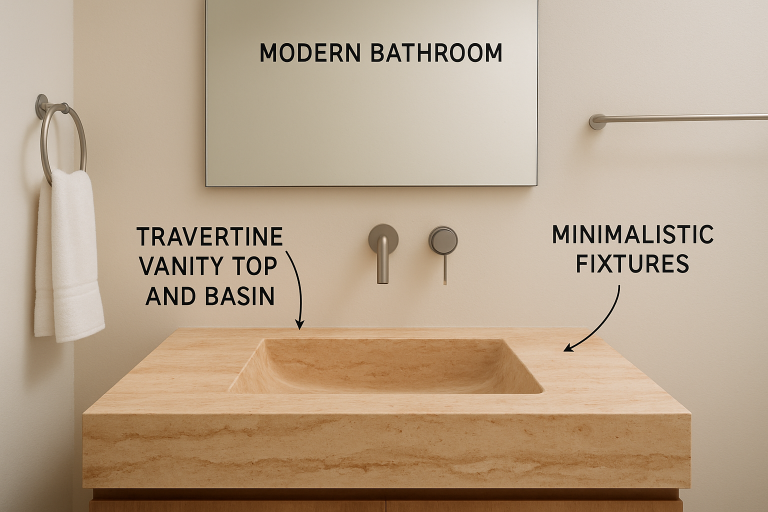
- Vanity Tops: A travertine vanity top serves as a statement piece, combining functionality with natural sophistication and highlighting the stone’s unique colors and patterns.
- Basins: Carved travertine basins lend a sculptural element to the space while providing a durable, functional washing area.
- Wall Cladding: Full- or partial-wall applications in travertine create a wraparound luxury that can turn any bathroom into a spa-like retreat.
These elements can be mixed and matched to create a cohesive design that reflects personal taste and complements other fixtures and finishes within the room.
Combining Travertine with Other Materials
The interplay between travertine and other materials is what allows the stone to shine in a multitude of settings. Pairing travertine with warm wood cabinetry offers a natural contrast that enhances both materials, while incorporating matte black or brushed metal fixtures produces a modern, industrial effect.
Glass shower enclosures and large-format mirrors heighten the sense of openness and light, keeping the overall look fresh and current. Creative lighting, such as under-cabinet LED strips or wall sconces, can accentuate the subtle textures and tones of the stone for a truly custom appearance.
There’s something about travertine that makes a bathroom feel like it belongs somewhere between a luxury spa and an old Italian villa. It’s a natural stone that’s been used in architecture for thousands of years — the Colosseum is partly built from it, if that gives you any sense of its staying power.
But in recent years, travertine has found a new home in modern bathroom design, particularly as vanity tops and basins where its texture and warmth can really shine. And honestly, it’s not hard to see why designers keep coming back to it.
Travertine forms in hot springs and limestone caves, which gives it that characteristic pitted surface and soft, layered look. No two slabs are identical, and that natural variation is a big part of its appeal. When you use it as a vanity top, you’re bringing a piece of geology into the room — something with actual depth and history baked into its surface.
Modern bathrooms tend to lean toward clean lines and minimal clutter, and travertine plays nicely with that aesthetic because its visual interest comes from the stone itself rather than from ornate carving or heavy detailing. It adds character without adding noise, if that makes sense.
The color palette helps too. Travertine typically comes in warm tones — ivory, beige, walnut, gold, and sometimes a soft silver-grey. These earthy shades pair well with the matte blacks, brushed brass, and warm wood tones that dominate contemporary bathroom design right now.
A travertine vanity top sitting beneath a frameless mirror with a matte black faucet? That’s a combination that photographs well and lives even better. The stone brings warmth to spaces that might otherwise feel cold or sterile, which is a common challenge in bathrooms built around porcelain and glass.
Travertine basins, whether carved from a single block or shaped into a vessel-style sink, take things a step further. A freestanding travertine basin on a floating vanity creates a focal point that draws the eye immediately. It’s the kind of piece that looks sculptural without trying too hard.
Designers working in the contemporary space have embraced these basins because they introduce an organic, handcrafted quality that contrasts well with the precision of modern fixtures and cabinetry. You get that tension between raw and refined, which is exactly what a lot of high-end bathroom design is chasing right now.
From a practical standpoint, travertine does require a bit more attention than, say, quartz or porcelain. It’s a porous stone, so it needs sealing to protect against water stains and etching from acidic products. Some people see that as a drawback, but in my opinion, the maintenance trade-off is worth it for the aesthetic payoff.
And the stone actually ages quite gracefully — a well-maintained travertine vanity develops a subtle patina over time that adds to its character rather than detracting from it. It’s a bit like leather in that way; it gets better with use.
The texture options available also give designers plenty to work with. Honed travertine has a smooth, matte finish that feels modern and understated. Tumbled travertine offers a rougher, more rustic surface that works well in Mediterranean or transitional-style bathrooms. Polished travertine brings out the stone’s natural veining and gives it a slight sheen, which can feel more formal. Each finish changes the mood of the room, so the same stone can serve very different design directions depending on how it’s processed.
There’s also a sustainability angle that appeals to environmentally conscious homeowners. Travertine is a natural material that doesn’t require the energy-intensive manufacturing processes associated with engineered stone or ceramic. It’s quarried, cut, and finished — and at the end of its life, it’s still just stone. That simplicity resonates with people who want their homes to reflect a lighter footprint, even in small ways.
What really makes travertine work in modern bathrooms, though, is the way it bridges the gap between nature and design. Bathrooms are becoming more personal, more considered — less about function alone and more about creating a space that feels good to be in.
Travertine vanity tops and basins contribute to that shift because they bring something alive into the room. The veining, the color shifts, the subtle imperfections — these are things no factory can replicate, and they remind you that good design doesn’t have to mean everything is perfectly uniform. Sometimes the beauty is in the variation, and travertine delivers that in spades.
Final Thoughts
Travertine vanity tops and basins exemplify how natural materials can enliven and modernize bathroom spaces. With their unique patterns, heat resistance, and compatibility with a wide range of décor styles, these pieces offer both beauty and performance.
By investing in quality travertine surfaces and maintaining them with simple care routines, homeowners can enjoy a bathroom that is elegant, enduring, and fully tailored to their tastes. The continued popularity and innovative uses of travertine prove its place at the heart of modern bathroom design.
