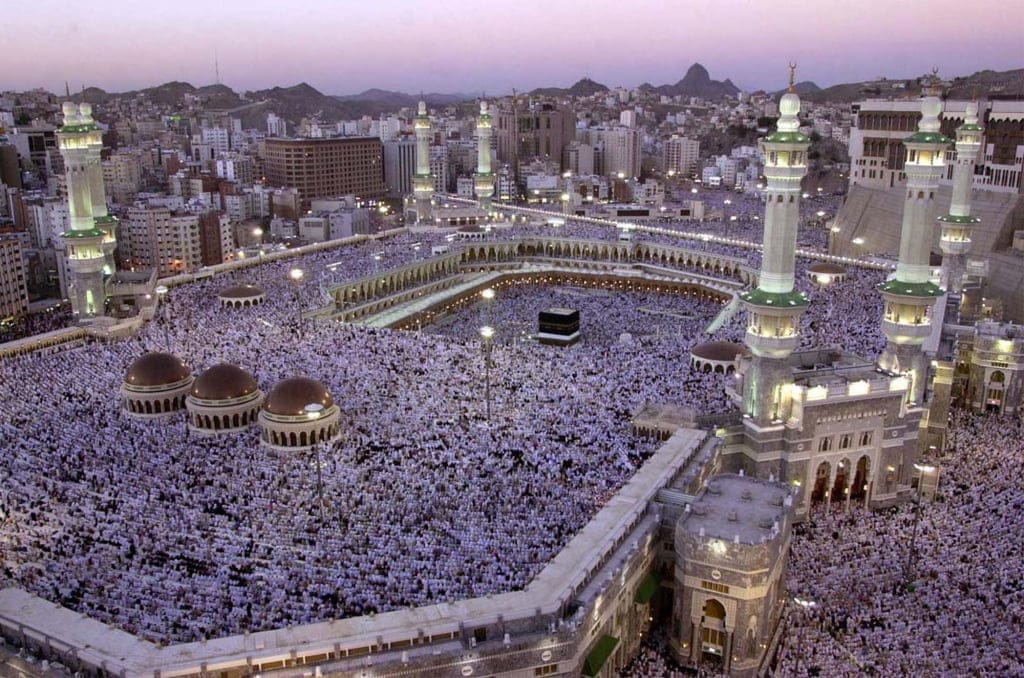
The Quran records the story of Abraham and Hajar as one of the earliest accounts tied to Hajj. Abraham was instructed to establish the Kaaba, one of the central sites in Mecca where the pilgrimage takes place. Since then, Hajj has been a religious duty for every Muslim whose health and means allow it. Those who have completed it often describe a lasting change in how they see themselves and their faith. Makkah, as the holy ground where Hajj unfolds, has also been shaped by the event over many centuries.
Makkah has grown considerably because of Hajj. Each year, Muslims and non-Muslim visitors travel from across the world to witness this place. During their pilgrimage, Muslims contribute to the development of the city, and the visitors who accompany the season do the same. The flow of people has turned a desert town into an international destination with the systems needed to host millions in a short window.
The Kaaba and the sight of the pilgrimage
The Kaaba is the focus of Makkah and it is centuries old. Seeing this one structure and knowing its history is enough to make a visitor respect it deeply. Watching Hajj in motion, with millions gathered in Mecca to perform the rituals together, is a spectacle few forget. The rites follow a fixed sequence: the state of ihram, the circling of the Kaaba, the walk between Safa and Marwah that recalls Hajar’s search for water, the standing at Arafat, and the symbolic stoning at Mina. Each step carries meaning, and performing them shoulder to shoulder with strangers is part of what gives the journey its weight.
Hajj helps Muslims understand the core of their faith. There is a difference between a Muslim who has made the pilgrimage and one who has not. The journey changes people. Many describe it as a form of clarity that lifts them to a higher understanding of Islam, and they say they are never quite the same afterward.
How Hajj reshaped the city
Makkah has advanced in infrastructure, public services, and technology because of the pilgrimage. The number of hotels, including luxury ones, has increased to house pilgrims arriving from every continent. When people from all over the world reach the city, these hotels ease their stay. The roads leading to Makkah have been widened and rebuilt to carry the crowds. The city has earned international recognition through the event, which spreads the meaning of Hajj beyond Makkah to the wider world.
The economic effect runs in a broad circle. Transport, food, accommodation, guiding services, and retail all depend on the season, and businesses across the region plan their year around it. For pilgrims, choosing a reputable operator or a well-located hotel is now part of the preparation, and much of that choice happens online before anyone leaves home. This is where the ordinary problem of finding and trusting a service intersects with a sacred journey. People compare providers, read reviews, and lean on the judgment of others who have gone before them. Robert Cialdini’s principle of social proof, set out in his book Influence, New and Expanded: The Psychology of Persuasion (2021), holds that people decide what is correct by finding out what others think is correct. That mechanism sits behind every rating and testimonial a first-time pilgrim reads when weighing a travel package.
Trust matters more here than in most purchases, because a pilgrim often has only one chance to get it right. Listings in curated directories, verified operator profiles, and honest accounts from previous travelers all help a family separate a dependable service from an opportunistic one. Being findable in a place that people already trust is a real advantage for the businesses that serve the season, and a genuine convenience for the pilgrims who use them.
One event, every kind of Muslim
During Hajj you find Muslims from every walk of life and every corner of the world. The event shows how varied the Muslim community is. Tall and short, wealthy and struggling, of every skin tone, learned and plain, all gather in one place to fulfill the same duty. They see how far the faith has reached. Hajj makes the point that everyone is equal before God, great or small, and that all will one day stand accountable in the presence of Allah. It is a plain reminder of what the religion asks and of what it means to be human. It reminds a person of who they are and where they stand in the world. Many leave feeling awake and renewed, which is why so many who complete the pilgrimage feel different afterward.
Part of what makes this equality visible is the uniform of ihram. Two simple white cloths strip away the markers of rank and money, so a merchant and a laborer look the same as they circle the Kaaba. The design of the ritual reinforces the message the faith wants to send.
Social and religious meaning
Islam carries a deep tradition of wisdom and conduct. It is a way of life that encourages peace and shared well-being. Within that framework a person can better understand their purpose and their obligations. Hajj holds both religious and social meaning for Muslims. The religious side is obvious. The social side is quieter but not hidden. A Muslim who has completed the journey is often seen as holding a slightly higher standing in the community than one who has not. This does not make them more important as a person. It is simply the regard that follows an accomplishment others value. When you have done something that matters to those around you, they tend to hold you in higher esteem.
Rachel Botsman, in Who Can You Trust? (2017), describes how trust has moved through three eras, from local trust to institutional trust to what she calls distributed trust, where reputation systems let strangers extend confidence to people and businesses they have never met. The respect a returning pilgrim earns in their own neighborhood is the older, local form of that idea. The reviews and ratings a family reads before booking are its modern version. Both rest on the same instinct: we look to the experience of others to decide who and what to believe.
Hajj has brought many benefits to Mecca, the place where the faith is at its most concentrated. It draws Muslims and non-Muslims alike to appreciate the Kaaba. It has driven economic development in Makkah and the surrounding city that supports the event. Of all the events tied to Islam, Hajj may leave the clearest mark, and nowhere is that mark plainer than in Mecca itself. For anyone preparing to make the journey, the practical takeaway is simple: plan early, book through providers others have vetted, and treat trustworthy information as part of the preparation, not an afterthought.
