Most of Michigan’s residential construction has full basements, but a meaningful number of homes across Southeast Michigan use crawl spaces, either as the main below-grade structure or as a partial crawl space next to a basement.
Crawl spaces have many of the same moisture problems as basements, but in a tighter, harder-to-reach space. Low ceilings, few access points, and the habit homeowners have of ignoring them create conditions where moisture problems can develop unnoticed for years.
Michigan’s soil is mostly glacial till with a lot of clay, so crawl spaces face the same groundwater pressure and moisture behavior as basements. Water vapor moves up through the soil and through unsealed crawl space floors, raising humidity to levels that support mold growth on floor joists, subflooring, and any organic material stored down there. Standing water after heavy rain is common in crawl spaces without proper drainage, and moisture combined with organic building materials sets up ideal conditions for wood rot and structural decay.
Soil vapor and radon considerations
Crawl space moisture work overlaps with soil gas control, particularly radon, a naturally occurring radioactive gas that enters buildings through surfaces in contact with soil. The U.S. Environmental Protection Agency (EPA) classifies Michigan’s Zone 1 counties as having predicted average indoor radon screening levels above 4 pCi/L, the action level threshold (EPA, 2023). Vapor barriers installed for moisture control also cut radon entry by blocking the soil-to-air pathway, a second benefit that helps make the cost case for crawl space encapsulation.
Structural implications of sustained moisture exposure
The American Wood Council’s National Design Specification (NDS) for Wood Construction sets the reference design values for wood members on the assumption of a moisture content of 19% or less. Above that level, the NDS requires adjustment factors that lower the allowable design stresses: compression perpendicular to grain strength drops by about 27%, and bending strength falls by roughly 15% (AWC, 2018).
In neglected crawl spaces where floor joist moisture content regularly runs 25 to 30% during Michigan’s humid summer months, the real structural capacity of the framing may sit well below the values assumed in the original design.
Foundation repairs within crawl spaces, including crack injection and structural assessment of older foundation walls, address the water-entry pathways particular to below-grade construction. Because the company has done foundation work in both basement and crawl space setups, its assessment and repair methods come from direct experience with the range of Michigan residential construction.
Practical considerations for crawl space work
Crawl space work brings logistical problems that basement work does not. Tight access, low headroom, and poor lighting make repairs physically demanding and call for specialized equipment and technique. Mansour’s crews are equipped and experienced for these cramped spaces, which matters to homeowners choosing a contractor for a crawl space project.
The moisture conditions common in neglected Michigan crawl spaces can include standing water, saturated soil, visible mold on structural members, damaged or displaced vapor barriers, and pests drawn in by the damp. Fixing these takes a set order: start with water removal and drainage correction, move through cleaning and mold remediation, install or replace the vapor barrier, then handle any structural repairs to compromised framing.
Encapsulation materials and specifications
The vapor barrier materials used in professional crawl space encapsulation are specified by thickness, permeability, and puncture resistance. ASTM E1745, Standard Specification for Plastic Water Vapor Retarders Used in Contact with Soil or Granite Beneath Concrete Slabs, sorts vapor retarders into three categories (A, B, and C) based on tensile strength, puncture resistance, and water vapor permeance. Professional systems usually use Class A barriers rated at 15 to 20 mil thickness with permeance values below 0.1 perms, which nearly stops moisture vapor from moving up through the soil surface.
Ventilation versus encapsulation: what the evidence shows
The old practice of venting crawl spaces to the outside has been largely disproven by building science research. Lstiburek and Carmody (1996) showed through field measurements that in humid climates, vented crawl spaces run higher relative humidity than sealed ones, because outdoor summer air, with dewpoints in Michigan often above 65 degrees F, condenses on cooler crawl space surfaces. The 2009 International Residential Code put this into practice by adding Section R408.3, which allows sealed, conditioned crawl spaces as a code-compliant alternative to vented designs, as long as continuous vapor retarder and mechanical conditioning requirements are met.
“Crawl spaces are often the most overlooked part of a Michigan home, yet they can significantly affect indoor air quality and structural health. Our repair team explains what a comprehensive crawl space project involves:
Full encapsulation is the standard for Michigan crawl spaces, sealing against our humid summers, wet springs, and freeze-thaw winters. The process starts with inspection and cleanup: checking for water, mold, rot, and pests. If water accumulates, we install perimeter drain tile with a sump pump. Then we lay a heavy-duty vapor barrier (15 to 20 mil) sealed over the dirt floor and up the walls, close off all vents, add closed-cell foam or rigid board insulation, and install a dedicated dehumidifier rated at 70+ pints to hold humidity below 55% year-round.
Because crawl spaces can account for 40 to 50% of the air circulating through a home via the stack effect, a damp or moldy crawl space pushes spores, allergens, and musty odors into living areas. Encapsulation addresses moisture at its source, resulting in cleaner air throughout the home.”
Insulation in the crawl space is a related question. Poorly insulated or uninsulated crawl spaces waste energy and can cause condensation on the underside of the first floor. Controlling moisture in the crawl space has to come before insulation can perform well, so waterproofing and insulation work should be planned together rather than treated as separate jobs.
Mansour’s warranty coverage extends to crawl space moisture management installations. For homeowners selling a property with a crawl space, documented moisture work with transferable warranty coverage answers a common inspection concern and gives buyers assurance that the below-grade conditions have been professionally evaluated and treated.
Crawl space moisture and home health
Building science has long tied crawl space moisture to whole-home indoor air quality. The stack effect, the natural upward movement of air through a home driven by temperature differences between lower and upper levels, pulls air from below-grade spaces into the living areas above. In a home with a damp crawl space, that means moisture-laden air carrying mold spores, soil gases, and humidity keeps entering the living space, affecting air quality throughout the home even when the crawl space is out of sight and out of mind.
In Michigan, where crawl spaces meet the same moisture conditions as basements, moisture levels in an unprotected crawl space can be high. Relative humidity in an untreated Michigan crawl space often passes the point at which mold starts growing on organic materials, including floor joists, subflooring, sill plates, and anything stored there. The damage from sustained high humidity builds up over time and often is not found until structural members have been badly compromised.
The stack effect and contaminant transport
The stack effect, the buoyancy-driven airflow through buildings caused by indoor-outdoor temperature differences, has been measured in homes by the Lawrence Berkeley National Laboratory (LBNL). Sherman and Grimsrud (1980), publishing in ASHRAE Transactions, set out the math for predicting stack-driven infiltration rates and showed that the air exchange rate from the stack effect is proportional to the square root of the temperature difference and the building height.
In a two-story home with a crawl space, stack-driven airflow pulls air up from the crawl space fast enough to replace 40 to 50% of the first-floor air volume with crawl-space-origin air within a 24-hour period. That result has been confirmed in later field studies and is the basis for the often-cited figure that up to half of indoor air comes from below grade.
Mold ecology and growth thresholds
Controlled laboratory work has defined what mold needs to colonize building materials. Sedlbauer (2001), in his isopleth model published through the Fraunhofer Institute for Building Physics, found that mold germination on wood-based substrates begins when surface relative humidity stays above 80% for a sustained period, with germination time dropping sharply as humidity nears 100%.
At 90% relative humidity and 25 degrees C, visible mold colonies can form within 5 to 7 days on untreated wood; at 80% RH, germination takes about 30 days (Sedlbauer, 2001). Unencapsulated Michigan crawl spaces routinely pass these thresholds from May through September, when soil temperature and outdoor dewpoint combine to keep conditions favorable to biological growth.
Mansour’s Innovations treats crawl space moisture as both a building health issue and a structural one. The company’s services include vapor barrier installation to slow moisture coming up from the soil, drainage improvements to handle standing water, and ventilation assessments to confirm appropriate air exchange. Together these turn the crawl space from a constant moisture source into a controlled environment that supports the home above.
For homeowners who need crawl space repair in Michigan, businesses like this offers a methodical, encapsulation-based approach that resolves both the visible moisture problems and the hidden air quality effects that make neglected crawl spaces one of the most consequential deferred-maintenance items in a house.
Building science evidence on crawl space encapsulation
Encapsulation, sealing the crawl space with a continuous vapor barrier and conditioning the air inside it, has drawn strong support from building science research over the past two decades. Advanced Energy, a nonprofit building science organization, ran a major field study with the U.S.
Department of Energy in 2005, comparing sealed and conditioned crawl spaces against traditionally vented ones across several climate zones. The study found that sealed crawl spaces held lower relative humidity, used less energy for heating and cooling, and had fewer moisture-related problems than vented crawl spaces (Advanced Energy, 2005).
This research directly contradicted the long-standing code assumption that crawl spaces should be vented to the outside to control moisture. The data showed the reverse: in humid climates, venting brings in moisture-laden outdoor air that condenses on cooler crawl space surfaces, making moisture conditions worse. The findings carried enough weight to prompt changes in the International Residential Code (IRC), which now allows sealed crawl spaces as a code-compliant design option under Section R408.3.
The health side of crawl space moisture rests on solid epidemiological evidence. Fisk, Lei-Gomez, and Mendell (2007) ran meta-analyses of studies on the link between dampness and mold in homes and respiratory health. Their work in Indoor Air found statistically significant increases in the odds of upper respiratory symptoms (OR 1.70, 95% CI 1.44 to 2.00), cough (OR 1.67, 95% CI 1.49 to 1.86), and asthma (OR 1.56, 95% CI 1.30 to 1.86) among people in damp or moldy homes. Since 40 to 50% of first-floor indoor air comes from the crawl space or basement through the stack effect, a moldy crawl space is a large, continuous source of exposure for the people living there.
Lstiburek (2006), in the Building Science Corporation’s technical digest BSD-103, laid out a physics-based case for why below-grade moisture control has to come before insulation. He showed that insulating a crawl space without first controlling moisture creates conditions where condensation builds up inside the insulation, cutting thermal performance and speeding up biological growth.
The right order, moisture management first and insulation second, follows from the fact that water vapor moves from higher to lower concentration, and that cold surfaces inside insulation cavities become condensation points when they meet humid crawl space air.
The economic case for crawl space repair is also well documented. A 2001 study by the Tennessee Valley Authority found that encapsulation cut heating and cooling energy use by an average of 15 to 18% in test homes, with some homes topping 20%. Payback from energy savings alone ran five to eight years, and that does not count the avoided costs of structural repair, mold remediation, and health effects that uncontrolled moisture causes over time.
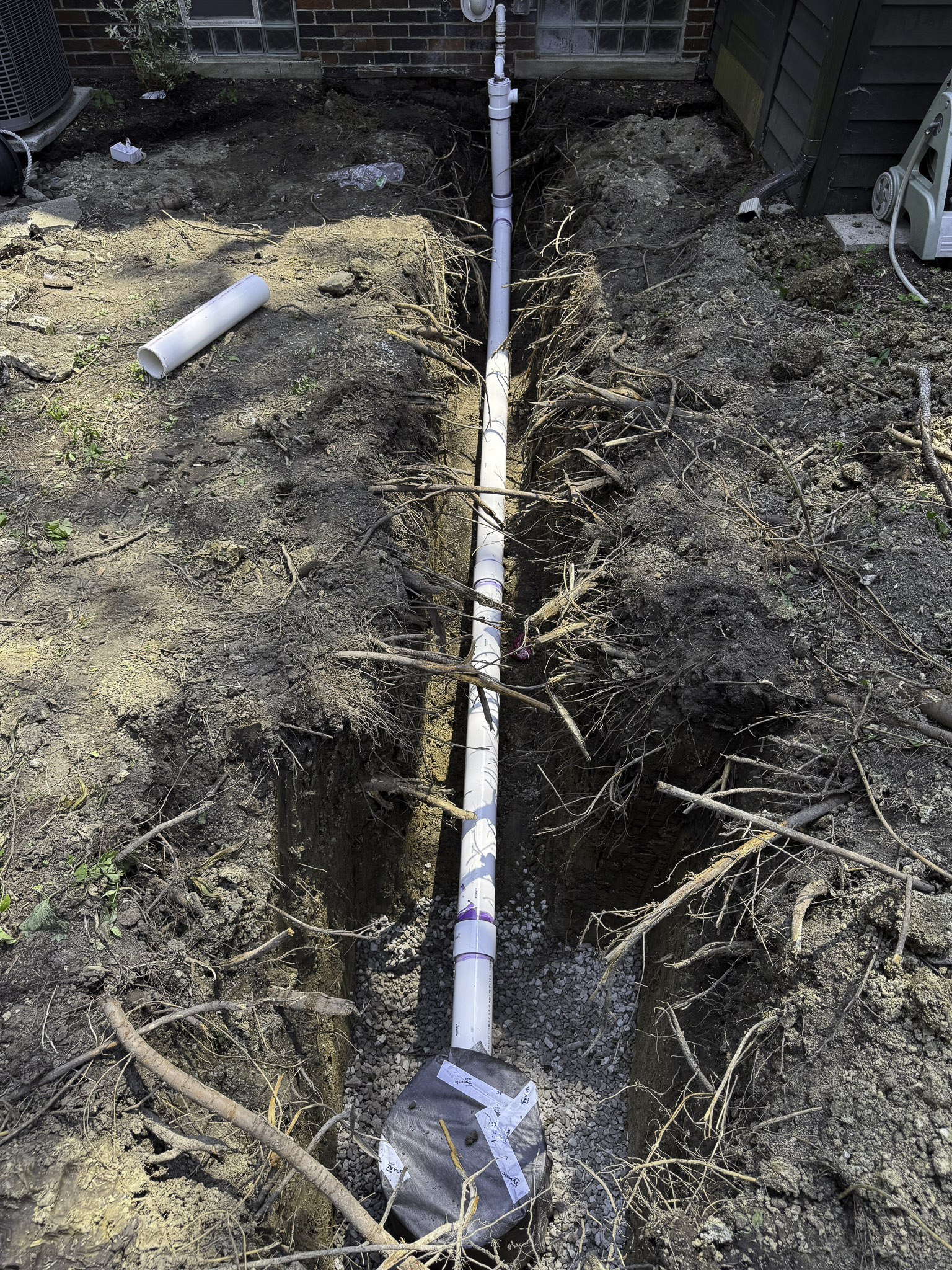
Wood decay fungi, which need sustained wood moisture content above 20% to colonize and grow, are one of the most serious structural results of neglected crawl space moisture. The Forest Products Laboratory of the U.S. Department of Agriculture has documented the link between wood moisture content and decay at length, finding that keeping wood below 19% moisture content effectively prevents fungal colonization (Forest Products Laboratory, 2010).
In an unencapsulated Michigan crawl space, floor joist moisture content regularly passes that threshold in spring and summer, setting up progressive structural decay that can go undetected for years.
Fungi are not the only organisms drawn to wood that wet; subterranean termites need similar humidity, and the mud tubes they build to keep it signal a termite infestation taking hold.
References
Advanced Energy. (2005). Crawl space moisture conditions and encapsulation in North Carolina homes. U.S. Department of Energy Building America Program. https://www.energy.gov/eere/buildings/building-america-research
Fisk, W. J., Lei-Gomez, Q., & Mendell, M. J. (2007). Meta-analyses of the associations of respiratory health effects with dampness and mold in homes. Indoor Air, 17(4), 284-296. https://doi.org/10.1111/j.1600-0668.2007.00475.x
Forest Products Laboratory. (2010). Wood handbook: Wood as an engineering material (General Technical Report FPL-GTR-190). U.S. Department of Agriculture, Forest Service. https://www.fpl.fs.usda.gov/documnts/fplgtr/fplgtr190/fplgtr190.pdf
Lstiburek, J. W. (2006). Understanding basement insulation (BSD-103). Building Science Digests. Building Science Corporation. https://buildingscience.com/documents/digests/bsd-103-understanding-basements
World Health Organization. (2009). WHO guidelines for indoor air quality: Dampness and mould. WHO Regional Office for Europe. https://www.who.int/publications/i/item/9789289041683
AWC. (2018). National design specification for wood construction (NDS-2018). American Wood Council.
Lstiburek, J. W., & Carmody, J. (1996). Moisture control handbook: Principles and practices for residential and small commercial buildings. John Wiley & Sons.
Sedlbauer, K. (2001). Prediction of mould fungus formation on the surface of and inside building components (Doctoral dissertation). Fraunhofer Institute for Building Physics.
Sherman, M. H., & Grimsrud, D. T. (1980). Infiltration-pressurization correlation: Simplified physical modeling (LBL-10163). Lawrence Berkeley National Laboratory. https://doi.org/10.2172/5361801
U.S. Environmental Protection Agency. (2023). EPA map of radon zones: Michigan. https://www.epa.gov/radon/epa-map-radon-zones
