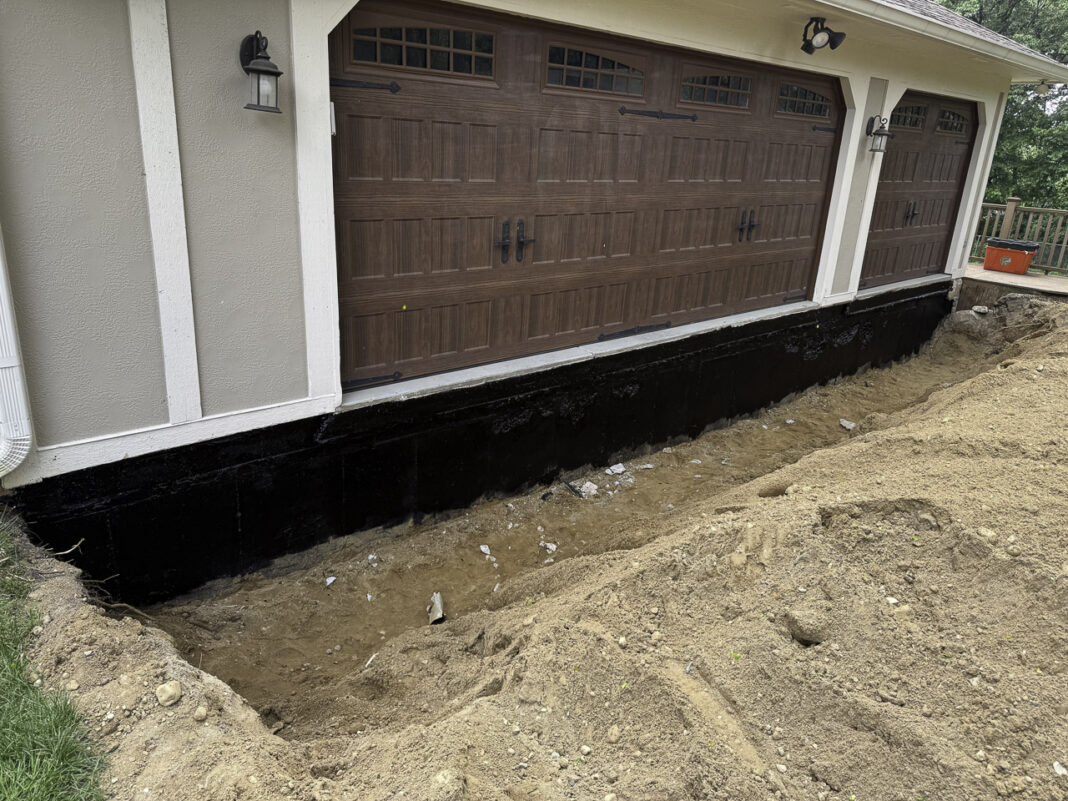
Foundation waterproofing covers all the measures taken to keep water from getting through a home’s foundation walls and floor slab. In Michigan, glacial clay soils hold moisture for long stretches and freeze-thaw cycling puts steady mechanical stress on concrete and block foundations. That combination makes thorough foundation waterproofing one of the most valuable investments a homeowner can make in the long-term structural health and livability of a property.
Without adequate waterproofing, water intrusion leads to a cascade of problems: structural deterioration of concrete and mortar joints, corrosion of reinforcing steel within poured walls, mold and mildew growth in basement spaces, damage to stored property and finished living areas, and worsening indoor air quality as moisture-laden basement air circulates through the home.
Anyone hoping to finish that space, perhaps by building a basement bar, has every reason to settle moisture control first.
Why moisture control matters below grade
A foundation is the structural interface between a building and the ground it sits on, and that interface is always exposed to moisture: from groundwater tables, from rainwater soaking through soil, and from capillary action inherent to porous cementitious materials. Failing to manage that exposure leads to problems that range from cosmetic defects to serious structural damage. Foundation waterproofing is not an optional extra but an engineering necessity, and neglecting it carries costs that compound over a building’s service life.
How water gets in
Water enters below-grade concrete through three main mechanisms. The first is hydrostatic pressure, the force that accumulated groundwater exerts against foundation walls and slabs. As soil becomes saturated, particularly during sustained rainfall or where water tables are high, this pressure drives water through cracks, construction joints, and porous zones in the concrete.
The second mechanism is capillary action, where water migrates upward through the micro-porous network of hardened concrete without any external pressure. This accounts for much of the rising dampness seen in slab-on-grade and basement construction.
The third is vapour diffusion, a subtler process in which moisture moves as vapour through the concrete under differences in humidity, then condenses on interior surfaces and creates conditions that favour biological growth and material breakdown.
Song et al. (2017) showed that below-grade structures under higher water pressures and prolonged wet conditions suffer increasingly compromised membrane adhesion, particularly at construction joints where structural settlement, thermal cycling, and external loads combine to create dynamic stresses that no static waterproofing design can fully anticipate.
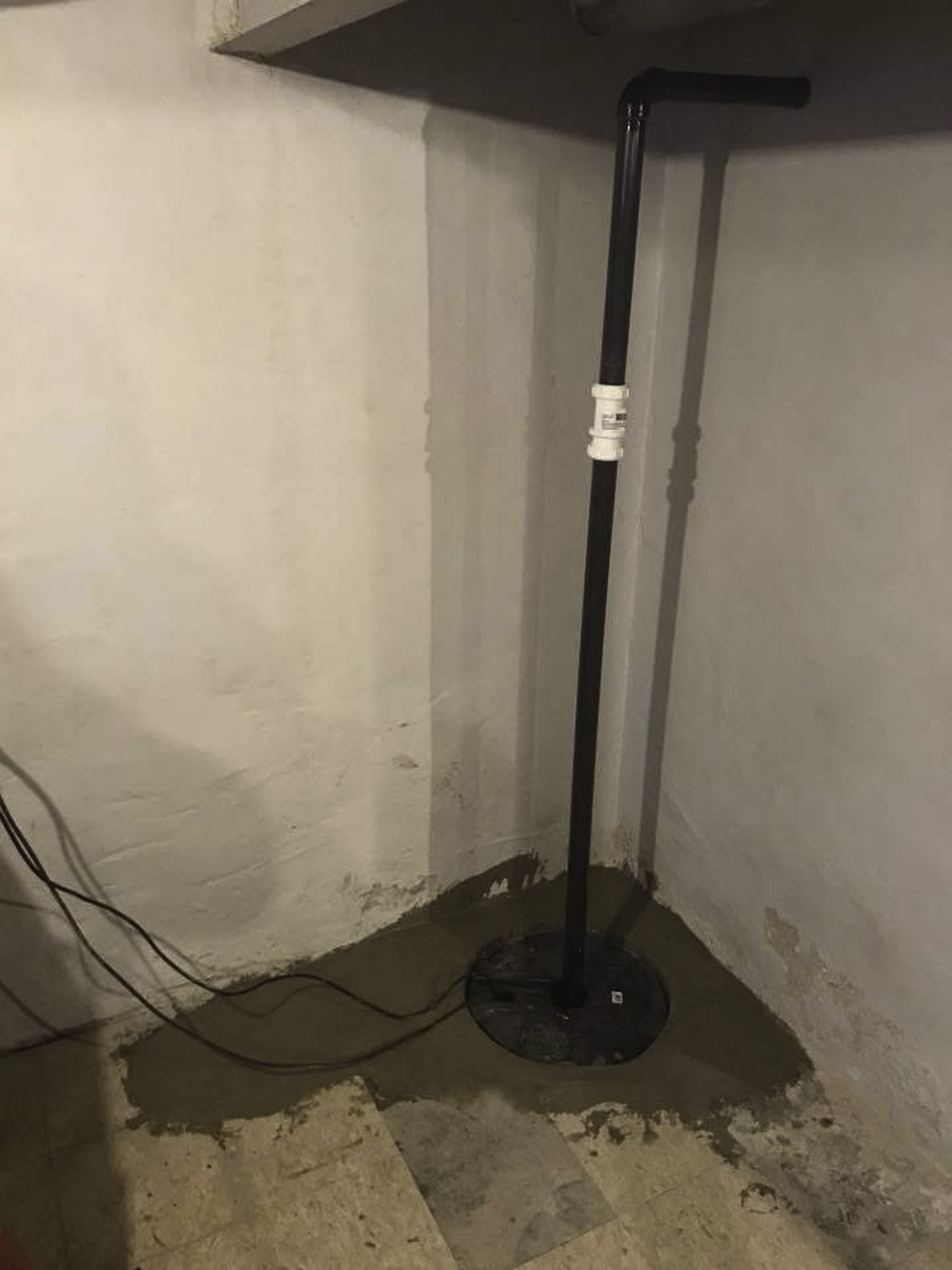
Mansour’s Innovations treats foundation waterproofing as a full discipline rather than a single service. The company’s foundation waterproofing capabilities span interior drainage systems, exterior membrane application, foundation crack injection using polyurethane and epoxy, tie rod and snap tie hole sealing, vapor barrier installation, sump pump systems with battery backup, exterior drainage including French drains and dry wells, and grading correction to move surface water away from the foundation.
This range lets the company address the whole spectrum of foundation water problems instead of supplying one solution that may not fit the conditions at a given property.
The process at Mansour’s starts with a thorough assessment that looks at the foundation type, age, and condition; soil characteristics; existing drainage systems; grading; gutter discharge patterns; and the history and severity of water intrusion. This assessment may include thermal imaging to detect moisture behind finished walls and camera inspection of existing drain tile or sewer connections. The goal is to find the actual water routes and their causes before recommending a solution, rather than defaulting to a standard approach that treats symptoms without resolving the underlying condition.
Exterior foundation waterproofing methods
Exterior foundation waterproofing is the most thorough approach available because it stops water at the point where it meets the foundation wall, preventing penetration entirely rather than managing water after it enters. The work includes excavating around the foundation to expose the exterior wall surface, cleaning and preparing that surface, applying a waterproof membrane system, installing perimeter drainage tile connected to a discharge point, and backfilling with appropriate material and compacting it properly. Grading correction is usually part of the restoration, so surface water flows away from the foundation rather than toward it.
Mansour’s Innovations uses modern membrane systems, including rubber membranes and dimple board drainage layers, rather than the older tar or bitumen coatings that degrade over time. These newer materials waterproof better and last far longer than the coatings that were standard when most of Michigan’s existing housing stock was built. The perimeter drainage tile installed during exterior waterproofing replaces the old drain tile system, which in many Michigan homes has failed from age, root intrusion, or ground displacement.
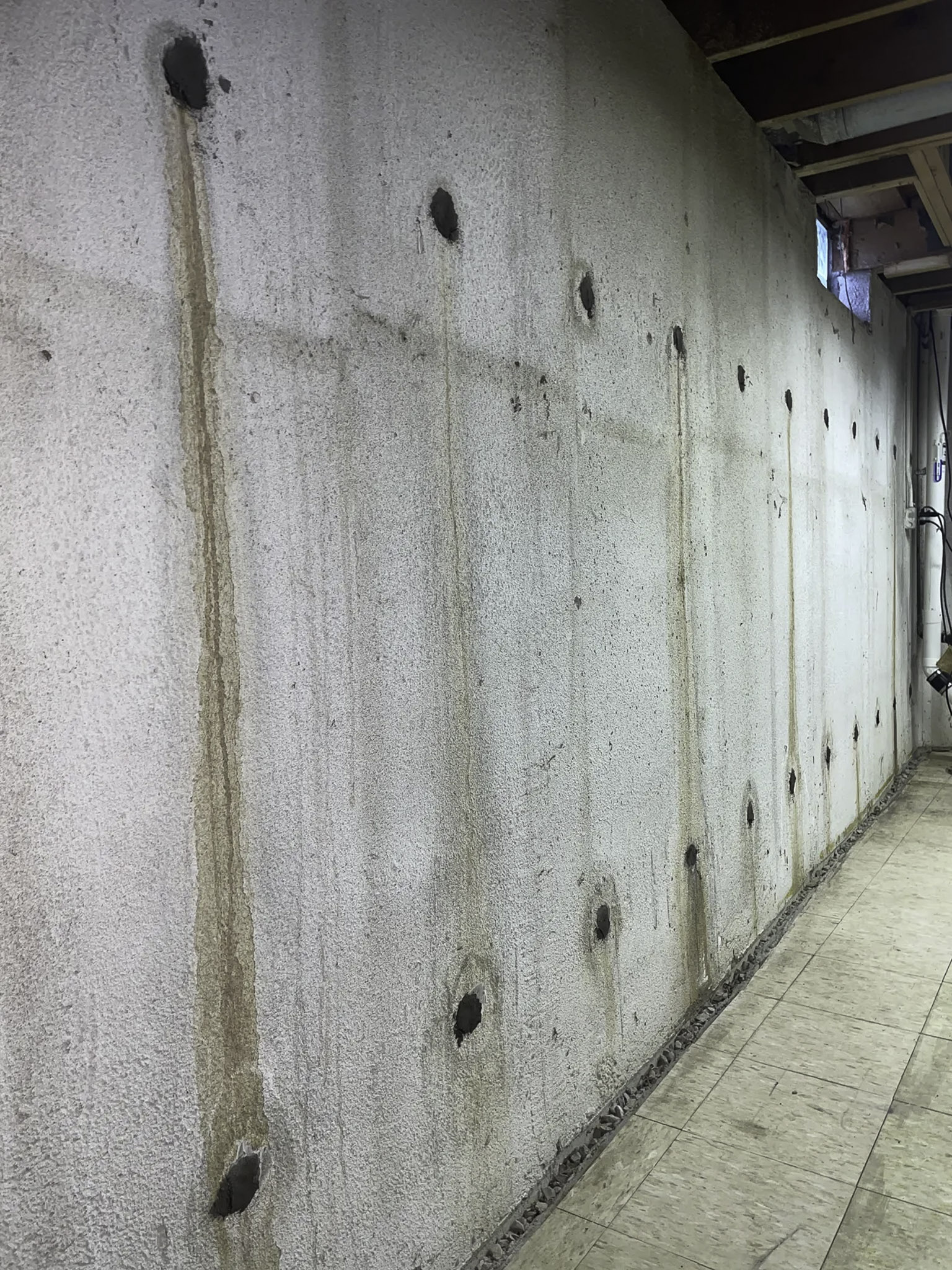
A question we frequently receive is: at what point does a foundation issue require professional waterproofing rather than a simple patch? Here is the expert breakdown:
In Michigan, a small hairline crack that’s less than 1/8 inch and not getting bigger is probably just a sign of a foundation settling – it’s pretty common and not a major concern at this point.
It becomes a serious situation that requires immediate professional attention and possibly waterproofing when you notice:
– Width over 1/4 inch (or even 1/8 inch if widening).
– Horizontal cracks, which scream hydrostatic pressure from wet Michigan soil pushing walls in.
– Stair-step cracks in block walls.
If you notice that the crack is getting bigger, water is seeping out, or one side of it is clearly wider than the other, that’s a sign of a problem.
– Bonus red flags: bowing/leaning walls, sticking doors/windows, uneven floors, or ongoing seepage.
When water starts seeping in, it’s more than a nuisance – it can actually weaken your foundation pretty quickly, especially here in Michigan, where we have to deal with freeze-thaw cycles and high water tables. You should really get a local basement expert to come out and take a look as soon as possible. If you catch the problem early, you can apply injections or waterproofing to stop the water in its tracks before it becomes a major headache or a costly repair. And don’t wait if you’ve got horizontal cracks – that’s a sign of a serious issue that needs to be addressed right away.
Add clay-heavy glacial soil to that mix and you have the short answer to why Michigan basements need waterproofing far more often than homes elsewhere.
Exterior projects usually take 5 to 10 days, depending on foundation size, excavation depth, soil conditions, and site access. The work does temporarily disrupt landscaping next to the foundation, and site restoration, including backfill, compaction, grading, and reseeding or sodding, is included in the service. Mansour documents the restoration as a deliverable rather than an afterthought, which answers one of the most common homeowner complaints after excavation work.
The company runs its own excavation equipment, and that matters. Contractors who subcontract excavation to a separate company create scheduling dependencies and split accountability between the excavation crew and the waterproofing crew. When one company controls both excavation and waterproofing installation, the project follows a single schedule with one party responsible for the outcome. This also tends to shorten the total project duration, which benefits the homeowner right away by cutting down yard disruption.
Interior foundation protection and crack repair
Interior foundation waterproofing complements exterior work or serves as the primary fix whenever exterior excavation is impractical. Interior perimeter drainage systems, sump pumps, vapor barriers, and crack injection together manage moisture that reaches the interior face of the foundation. For many Michigan homes, particularly those with close property lines, significant adjacent landscaping, or budgets that favor the more economical interior approach, these methods deliver reliable water management that protects the basement and its contents.
Foundation crack injection is a specialized part of the work that deserves particular attention. Poured concrete foundations develop cracks from a combination of shrinkage during curing, hydrostatic pressure from groundwater, and mechanical stress from freeze-thaw soil movement.
These cracks range from cosmetic hairline fractures to active water pathways that deliver measurable flow during rain events. Mansour’s Innovations repairs these cracks by injecting polyurethane foam or epoxy resin under pressure, filling the crack through the full thickness of the wall rather than applying surface patches that fail when the next season of soil movement reopens the crack.
Tie rod holes are another common water entry point in poured concrete foundations. Every poured foundation wall was formed using steel tie rods that held the form panels at the correct spacing during concrete placement. After curing, the forms were removed and the rods were cut, leaving small through-wall penetrations at regular intervals across the foundation.
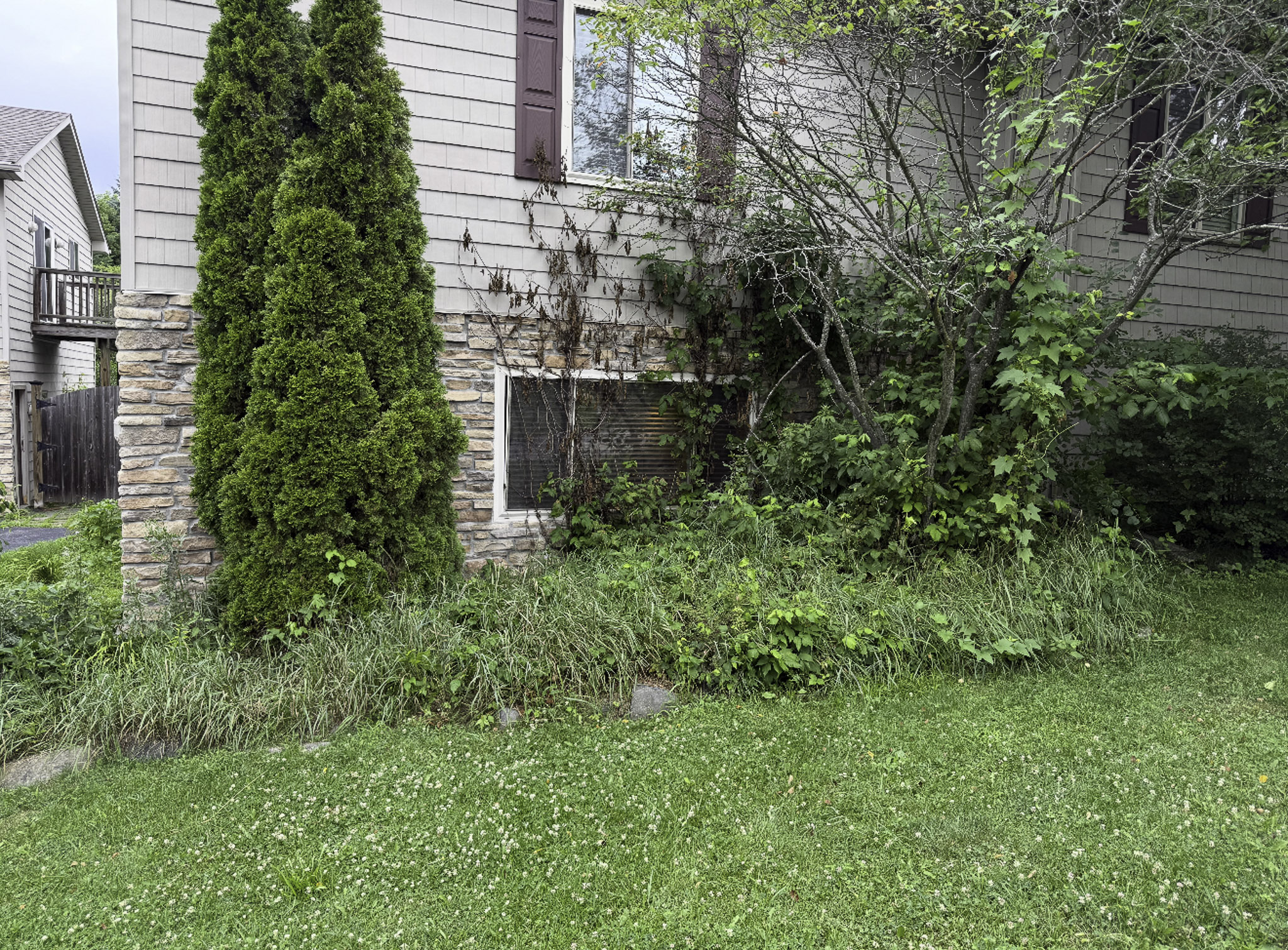
These holes are present in virtually every poured-wall foundation in Michigan, and they are often overlooked during assessments that focus only on visible cracks. Mansour’s addresses tie rod holes as part of its foundation waterproofing service, because a complete approach has to treat all water entry points, not just the most obvious ones.
The 25-year transferable warranty applies to all foundation waterproofing work performed by Mansour’s Innovations, whether interior, exterior, or a combination of both. This warranty is documented and given to the homeowner at project completion, creating a record that supports future real estate transactions and gives long-term assurance that the work meets a defined standard. Since Michigan homeowners, where foundation waterproofing is a near-universal need at some point in a home’s lifecycle, this warranty is a meaningful form of property protection that extends well past the immediate project.
For homeowners searching for reliable foundation waterproofing in Michigan, Mansour’s Innovations delivers proven expertise backed by a 25-year transferable warranty and hundreds of satisfied customers across Southeast Michigan.
How waterproofing systems are classified
Foundation waterproofing systems are classified by their position relative to the structural element being protected. Positive-side waterproofing, applied to the exterior face of the foundation, intercepts water before it reaches the concrete and is widely considered the most effective approach.
Negative-side waterproofing, applied to the interior surface, manages water that has already penetrated the substrate. It is a remedial strategy usually reserved for existing buildings where exterior access is no longer feasible. Blind-side waterproofing, a pre-applied system installed before the concrete is poured against soil retention structures such as sheet piles or shoring walls, serves urban and constrained sites where reaching the exterior wall after excavation is impossible.
Each category uses several material technologies. Sheet membranes, typically made of rubberized asphalt, PVC, or thermoplastic polyolefin, provide a pre-manufactured barrier of controlled thickness. Liquid-applied membranes, which are elastomeric coatings sprayed or rolled onto the substrate, form a seamless single-layer barrier that can bridge hairline cracks.
Bentonite-based systems use the natural swelling of sodium bentonite clay, which can absorb seven to ten times its own weight in water and expand into an impermeable seal when confined between the foundation and surrounding soil. Cementitious waterproofing coatings are applied as a slurry to concrete surfaces and rely on chemical interaction with the substrate to block capillary pathways.
Crystalline waterproofing technology
One of the most actively researched developments in foundation waterproofing is cementitious capillary crystalline waterproofing (CCCW). This technology introduces reactive compounds, typically silicates and metallic salts, into or onto the concrete, where they interact with moisture and unhydrated cement particles to form insoluble crystals within the pore structure. Cappellesso et al. (2016) evaluated crystalline waterproofing both as an admixture and as a surface coating, comparing its performance against silica fume concrete.
Their findings showed that crystalline treatment altered the capillary porosity of concrete, though how effective it was depended on the application method and mix composition.
Zhang et al. (2019) took this further by examining the gas permeability of mortar specimens coated with CCCW. Their results confirmed that the coating shifted the pore structure toward smaller pore sizes and reduced overall permeability, with scanning electron microscopy revealing significant ettringite crystal formation filling voids within the treated matrix.
Zhong et al. (2024) supported these findings, reporting that concrete specimens containing 2% internal CCCW showed the most effective self-healing behaviour, with a recovery rate of about 114.4%, attributable to increased formation of calcium silicate hydrate and calcium carbonate within crack planes.
Self-healing and long-term durability
The self-healing capacity of crystalline admixtures changes the aim of foundation waterproofing from a passive barrier to an active material response. Gojevic et al. (2021) investigated the relationship between crystalline admixture concentration, water-binder ratio, and crack sealing over time.
Their research showed that while the admixture did not significantly change compressive strength, it measurably reduced water penetration depth, particularly in mixes with lower water-binder ratios. The self-healing contribution worked best for cracks narrower than 0.3 mm, a result consistent with the wider literature.
Zhang, Wang, and Ding (2022), in a comprehensive review of autonomous healing mechanisms, confirmed that crystalline admixtures can completely seal cracks up to 0.4 mm wide. The authors noted that these materials offer favourable cost-performance ratios and simpler application than alternatives such as shape memory alloys, bacterial encapsulation, or microcapsule-based systems.
Failure modes and preventive design
Even with effective technologies available, waterproofing failures remain common. Mydin, Nawi, and Munaaim (2017), through case studies of commercial, hospitality, and residential buildings in Malaysia, identified four dominant failure factors: structural cracking, deterioration of the waterproofing membrane itself, honeycombing defects in the concrete substrate, and failure at construction joints. Their findings show that material selection, however advanced, cannot make up for poor construction practice.
Membrane rupture during backfilling, inadequate surface preparation, insufficient curing times, and poorly detailed transitions between horizontal and vertical planes remain the primary causes of premature waterproofing failure. The authors stressed that repairing a failed waterproofing system is one of the most expensive categories of building remediation, a conclusion supported by the wider building pathology literature.
Conclusion
Foundation waterproofing is the first defence against the most persistent and universally present threat to structural longevity. The three ways water gets in, hydrostatic pressure, capillary transport, and vapour diffusion, are well understood, and the available countermeasures range from centuries-old drainage principles to emerging crystalline self-healing technologies that can repair cracks at the microstructural level on their own. Yet the gap between available technology and field performance persists, driven less by material limitations than by shortfalls in design detailing, construction oversight, and quality assurance.
The research consistently shows that no single product or system is a complete solution. Effective foundation waterproofing requires an integrated approach that combines appropriate material selection with geotechnical awareness, careful installation, and provision for long-term monitoring of a system whose failure, once hidden beneath soil and structure, becomes very difficult and costly to fix.
References
Cappellesso, V. G., dos Santos Petry, N., Dal Molin, D. C. C., & Masuero, A. B. (2016). Use of crystalline waterproofing to reduce capillary porosity in concrete. Journal of Building Pathology and Rehabilitation, 1(1), 9.
GojeviA++, A., Ducman, V., Netinger GrubeAa, I., BariAeviA++, A., & Banjad PeAur, I. (2021). The effect of crystalline waterproofing admixtures on the self-healing and permeability of concrete. Materials, 14(8), 1860.
Mydin, M. A. O., Nawi, M. N. M., & Munaaim, M. A. C. (2017). Assessment of waterproofing failures in concrete buildings and structures. Malaysian Construction Research Journal, 2(2), 166-179.
Song, J., Oh, K., Kim, B., & Oh, S. (2017). Performance evaluation of waterproofing membrane systems subject to the concrete joint load behavior of below-grade concrete structures. Applied Sciences, 7(11), 1147.
Zhang, H., He, B., & Zhu, X. (2019). Effect of cementitious capillary crystalline waterproofing coating on the gas permeability of mortar. Structural Concrete, 21(3), 1163-1173.
Zhang, Y., Wang, R., & Ding, Z. (2022). Influence of crystalline admixtures and their synergetic combinations with other constituents on autonomous healing in cracked concrete, A review. Materials, 15(2), 440.
Zhong, J., Zhang, H., Mao, J., & Wang, L. (2024). Influences of cementitious capillary crystalline waterproofing on the hydration products and properties of cement-based materials. Journal of Building Engineering, 98, 111451.
