A sense of separation from your own culture’s history and traditions runs through the work of many accomplished artists of African descent. Here we look at the lives and work of a few of them, and where they draw their inspiration from.
Lubaina Himid
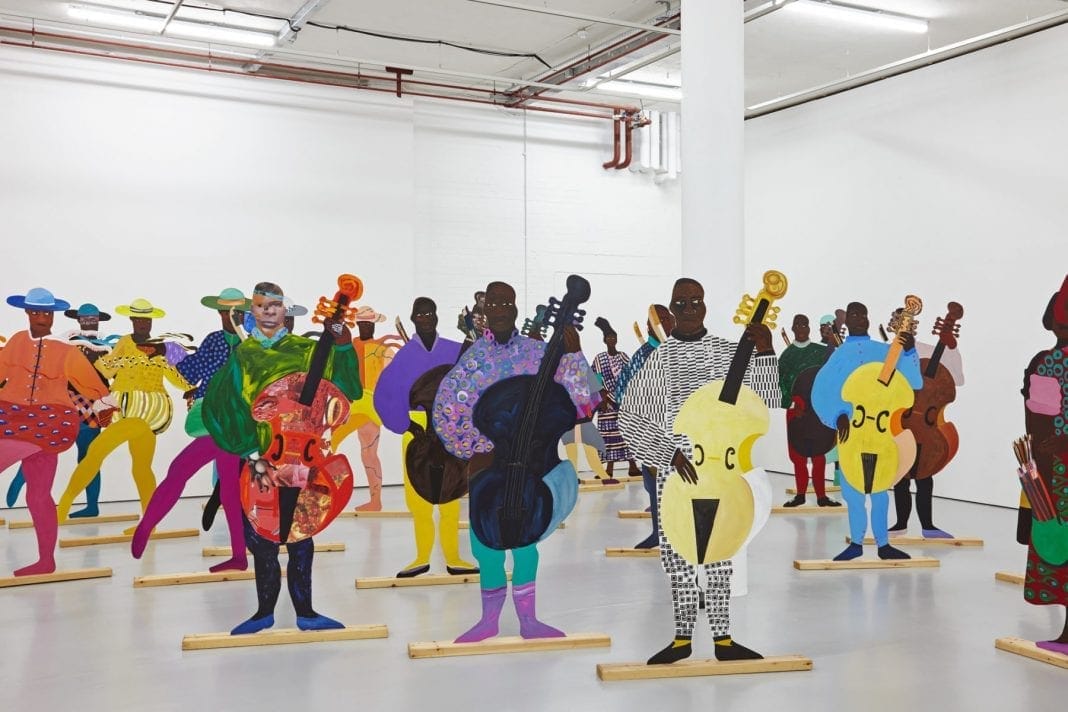
Lubaina Himid was born in Zanzibar in 1954 and moved to Britain when she was only four months old, following the death of her father. Her work today includes her own paintings alongside collections of pottery, wooden figurines, and newspaper excerpts that she paints over and marks with her own message. She first made her name in the 1980s as one of the leaders of the British black arts movement. In December 2017 she became both the oldest and the first black artist to win the Turner Prize, awarded for work that addresses racial politics and the legacy of slavery.
Himid has also arranged several exhibitions of black female artists, among them Five Black Women, a 1983 show at the Africa Centre in London. Cultural history and reclaiming identity recur throughout her work. She studied at the Wimbledon College of Art and earned her master’s degree in cultural history from the Royal College of Art in London.
That work of reclaiming how people are pictured has a long counterpart in painting, where the female nude as expression became modern art’s most contested subject.
Fabrice Monteiro
Born in Benin, educated in Belgium, and now based in Senegal, Fabrice Monteiro makes photographic work that focuses on environmental damage in West Africa. He was born to a Beninese father and a Belgian mother, and did not find his artistic calling until the age of 37. He trained as an industrial engineer for several years, and a brief spell as a model sparked his interest in photography, composition, and lighting.
After travelling the world in the mid-2000s working as a milliner, he met Alfonse Pagano in New York, who became his mentor. He trained first as a fashion photographer, but soon found he wanted to tell a different kind of story.
The name Monteiro comes from his ancestors, who were deported during slavery to the islands by the Portuguese. That history is where he chose to begin his photographic work. Inspired as a child by Les Passagers du Vent, the story of an English ship sent to the coast of Benin to collect slaves, he set out to recreate some of the images of the period. The result was his first portrait gallery, Marrons, and his profile in the art world has grown since.
Kerry James Marshall
Kerry James Marshall was born in Alabama in 1955 and works across painting, installation, and video. He uses his work to comment on the history of black identity as it relates to the United States and to Western art more broadly.
In the documentary Art21, he explains the effect the Black Power and Civil Rights movements had on him: “You can’t be born in Birmingham, Alabama, in 1955 and grow up in South Central [Los Angeles] near the Black Panthers headquarters, and not feel like you’ve got some kind of social responsibility.”
His signature style uses very dark figures, and he is known for a range of paintings that reference the paint-by-numbers art sets popular in the fifties, often showing the figure painting an image of themselves. Many of his works depict the struggle of African Americans to find their place in American society.
Marshall received a MacArthur Foundation “genius grant” in 1997 and was awarded the Fifth Star Award by the City of Chicago in 2017.
Aida Muluneh
Muluneh was born in Ethiopia and spent her early years between Yemen, England, and Cyprus before moving to Canada and later the United States. She worked as a photojournalist for the Washington Post, and over time felt the need to reconnect with her home country.
In her own words: “I also want to make Africa digestible in a different way. When people think about Africa right now, they often only think about animals, war, and famine. I’m trying to distort that impression to provoke questions in a different sense.“
She has since moved back to Ethiopia, where she plays an active role in promoting art in the country. She founded the biennial Addis Foto Fest and DESTA (Developing and Educating Society Through Art), which organizes workshops, exhibitions, and creative exchanges.
Common threads across their work
Read across these four careers and a pattern emerges. Each artist works from a personal displacement (Himid from Zanzibar to Britain as an infant, Monteiro tracing an ancestral name back through the slave trade, Marshall shaped by Birmingham and South Central, Muluneh moving between four countries before returning to Ethiopia) and turns that experience into a body of work about history, identity, and how a people gets seen. None of them treats the past as settled. Himid paints over found objects to change what they say; Monteiro restages images of the slave trade; Marshall inserts dark figures into a Western art tradition that long left them out.
Their choice of materials matters too. Photography, painting, installation, and video each reach a different audience, and each carries a different kind of authority. Muluneh’s point about wanting to distort the standard picture of Africa is a comment on visibility as much as art: what people believe about a place or a person depends heavily on which images reach them, and who controls that flow. Safiya Umoja Noble, in Algorithms of Oppression: How Search Engines Reinforce Racism (2018), argues that commercial search results are not neutral, since ad-driven ranking and private interests shape which people, businesses, and communities become visible. Treating a search engine’s first page as an objective map of what exists, she warns, is a mistake. That caution applies to art too: the names that surface easily are not the same as the names that matter.
Finding artists and the places that shape them
If these four painters and photographers interest you, the practical follow-up is knowing how to find their work, and the galleries, festivals, and cultural organizations connected to it. Much of that discovery still happens through a mix of searching and browsing organized categories, the two complementary ways people locate things online described in Information Architecture: For the Web and Beyond (2015) by Louis Rosenfeld, Peter Morville, and Jorge Arango. A search engine is quick when you already have a name. A curated listing helps when you are trying to find a festival like Addis Foto Fest, a gallery that shows work in Monteiro’s vein, or an arts organization in a country you want to learn about.
That is where being listed in a reviewed, human-checked place earns its keep. For an independent gallery or a festival, showing up in a directory a person actually vetted lends a credibility that an anonymous search result does not, and it helps the smaller, niche name reach people who would otherwise never come across it.
Look up the African countries that shape these artists, and you start to see how much of their work is rooted in specific places, histories, and communities. That context is the best entry point into everything they make.
