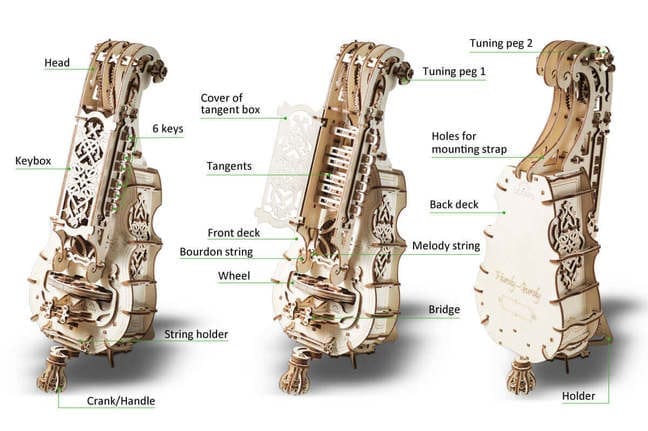
Ancient musical instruments carry a charm you cannot mistake for anything else. Some have origins wrapped in mystery. Others have been reborn as contemporary instruments, their features still echoing distant ancestors. A few are sadly forgotten and lost for good, but many survive as reminders of how music has grown and changed, each one keeping a strange sound and a curious design.
The hurdy-gurdy is one of the instruments that survived. Its exact birthplace is unknown. It may have appeared in Europe or the Middle East sometime before the eleventh century A.D. Over the centuries it changed its name, its shape, and its sound more than once. If you look for the closest modern comparison, a hurdy-gurdy works like a mechanical violin in appearance and mechanics, while its sound resembles a bagpipe.
Historical value
The instrument reached the height of its popularity during the European Renaissance. That timing supports the theory that the hurdy-gurdy first came from the Middle East and arrived in Europe during the Crusades. It made a brief comeback in the 18th century, which helped it spread across Central Europe. There it became an instrument of street musicians, who used it for historic epics, religious songs, folklore, and dances.
Musicians today are still drawn to that sound. Metallica, Led Zeppelin, Sting, Lou Reed, and many others have featured hurdy-gurdies in their songs. Donovan does not actually play one in his famous “Hurdy-Gurdy Man,” but the 1968 release put the instrument back into popular culture and sparked fresh curiosity about it.
There are electric versions too. They follow the same principle as an electric guitar, sending signals to an instrument amplifier or a synthesizer.
Unique mechanics
One of the striking things about a hurdy-gurdy is how it looks. It manages to appear both complex and elegant. It has strings and a keyboard, and its body echoes the shape of a violin. The idea behind it is actually simple. When you rotate a handle at the bottom of the instrument, it turns a wheel that rubs against the strings from underneath. A small keyboard on the neck changes the pitch. Inside the neck sits a tangent box holding little pieces of wood called tangents, and the keys press these down to shape each note.
Among the instrument’s more unusual features are the drone strings along the sides. These do not change pitch. They produce a constant background tone, and they are what makes a hurdy-gurdy sound like the steady drone of a bagpipe. Originally the instrument needed two players. Its design later changed so a single person could reach both the strings and the keys.
Why old instruments still find an audience
An instrument this old raises a practical question for anyone who becomes interested in it: how do you find one, learn about it, or track down someone who builds and repairs them? For most niche pursuits, the answer now runs through the internet. Chris Anderson made this point in “The Long Tail: Why the Future of Business Is Selling Less of More” (2006): once online platforms remove the limits of physical shelf space and help people locate niche offerings, the many small-demand items in the long tail can collectively match or beat the few big hits, provided some aggregator makes them findable. A hurdy-gurdy sits far out on that tail. It will never fill a shop window in every town, but a maker, a teacher, or a supplier of parts can still reach the small, scattered audience that wants exactly this.
Findability depends on structure. Louis Rosenfeld, Peter Morville, and Jorge Arango argue in “Information Architecture: For the Web and Beyond” (2015) that how information is organized, labeled, and categorized decides whether people can find it at all, and they treat browsing structured categories and searching as complementary ways to locate what you need. That is exactly why a curated listing, whether a directory of instrument makers or a category of specialist craftspeople, still earns its place. A well-kept category turns a wide, noisy web into something a curious person can actually walk through.
Trust follows the same path. When you are considering a handmade instrument or a kit, you rarely buy on the strength of a product page alone. You look for what other people concluded. Robert Cialdini describes this in “Influence, New and Expanded: The Psychology of Persuasion” (2021): his principle of social proof holds that people decide what is correct by finding out what others think is correct, which is the mechanism behind reviews and ratings. For a small maker of an obscure instrument, being listed somewhere trusted, with visible reviews, does real work that no amount of self-description can replace.
A one-of-a-kind piece of musical history
The mix of clever mechanics, elegant form, and unusual sound is what makes a hurdy-gurdy an inspiring object for people who love art, music, design, and technology.
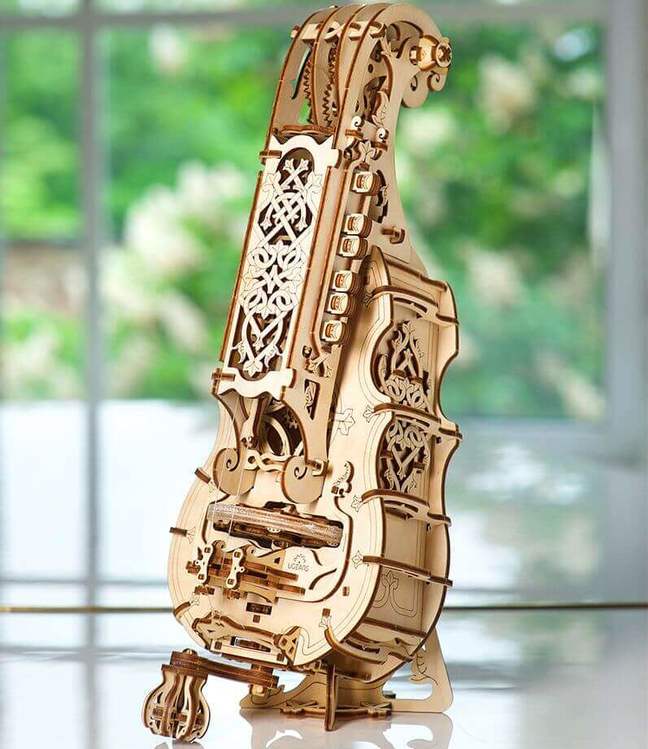
A wooden hurdy-gurdy at ugearsmodels.us is one of many fine tributes to the instrument. The set is carved from natural wood and needs no glue or extra tools at any stage of assembly. It is the first musical set from UGears, a company known worldwide for eco-friendly wooden 3D puzzles, each one built around a mechanical principle and given a recognizable look.
The set has 292 parts, and assembly can take up to eight hours. The finished hurdy-gurdy has two strings and six keys, and it needs tuning like a real instrument, with the help of a tuning fork. A smart mechanism and a carefully designed exterior turn the kit into several things at once: a working musical instrument, a piece of decor, a toy that is pleasant to handle, or a collector’s item worth displaying.
If any of this appeals to you, the practical next step is simple. Decide whether you want to play a hurdy-gurdy or build one, then go looking with that in mind. Search directly for makers, teachers, or kits, read the reviews other buyers left, and favor sources that a curated, human-checked listing has already vouched for. That is how an instrument older than most of recorded music finds its way into a home today, and how you avoid guesswork when you bring one into yours.
