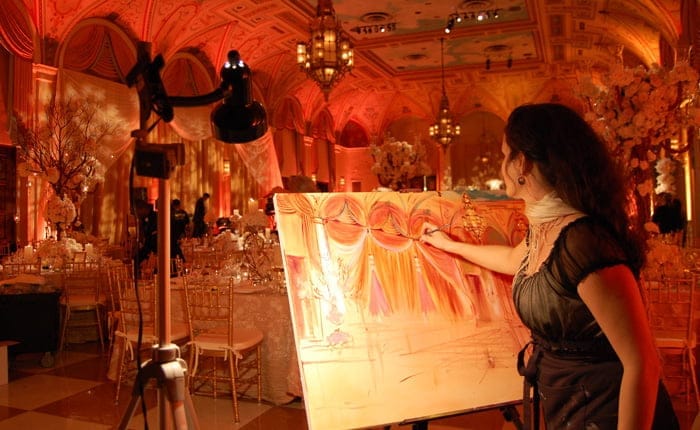
Your wedding can be treated as a work of art. It is one of the most significant events of your life, shared with someone you love and witnessed by your closest friends and family. When you approach the day as an artistic display rather than only a social gathering, you give everyone more vivid memories and lend the whole experience a character you would not get any other way.
The question is how to work more art into your wedding in a way that actually holds together.
Treating your wedding as art
A few guiding principles are worth settling before you make any decisions.
- Art is expression. The philosophy of art is too broad to reduce to a single idea, but for your purposes it helps to think of art as a means of expression. What you express and how you express it is up to you. You can tell the story of how you and your partner met, convey your feelings as you head into the day, or signal your hopes for the future through the choices you make.
- Any sensory experience can be artistic. Art is not confined to visual aesthetics. As long as there is intention behind the arrangement, any sensory experience qualifies. Consider sights, sounds, smells, tastes, and even touch.
- Consistency is key. If you pull in art from too many different backgrounds or with too many competing focal points, the result reads as clutter rather than a statement. Keep your choices in conversation with one another.
That last point deserves a little more attention, because consistency is easier to talk about than to achieve once you are choosing between real options. The clearest weddings tend to have one organizing idea that quietly governs everything else. A guest may never articulate it, but they feel it when the flowers, the music, the invitations, and the lighting all seem to belong to the same world. Contrast can be powerful, but it works best as a deliberate accent against a settled backdrop, not as the backdrop itself.
Specific opportunities
With those principles in place, here are concrete ways to bring more art into the planning.
- Set a tone, mood, or clear rubric for selection. Before you start planning in earnest, decide what standards will guide the art you curate and create. Are you drawn to a particular period, a specific mood, an overall tone, or a defined color scheme? Answering this early gives every later choice something to line up against.
- Choose creative wedding rings. You can begin with rings that represent what you and your partner mean to each other. A ring with the right materials, the right shape, and perhaps some history behind it adds character to the main event, and it becomes a permanent reminder you carry with you long after the day is over.
- Look for a venue with artistic sensibilities. Your venue shapes your guests’ first impressions and gives context to every other decorative choice. You might even hold the wedding or reception in an art museum or another space built around art.
- Think beyond the obvious. If you get stuck picturing the artistic components, widen the frame. What music or soundscapes can set the mood? What smells, tastes, and textures could give your guests something they have not experienced at a wedding before?
- Consult art-friendly professionals. If you want help, look for a wedding planner with a real feel for aesthetics, or ask any professional artist friends for their read on your plans. The final call stays yours, but more perspectives widen the range of ideas in front of you.
- Avoid off-the-shelf decor. Try not to lean on mass-produced pieces. They tend to dull the aesthetic you are building, and they will never fit your mood as well as something made for the occasion.
- Display works of personal creativity. Do not underestimate what you can make yourself. A large budget is not required to feature some genuinely original work. With time and a little dedication to gather supplies and assemble them your way, you can keep full creative control over centerpieces, tabletop items, walls, and flooring.
- Enlist friends and family. If you cannot make everything yourself, ask the people around you. They are usually glad to help, and each item they contribute carries a personal touch that makes the day more yours.
Finding the makers and venues who fit your vision
Much of this hinges on locating the right people: a florist who thinks in palettes, a calligrapher, a ceramicist, a venue that already reads as a gallery. Most couples now start that search online, which is worth being deliberate about. Pew Research Center found that Americans looking for information about local businesses turn to the internet ahead of any other source, with 36% of adults using search engines for local businesses. That reach is real, but it also means the first page you see is a filtered slice, not a full map. As Safiya Noble argued in Algorithms of Oppression (2018), commercial search results are shaped by advertising and private interests, so it is a mistake to treat a search engine’s top results as a neutral inventory of everyone who exists.
This is where curated, human-edited directories and reputable review platforms earn their place. They let you browse by category and compare makers you would never have surfaced through a single search, and they carry the accumulated judgment of past clients. Reviews matter here for the same reason they matter anywhere: Robert Cialdini’s principle of social proof holds that people work out what is correct partly by seeing what others already judged to be correct, which is exactly the reassurance you want before handing an independent artist a meaningful piece of your wedding. When you find a candidate, look past the star average to what people actually wrote about reliability, communication, and whether the finished work matched the promise.
A practical takeaway
Deciding to build your wedding on an artistic foundation opens up a wide field of choices, and the field is large enough to feel overwhelming. Keep your organizing idea in view, vet the people you hire the way you would any important service, and lean on friends and family where you can. One more practical step: plan in advance how you will document everything, from the centerpieces to the soundscape, so the experience you worked to create stays with you long after the last guest leaves.
