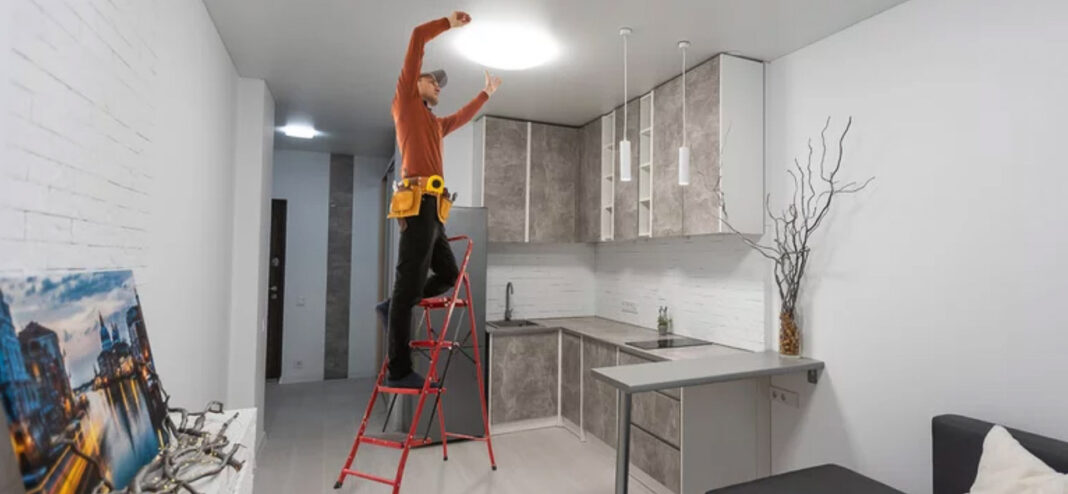
A flush-mount chandelier is a ceiling light fixture whose base is mounted flush against the ceiling. Thanks to this design, it can be used in rooms with low ceilings, eight feet (approximately 2.44 meters) or less. That’s why flush-mount chandeliers are typically installed in hallways, walk-in closets, or small bedrooms.
A good choice starts with a few quick measurements of the room. Among the models designed for low ceilings, the category designer flush-mount ceiling lights by Visual Comfort demonstrates how a slim profile can still retain authentic details. The sections below walk through each decision in the order a buyer encounters them.
Two Types of Mounting for Different Ceilings
A true flush-mounted chandelier typically hangs about 4 to 8 inches (10 to 20 centimeters) below the ceiling. A semi-flush-mounted chandelier is suspended from a short rod, which leaves a small gap above the shade. Through this gap, light spills onto the ceiling as well, giving the interior a softer glow.
Ceiling height determines the type. If the ceiling is 8 feet high, a true flush-mounted chandelier is better because it leaves enough headroom. With a 9-foot ceiling (approximately 2.74 meters), a semi-flush model may stand out more. An adult can easily walk under any of them.
The width of the light fixture depends on the size of the room
The width of a light fixture is the distance between its two farthest points. This determines how far the light reaches into the corners of the room. In larger rooms, it’s probably worth installing several surface-mounted light fixtures, evenly spaced across the ceiling.
In long hallways, you can install a row of smaller fixtures that evenly illuminate the entire length. The table below provides a rough estimate of suitable sizes for typical spaces.
| Space | Typical Area | Recommended Fixture Width |
|---|---|---|
| Walk-in closet or laundry room | Under 70 square feet (about 6.5 m²)( | 10 to 12 inches (25 to 30 cm) |
| Small bedroom or home office | 100 to 140 square feet (about 9 to 13 m²)+ | 13 to 16 inches (33 to 41 cm)+ |
| Master bedroom | 150 to 250 square feet (about 14 to 23 m²)+ | 18 to 24 inches (46 to 61 cm)+ |
| Kitchen | 150 square feet or more (approximately 14 m² or more) | 16 to 20 inches (41 to 51 cm) or two units |
| Hallway | Long and narrow shape | 10 to 14 inches (25 to 36 cm), one every 8 to 10 feet (2.4 to 3 m) |
Diffusers spread light evenly
A diffuser is the glass or fabric cover that sits over the light bulbs. Diffusers made of frosted glass, alabaster, or linen soften the light and spread it evenly. This is important in the bedroom, where people look up at the ceiling from their beds, and a frosted shade hides the bulb from this angle.
Clear or ribbed glass adds brightness and projects a distinct light pattern onto the ceiling. This style is well-suited for kitchens or entryways, where a bit of brightness is welcome. Some models use integrated LEDs, meaning the light source is built into the fixture as a permanent part of it.
Light intensity depends on the room’s purpose
Lumens measure the amount of light emitted by a bulb. A bedroom may need about 10 to 20 lumens per square foot. A kitchen may require about 30 to 40 lumens per square foot for clear task lighting on the countertop.
Multi-bulb wall sconces distribute light across two to four sockets. The homeowner can add up the lumens of each bulb to determine the total. A 150-square-foot bedroom, at 15 lumens per square foot, would need approximately 2,250 lumens. A dimmer then allows the same light fixture to provide both bright light for cleaning and soft evening lighting.
Spaces where surface-mounted chandeliers work well
Surface-mounted chandeliers are well-suited for spaces where people pass under the light fixture many times a day. They are also suitable for rooms where a discreet design allows the eye to focus on other elements. The list below includes some common examples:
- hallways where tall guests walk through;
- children’s rooms with bunk beds close to the ceiling;
- walk-in closets where clothes need bright light;
- laundry rooms with tall wall-mounted cabinets;
- bathrooms, where a fixture rated for damp locations can withstand steam.
A damp rating means the product is approved for rooms with steam or humidity, such as the bathroom. Homeowners can check for this designation on the product page before making any bathroom purchases. In walk-in closets, a closed-shade light fixture is required, mounted at a safe distance from the top shelf.
What the Electrical Code Requires in Bathrooms and Walk-In Closets
The recommendations above regarding bathrooms and walk-in closets have, in the United States, a precise counterpart in the National Electrical Code (NEC), the standard published by the National Fire Protection Association and adopted, in various editions, by most states and localities. For bathrooms, Article 410.10(D) defines a zone extending 3 feet (about 90 centimeters) horizontally and 8 feet (about 2.44 meters) vertically from the edge of the bathtub or the threshold of the shower. Within this zone, fixtures suspended by a chain, cable, or cord; pendants; track systems; and ceiling fans are prohibited.
Light fixtures installed above the bathtub or shower must be listed for damp locations, and if they can be reached by the shower spray, for wet locations, a higher level of protection than that mentioned in the text above. For an 8-foot ceiling, the practical implication is that a surface-mounted chandelier with the appropriate rating is suitable for installation above the shower stall, while the semi-recessed version, with its rod, should be carefully checked before purchase.
For walk-in closets, Article 410.16 defines the clothing storage area and specifies minimum distances between it and the light fixture. The distance is 12 inches (about 30 centimeters) for surface-mounted LED or incandescent fixtures with a fully enclosed light source, and 6 inches for recessed fixtures. The same section prohibits fixtures with open or partially enclosed bulbs in walk-in closets. The rule transforms the text’s general recommendation to install “an enclosed shade at a distance from the top shelf” into a verifiable requirement, and in a small walk-in closet with an 8-foot ceiling, it may rule out a model chosen solely for its appearance.
The adopted version of the code varies from one jurisdiction to another, and some localities add their own amendments. For a specific project, the final interpretation rests with the local inspector and the licensed electrician performing the installation.
How Light Changes the Perception of a Low-Ceilinged Room
The observation in the text that light cast onto the ceiling by a semi-recessed fixture creates a soft effect is backed by a tradition of research that began in the early 1970s. In 1973, John Flynn, Terry Spencer, Osyp Martyniuk, and Clyde Hendrick published a study in the Journal of the Illuminating Engineering Society. In that study, the same office room was illuminated in six different ways, and 96 observers evaluated it on semantic scales, choosing between pairs of opposing impressions. The results showed that impressions of visual clarity, spaciousness, relaxation, and intimacy varied consistently with the distribution of light.
Flynn described these differences in terms of several “modes” of light: overhead lighting, concentrated in the center of the room, versus peripheral lighting, directed toward the walls; uniform lighting versus non-uniform lighting, with brighter areas; and bright lighting versus dim lighting. One of the most frequently cited conclusions is that lighting the walls contributes to the impression of a more spacious room, and for a room with a low ceiling, this idea has direct practical application. A ceiling-mounted light fixture, no matter how well chosen, primarily illuminates the center of the room. Additional light directed toward the walls, from wall sconces or floor lamps, can make the room appear more spacious than a larger ceiling fixture does.
The framework has limitations that must be acknowledged. Flynn’s studies were conducted in office spaces with relatively small groups of participants, and their results have been replicated inconsistently; researchers such as Jennifer Veitch have drawn attention to the methodological difficulties of measuring subjective impressions. A 2020 study published by Ulrika Wänström Lindh, Monica Billger, and Myriam Aries in the SDAR Journal of Sustainable Design and Applied Research found a relationship between light on the walls and the perception of greater width. The same authors also observed a relationship between indirect light projected onto the ceiling and the perception of lower height. In other words, light cast onto the ceiling by a semi-recessed fixture can make the room more pleasant without necessarily making it appear taller, and this trade-off is worth considering in a room where height is already an issue.
Color Temperature and the Dimmer
The recommendation to use a dimmer, so that the same fixture can provide both task lighting and evening lighting, addresses an issue that has been studied for nearly a century. In 1941, Dutch physicist Arie Andries Kruithof, a researcher at Philips, published a diagram in the Philips Technical Review linking illuminance levels to the color temperature of light. According to the diagram, low light levels appear pleasant with warm, yellowish light sources, and high levels with cooler, bluish ones, while the opposite combinations appear either gloomy or artificial.
Kruithof’s diagram has been cited for decades, but its empirical basis is tenuous, and an analysis published in 2017 by Steve Fotios in the journal Leukos found that subsequent studies offer little support for its original form. A more modest practical observation remains valid: an LED that dims without changing color may appear cold at low intensity. For this reason, some modern fixtures use LEDs that get warmer as the light dims, mimicking the behavior of incandescent bulbs, and this feature is worth looking for in specifications for bedrooms.
The Ceiling Box and the Weight of the Fixture
A designer wall-mounted chandelier with an alabaster or thick glass shade may weigh more than it appears in the photo. The National Electrical Code addresses this issue as well. The ceiling junction box to which the fixture is mounted must be designed to support it, and for fixtures heavier than 50 pounds (about 23 kilograms), a box listed and rated for that weight or an independent support is required.
For most surface-mounted chandeliers, the weight remains well below this threshold, but older homes sometimes have makeshift boxes or boxes secured only to drywall. Having the electrician who installs the fixture check the box before installation prevents a situation where an expensive model is mounted on a support that wasn’t designed for it.
Where to Find Suppliers and Installers
Choosing the light fixture is only half the job; the other half is the installation. Replacing a chandelier involves working on the home’s electrical circuit, and in many jurisdictions, work of this kind must be performed or inspected by a licensed electrician, especially in bathrooms, where the above rules apply directly. An electrician’s license can be verified in the registry of the issuing authority, usually the state licensing board or department.
To find suppliers, the residential lighting category in the Jasmine Directory brings together suppliers, installers, designers, and specialty stores, all of which have been editorially reviewed. A homeowner planning to renovate a kitchen or an attic can thus go from a vague idea to a shortlist of suitable companies. The broader category of home renovations and improvements groups trades by specialty, from electricians to companies that remodel kitchens.
The limitations of a listing should be stated clearly. It confirms that the company exists, operates in the stated field, and can be contacted using the published contact information. It does not verify an electrician’s license, does not confirm a product’s rating for wet areas, and does not constitute a recommendation; for licensing, the authoritative source remains the licensing authority’s registry.
What to Check on the Product Page Before Ordering
A lighting product page usually contains more information than is typically read. It’s worth checking, in order: the total height of the fixture, that is, how far it extends below the ceiling, the maximum width, the type and number of sockets, the luminous flux (in lumens) of the integrated LED, compatibility with dimmers, and the rating for damp or wet locations. In the case of integrated LEDs, which cannot be replaced individually, it’s also important to check the stated lifespan, because once it ends, the entire light fixture must be replaced.
For walk-in closets, where the text calls for bright light on clothing, another parameter matters: the color rendering index (CRI), which indicates how faithfully the light source renders the colors of objects on a scale up to 100. A value of 90 or higher helps distinguish between similar shades, for example, navy blue versus black, and the difference is particularly noticeable in small spaces lit by a single ceiling fixture.

A certification mark from a recognized testing laboratory, such as UL or ETL in the United States, indicates that the product has been tested for electrical safety, and electrical codes generally require that installed equipment be listed. For online purchases, especially on platforms with third-party sellers, the absence of this certification in the product description is reason enough to ask an additional question before placing an order.
The finish ties the light fixture to the rest of the room
The metal trim of a wall-mounted chandelier harmonizes with the finishes in the rest of the room. Patinated brass pairs well with wooden doors or warm tones. Polished nickel is suitable for a bathroom with chrome faucets. Matte black highlights a white ceiling.
Traditional styles may call for a fixture with a beaded edge or a fluted glass shade. Contemporary interiors can benefit from a flat disc with a very thin metal frame. The same light fixture can be used multiple times in a hallway to create a clean, unified style.
Choosing the right surface-mounted chandelier starts with measuring the ceiling height, which determines the appropriate width and finish of the light fixture. Models can be selected from Visual Comfort’s dedicated collection of designer surface-mounted chandeliers. By knowing the ceiling height and the room’s area, the buyer can choose the light fixture best suited for that interior.
Bibliography
- National Fire Protection Association. NFPA 70, National Electrical Code, Article 410: Luminaires, Lampholders, and Lamps, Sections 410.10(D) and 410.16.
- Flynn, J. E., Spencer, T. J., Martyniuk, O., and Hendrick, C. (1973). Interim Study of Procedures for Investigating the Effect of Light on Impression and Behavior. Journal of the Illuminating Engineering Society, 3(1), 87.
- Flynn, J. E. (1977). A Study of Subjective Responses to Low Energy and Nonuniform Lighting Systems. Lighting Design and Application, 7(2), 6.
- Kruithof, A. A. (1941). Tubular Luminescence Lamps for General Illumination. Philips Technical Review, 6(3), 65–73.
- Fotios, S. (2017). A Revised Kruithof Graph Based on Empirical Data. Leukos, 13(1), 3–17.
- Wänström Lindh, U., Billger, M., and Aries, M. (2020). Experience of Spaciousness and Enclosure: Distribution of Light in Spatial Complexity. SDAR Journal of Sustainable Design and Applied Research, 8(1), Article 5.
