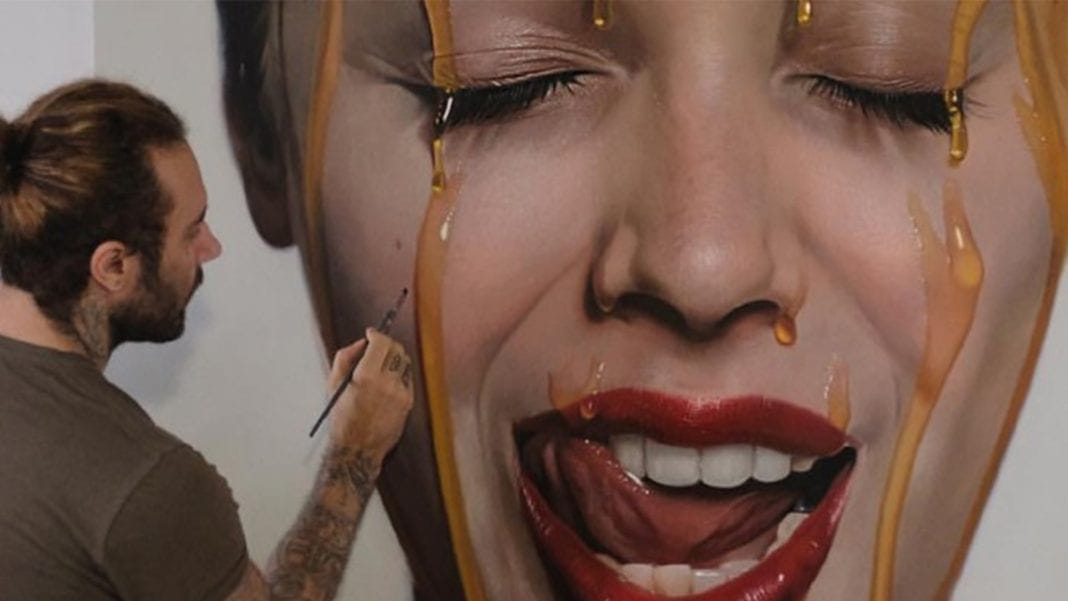
Art is one of the most intense modes of individual expression we have. It can cross cultural boundaries and explore the physical and the metaphysical, the real and the imaginary. Many movements have emerged and shaped artists over the centuries, and Hyperrealism is one that has drawn a large following in recent years. To understand it, you have to follow a line that runs back through Photorealism and, further still, to the Realism that changed European painting in the middle of the nineteenth century.
Hyperrealism is a fairly new style of visual art that developed from the late 1960s onward. Its roots reach back to the Realism movement that began in post-revolutionary France in the mid-19th century.
How Realism broke with Romanticism
Realism was a reaction against Romanticism, which had dominated art and literature. The Realists wanted to move away from the Romanticist habit of idealising, exaggerating and dramatising the world, and instead to depict scenes as they actually were. That produced a style in which artists tried to represent the world as truthfully as possible. The focus turned to ordinary people doing ordinary things in ordinary surroundings. Artists like Jean-Francois Millet, Gustave Courbet, Jean-Baptiste-Camille Corot and Honore Daumier made lasting contributions to this genre.
The interest in the everyday was, in its own way, radical. Painting a laundress or a farm labourer with the same care once reserved for gods and generals reset what art was allowed to be about. That instinct, that unglamorous reality deserves close attention, is the thread that later movements would pick up and pull much tighter.
Whose lives count as worth painting is still a live question, one that shapes the work of artists of African descent like Lubaina Himid and Kerry James Marshall.
From Realism to Photorealism
Advances in photography during the twentieth century opened new possibilities. Inspired by the Realists and surrounded by an abundance of photographs to work from, Photorealists set out to reach the highest levels of precision and detail in their depiction of reality. Photorealism became a full movement in the 1960s, positioned against the Abstract Expressionism and Minimalist styles then popular in the United States.
As the name suggests, Photorealists use one or several photographs to gather information and produce scenes so detailed that they create the illusion of seeing the real thing. Such paintings include photographic elements like flash reflections, depth of field, and even objects left slightly out of focus. Subjects ranged from household and pop-culture objects to portraits and urban settings, and the results replicated photographs with striking precision. The movement was heavily criticised in the 1960s and 1970s, however, because its reliance on photographs struck some observers as cheating.
That charge is worth pausing on, because it recurs whenever a new tool changes how art gets made. A camera does part of the compositional work, so the argument went, the painter is merely tracing. Photorealists answered that choosing the source image, the crop, the scale, and the surface is itself the artistic act. The debate never fully closed, and it set the terms for what came next.
The origin of Hyperrealism
The term Hyperrealism dates to 1973, when Isy Brachot, a leading Belgian art dealer, organised a major exhibition and catalogue at his gallery in Brussels and named it L’hyperrealisme. The exhibition featured works from American Photorealists such as Ralph Goings, Chuck Close, Don Eddy and Robert Bechtle. Since then the term has been used for work influenced by Photorealism.
So how does Hyperrealism differ from Photorealism? It is an offshoot that pushed a step further. Where Photorealists aimed to reproduce an exact copy of the photograph they used as source material, Hyperrealists treat the source as inspiration and add extra narrative and emotion that a plain photograph sculpture that Photorealistic works lacked. As technology improved, photographic images became far more detailed, and so did the artworks. High-resolution pictures let Hyperrealists build a simulated reality by studying the surfaces, textures, lighting and shadows in their source photos, producing pieces that read as three-dimensional and tangible. The style is built around a convincing illusion, and many Hyperrealist works also carry a broader theme open to social, cultural, emotional or political reading.
Notable Hyperrealist artists who helped shape the genre include Denis Peterson, Audrey Flack, Chuck Close and Ron Mueck. Many others around the world, among them Sergey Piskunov, Jason de Graaf, Pedro Campos and Steve Mills, have mastered this demanding form.
Finding and buying the work today
Despite being only a few decades old, Hyperrealism has captured global attention and become a widely followed style. The internet has made both learning and collecting far easier. Several instructional books on the technique are sold through stores like Amazon Australia and eBay, and online marketplaces such as Etsy carry Hyperrealist art for sale.
The harder part, for a buyer or a curious newcomer, is not access but judgement. When you can see thousands of images in an afternoon, deciding what is genuinely accomplished, and who actually made it, becomes the real work. This is where structure helps. The classic reference on organising websites, Louis Rosenfeld, Peter Morville and Jorge Arango’s Information Architecture: For the Web and Beyond (2015), argues that how information is labelled and categorised determines whether people can find it at all, and treats browsing curated categories and searching as complementary ways to locate what you need. A well-kept category of galleries or artists does something a search box cannot: it applies a human decision about what belongs.
Trust matters just as much as findability. When you buy from an independent seller you have probably never heard of, you lean on the signals other people leave behind. Robert B. Cialdini’s principle of social proof, laid out in Influence, New and Expanded (2021), holds that people work out what is correct by finding out what others think is correct, which is exactly the mechanism behind ratings and reviews. A verified profile, a track record, and a listing in a place that vets its entries all reduce the risk of paying for something that turns out to be a print, a copy, or nothing at all.
None of that changes what makes the art compelling. The strongest thing about Hyperrealism is that anyone, trained or whether well-informed about art forms or not, can respond to it and be astonished by the illusion. If you want to move from admiring the work to owning a piece, start by narrowing the field to sellers and artists you can actually verify, then look closely at the surfaces and shadows in the images. That is where the real skill, and the real value, tends to show.
