Selecting the right industrial processing equipment for powder uniformity
The quality of a great many products depends on one process: precise powder blending. Pharmaceuticals, food, construction materials, and advanced chemicals all need a uniform mix of dry ingredients, and in each case that uniformity determines whether the product performs, whether it performs the same way twice, and whether it is safe. The equipment that does this work is the dry blend mixer.
Selecting, operating, and maintaining these machines involves real complexity. In pharmaceutical applications, uniform distribution of active ingredients is a requirement rather than a target, which makes reliable Industrial dry blend mixers a core piece of process equipment.
The choice of dry blend mixer affects product quality, operational efficiency, and cost. Which machine suits a given plant depends on the characteristics of the materials being blended, the batch size, and industry requirements such as GMP compliance or SS316L stainless steel construction.
| Mixer type | Mixing mechanism | Key advantages | Primary limitations | Ideal applications |
| Tumble blenders | Diffusion (gentle tumbling) | Low shear, high uniformity for free-flowing powders | Longer blend times, less effective for cohesive materials | Pharmaceuticals, nutraceuticals, delicate materials, trace ingredients |
| Conical screw | Orbital screw (lifting and cascading) | Gentle, effective for segregative and cohesive powders | Can be slower for very large batches, vertical footprint | Fine powders, pigments, sensitive materials, liquid injection |
| Rotary drum | Free-fall (lifting and folding) | High capacity, rapid blending, gentle handling | Not suitable for very fine, dusty powders | Large volumes, friable snacks, plastic pellets, construction materials |
| Air blenders | Pulsed compressed air | Extremely fast, no moving parts, handles abrasives | Requires specific silo design, air consumption | Large batches, abrasive materials, cement, glass batch, high-volume blending |
The table compares the four families at a high level. Each has strengths that only become clear when matched against a specific material, and for processes under stringent quality control, such as pharmaceutical powder blending, the equipment choice carries directly into product efficacy and safety.
Tumble blenders and the physics of diffusion
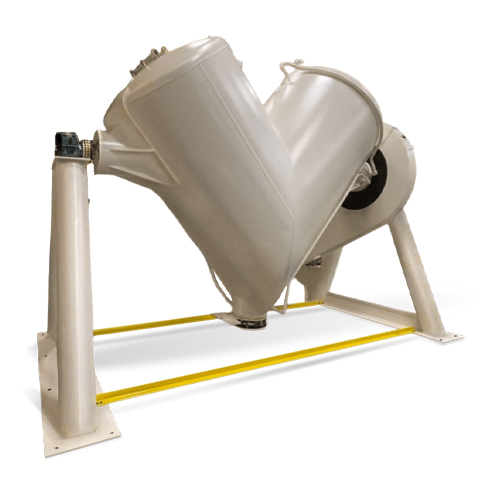
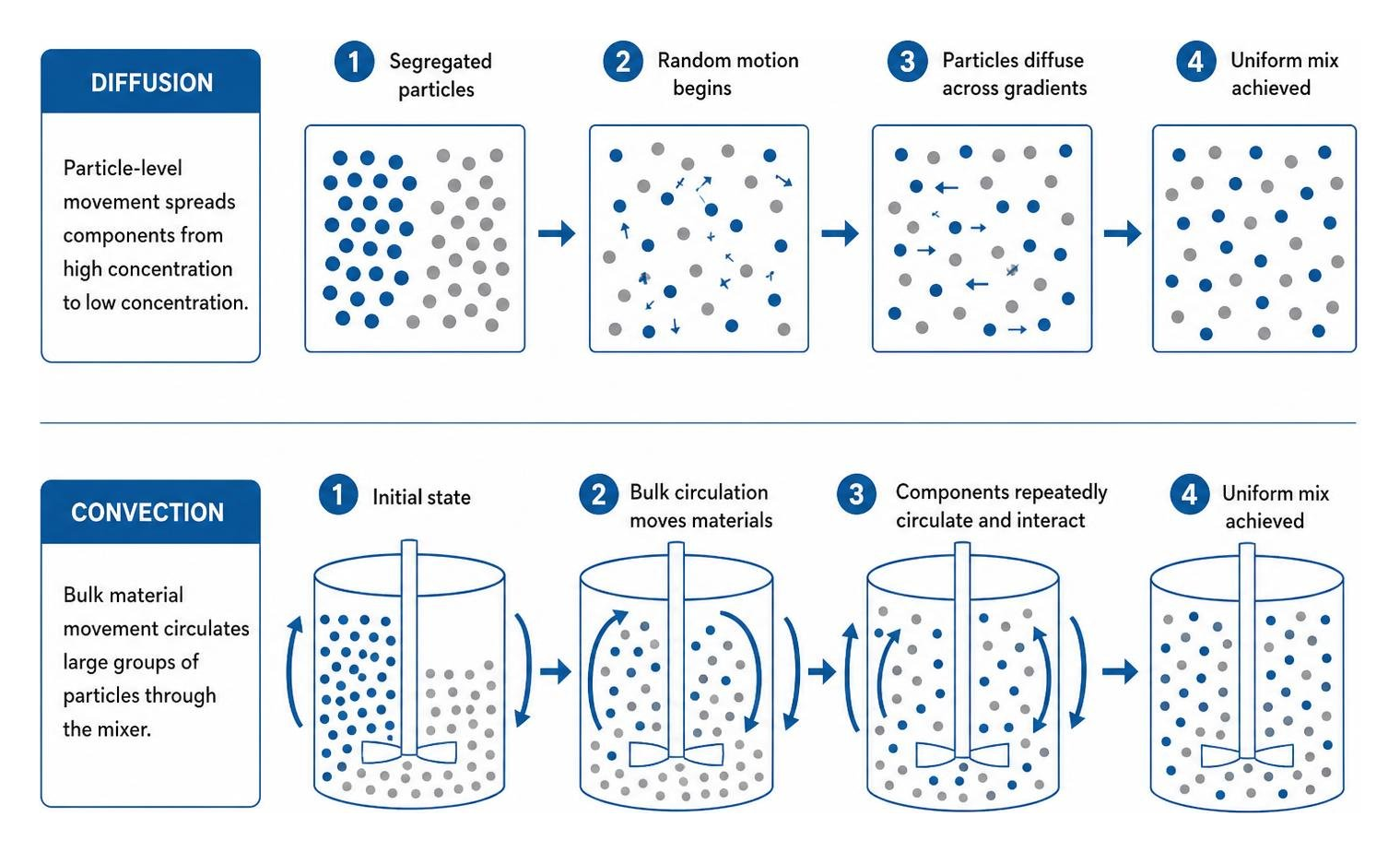
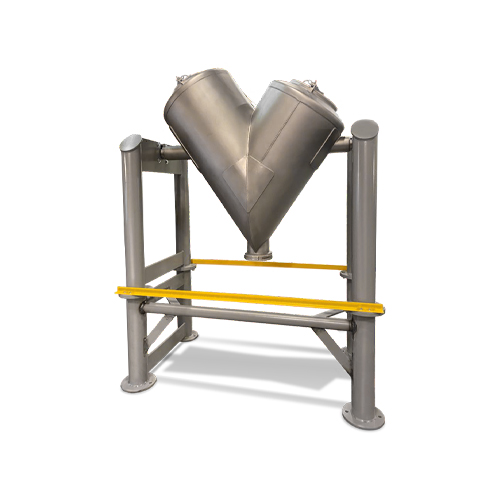
Tumble blenders, including V-blenders and double cone blenders, mix gently, which is why they suit delicate or shear-sensitive materials. They work by diffusion mixing: material is repeatedly split, recombined, and tumbled as the vessel rotates, producing random particle movement and highly uniform blends, with manufacturers commonly reporting above 99 percent uniformity in 5 to 15 minutes.
A V-blender’s chamber uses asymmetric barrel lengths to create lateral forces, so material exchanges thoroughly with each rotation. Gentle as they are, these mixers can take optional intensifier bars. These high-speed rotating shafts, fitted with paddles or blades, apply localized shear to break up agglomerates or disperse liquids evenly during liquid injection. That extends the range of applications a tumble blender can cover while keeping its low-impact blending action.
Conical screw mixers for low-shear applications
Conical screw mixers take a different approach in a vertical format. A cantilevered screw agitator rotates on its own axis while orbiting the perimeter of a cone-shaped vessel. The orbital arm lifts material from the bottom of the cone and lets it cascade back down, which sets up a continuous recirculation loop.
Low shear and low intensity suit segregative powders and materials prone to compaction. The design keeps particle attrition down and stops material building up, so residue is minimal and cleaning is easier. A cantilevered design has no bottom bearing, which simplifies sanitation further and suits hygiene-critical applications. These mixers handle a wide range of volumes and material characteristics, including fine granular sugar with pigments, where homogenization takes a few minutes.
Rotary drum mixers for high-volume processing
Where capacity and speed matter most, rotary drum mixers are worth examining. A rotating drum lifts material on internal flights or through the vessel geometry, and the material tumbles and folds onto itself. The action is gentle and effective even on large batches. Continental Products Corporation, which manufactures the Rollo-Mixer line, markets this as Free-Fall Processing, and both names are that company’s registered trademarks.
Rotary drum mixers handle friable ingredients such as snack foods, dried fruit, and nuts without breaking them. Continental states that its Mk X model can uniformly blend fragile cracker bits, dried fruit, and cashews in 80 seconds, and that some models discharge 2,000 pounds in around 8 seconds. Those are manufacturer figures for one product line rather than independently verified benchmarks for the category, and they should be read as such. What generalizes is the mechanism: drum designs move large masses of dissimilar particles quickly with very little shear.
Optimizing performance and sanitation
The mixing mechanism sets what a machine can do. Everything else about its efficiency and reliability comes from the features around it and from how consistently the plant cleans and maintains it. Modern dry blend mixers carry functions that improve precision, contain dust, and shorten cleaning.
Advanced features for precision and dust control
Integrated load cells give continuous, real-time weight control, which supports formulation accuracy and automated progressive dosing. Rather than dumping all materials at once, progressive dosing introduces ingredients in small controlled sequences, so blending starts during filling. That improves homogeneity and cuts total processing time.
Dust control matters with fine powders and in areas with strict air quality requirements. Retractable seals on loading and discharge ports keep batch cycles dust free, which protects both personnel and product. Vacuum capability is increasingly common and covers precise material transfer as well as vacuum drying, degassing, and solvent recovery, which heat-sensitive materials and moisture-specified products often need. Automated control panels handle mixing parameters, and integrated de-lumpers break down agglomerates that form during the cycle.
Streamlining sanitation and maintenance protocols
Hygiene requirements dominate in pharmaceuticals and food processing. Industrial dry blend mixers built for these sectors use washdown motors and sanitary finishes, typically highly polished SS304 or SS316L stainless steel, which resist corrosion and clean thoroughly. Clean-in-Place systems with positioned CIP nozzles run automated internal cleaning without disassembly, cutting downtime and labor. Manufacturers of some high-purity units report rinse, clean, and dry cycles completed inside 15 minutes.
Maintenance decides how long that performance lasts. Gear reducers and other mechanical components need regular lubrication, and belts, gears, and electrical components need inspection on the schedule the manufacturer specifies. Regulated industries also need validation procedures demonstrating that cleaning and blending consistently meet the required standards, which is what keeps the equipment defensible during an inspection rather than merely working.
What the comparison table cannot tell you
Four rows, five columns, and a purchase decision worth six figures. The table earlier in this article is a good first filter and it cannot be a decision procedure, for a reason that runs deeper than any table.
Walter Vincenti spent his career as an aeronautical engineer at Stanford before writing a book in 1990 about how engineers actually come to know things. What Engineers Know and How They Know It argues against the assumption that engineering is applied science. Technology, he wrote, may apply science but is not the same as, or entirely, applied science. Engineering generates knowledge of its own, and one of the ways it does so he named parameter variation: varying design parameters systematically through experiment so as to produce data that no available theory can supply. His case study was propeller testing at Stanford between 1916 and 1926, where Durand and Lesley built and ran dozens of propellers because the aerodynamics of the day could not predict which would perform best.
Powder behavior sits in that position now. Nobody can compute from first principles whether a particular cohesive powder, at a particular particle size distribution and a particular moisture content, will blend well in a V-blender. Discrete element modelling has improved a great deal and remains nowhere near a substitute for running the material. Which means the honest answer to the question of which mixer is a trial with your own powder, and the useful question to ask a supplier is not what their brochure claims but whether they operate a test lab and will run your material in it.
There is a commercial reading of this too. If the decisive knowledge comes from running the material rather than from theory, then a supplier who has run thousands of trials holds something a competitor cannot copy from a catalogue, and a buyer who skips the trial is discarding the most valuable thing on offer.
The frame has limits worth naming. Vincenti drew all five of his case studies from United States aeronautics between 1908 and 1953, a well-funded field with unusually good test infrastructure and a strong culture of publishing results, so extending the picture to a mid-size powder plant is an extrapolation rather than a deduction. He also restricted himself deliberately to design engineering, and said the framework would need extending before it covered production and operation.
Ninety-nine percent uniformity is a measurement, not a property
The figure quoted earlier arrives without saying how it was obtained, which is normal in equipment literature and unusually consequential in this particular field.
The regulatory history is worth knowing. The FDA published a draft guidance on blend uniformity analysis for abbreviated new drug applications in August 1999. Industry objected, the Product Quality Research Institute convened a Blend Uniformity Working Group in February 2000, and that group submitted an alternative approach to the agency at the end of 2002. A further FDA draft followed in October 2003, covering stratified in-process sampling of powder blends and finished dosage units, and the agency later withdrew it. Among the stated reasons were doubts about the adequacy of current blend sampling techniques, about whether the available test methods were appropriate for assessing blend uniformity at all, and a lack of confidence that passing the USP uniformity of dosage units test on its own demonstrates that a batch is uniform.
A regulator withdrew a guidance partly because the industry could not establish that it knew how to take a representative sample from a powder blend. That is the context any uniformity percentage sits in.
The mechanism behind the doubt is straightforward. A sample thief pushed into a static powder bed disturbs the bed as it enters and preferentially collects some particles over others, so the number that comes back from the laboratory is a combination of blend variance, sampling variance, and analytical variance. Attribute all of it to the mixer and you may be grading the thief. The ISPE Blend Uniformity and Content Uniformity group, convened in 2013, published recommendations in the Journal of Pharmaceutical Innovation in 2015 that use ASTM E2709 and E2810 to set acceptance criteria, and their central methodological insistence is variance component analysis: separate the sources before assigning the result to any one of them.
So a uniformity figure quoted without a sample mass, a sample count, sample locations, and a variance decomposition is not a property of the machine. None of which argues that manufacturers are overstating anything. It argues for specifying the test before the trial instead of interpreting it afterwards.
What to write into a trial protocol
Six things are worth agreeing in writing before booking a test-lab slot, and none of them is exotic or expensive:
- The material. Your powder, from your supplier, at your moisture content, rather than a surrogate with similar bulk density. Cohesion changes with humidity and between lots, and a surrogate that flows better than the real thing will flatter any machine.
- The worst case. Trials tend to run the easy formulation. Specify the one with the largest particle size disparity, the lowest-inclusion additive, and the most cohesive excipient in the portfolio.
- The sampling plan. Number of locations, mass per sample, whether sampling is by thief or from the discharge stream, and who physically takes the samples.
- The acceptance criterion, written as a relative standard deviation at a stated sample mass, agreed before the run rather than negotiated after it.
- What happens after the mixer. Sample the discharge, and if a transfer step follows in the real process, sample after that too. Blends come apart in chutes and totes.
- Who owns the data, and whether the raw analytical results travel with the report.
This converts a demonstration into an experiment. A supplier confident in the machine will agree to all six without hesitating, and the reaction itself is informative. A test lab that declines to sample the discharge, or that wants to supply the powder, is telling you something about what its own results normally measure.
It is also worth asking what happens if the trial fails. A vendor who has run a few hundred of these will usually be able to say, from the failure mode alone, whether the answer is a different agitator, a longer cycle, a pre-blend step for the low-inclusion additive, or a different family of machine altogether. That diagnostic ability is the thing being bought alongside the steel, and it is not visible anywhere on a specification sheet. It shows up only in how a supplier reacts when their own equipment does not work first time.
Categories that do not match the decision
The table sorts equipment by mixing mechanism, which is the right axis for an engineer and the wrong one for somebody at the start of a search. Buyers do not arrive knowing they need diffusion rather than convection. They arrive knowing their tablets are failing content uniformity, or that a premix segregates in the tote between blending and filling, or that a new formulation refuses to behave like the old one.
The vocabulary in between is wide and inconsistent. Tumble blender, V-blender, twin-shell, double cone, bin blender, conical screw, Nauta, ribbon, paddle, plough, rotary drum, air blender. Some of those are the same machine under different names, some are genuinely different machines, and a search engine will present them as interchangeable because it has no way of knowing otherwise. The specialists who solve the underlying problem sit somewhere else again: powder characterization laboratories, segregation testing services, and contract blenders who will run the batch so that nobody has to buy a machine at all. This is a market where capability and certification carry more weight than star ratings, which is why curated and industry-specific listings have held their ground in manufacturing while review platforms took over consumer categories.
What a listing settles in a regulated supply chain
A listing confirms five things, and none of them is quality. That a manufacturer exists. That it builds this class of equipment rather than an adjacent one. That a certification it advertises can be traced back to the body that issued it. That somebody answers the number published. And that it can be found again in ten years when a seal or a drive needs replacing. Category pages covering pharmaceutical research and manufacturing alongside the standards that govern them are useful for building a shortlist precisely because they sit next to the regulatory context rather than pretending to replace it.
In a GMP supply chain the limits are sharper than usual. No directory has audited anyone’s quality system, witnessed an installation qualification, or read a cleaning validation report. What actually governs the decision is your own supplier qualification and audit, the equipment qualification protocols you run on site, and the validated cleaning procedure that follows. A listing shortens the path to a shortlist and stops there. The audit, the trial, and the validation are yours, and they are the parts that carry the risk.
Maximizing efficiency across applications
Dry blend mixers work across a wide range of industries, each with its own material characteristics and regulatory demands. The precision required in pharmaceuticals and the bulk handling of construction materials sit at opposite ends of that range, and machines are engineered accordingly.
High-purity processing in regulated industries
In pharmaceuticals, food, and nutraceuticals the requirements are strictest. Dry blend mixers here combine active pharmaceutical ingredients with excipients, produce food-grade powders, or formulate nutraceutical premixes. The governing concerns are homogeneity, prevention of cross-contamination, and compliance with regulations such as Good Manufacturing Practices.
Mixers for these applications are built in stainless steel, often SS316L, with highly polished internal surfaces and geometry that minimizes retention areas and allows complete discharge. Blending trace ingredients, sometimes in microgram quantities, uniformly into hundreds of pounds of material is a demanding test of any design. Continental Products reports batch-to-batch uniformity with 80 ingredients, including minute quantities of vitamins, in its Mk VIII unit, which illustrates what the class is capable of when the sampling and validation work behind it is done properly.
Heavy-duty blending for industrial materials
Away from high-purity work, dry blend mixers handle metal powders, plastic pellets, ceramic refractories, and abrasive solids. These materials bring high bulk density, abrasive wear, or awkward flow characteristics.
Equipment for them is built heavily, from thick carbon steel or specialized alloys, to survive the wear. Air blenders suit large batches of abrasive materials such as cement grouts, because pulsed compressed air replaces the mechanical agitator and removes the wearing parts entirely. Rotary drum mixers suit plastic pellets and construction materials and move very large batches quickly. Selecting for these materials means weighing construction, power requirements, and whether the machine can handle the material’s specific behavior without degrading it or wearing out early. For a tailored assessment of a specific heavy-duty blending application, request a custom quotation.
