The Workplace Safety Gap Most Small Business Owners Miss
If you run a small business, you already wear every hat. Owner, manager, bookkeeper, recruiter, sometimes the person who fixes the printer. Workplace safety tends to land on that same pile, somewhere between payroll and the next marketing push. It’s easy to assume it’s covered because nothing has gone wrong yet. But in Ontario, first aid coverage isn’t just good practice. For most employers, it’s a legal requirement. The good news is that corporate first aid training doesn’t have to mean closing for a day or sending staff across town, and it closes a gap many owners don’t realize they have.
What Does Ontario Actually Require?
Ontario employers covered by the WSIB follow Regulation 1101. The rules scale with the number of workers on each shift:
- 1 to 5 workers per shift: at least one worker with Basic First Aid (formerly Emergency First Aid)
- 6 or more workers per shift: at least one worker with Intermediate First Aid (formerly Standard First Aid)
- 200 or more workers per shift: a first aid room with a qualified attendant
Certificates are valid for three years. On 22 June 2026, the WSIB aligned its First Aid Program with the national standard CSA Z1210:24. The course names changed, but the thresholds and validity did not.
That’s the core of it. The challenge isn’t understanding the rule. It’s keeping up with it as your business changes.
Where Do Small Businesses Usually Fall Short?
Most owners don’t ignore first aid on purpose. The gaps creep in quietly:
- The one trained person leaves. Your only certified employee takes a new job, and nobody notices that coverage left with them.
- Shifts change. The rule counts workers per shift, not total headcount. Your trained person works mornings, but your busiest shift is evenings.
- Seasonal hiring pushes you over six. A holiday rush or summer season can move a shift from five workers to eight, which changes the level of training you need.
- Certificates quietly expire. Three years goes by faster than you think.
- Nobody knows where anything is. The first aid kit is buried in a storage room, and no one can say whether the building has an AED.
None of these are dramatic. All of them are easy to fix once you spot them.
What About Customers and Visitors?
If your business serves the public, an emergency might not involve an employee at all. A customer faints in line. A client has an allergic reaction in your waiting room. A delivery driver slips on the steps outside.
In those moments, your staff are the first people on scene. Customers don’t wait to find out whose job it is. They look to whoever is wearing the name tag.
That’s a big reason many retail shops, restaurants, clinics, salons and gyms train more staff than the minimum. It protects people, and it protects your reputation.
How Should You Handle New Hires?
Onboarding is the easiest place to build first aid into your routine. A few simple habits help:
- Ask about certifications during hiring. A candidate who already holds a valid certificate can help cover a shift right away.
- Show every new hire where the kit and AED are on their first day.
- Tell them who the trained first aiders are on each shift.
- Make sure they know your address. In an emergency, the 911 dispatcher needs an exact location, and new staff often don’t know it by heart.
It takes five minutes. It can save far more than that.
Why Does It Matter Beyond Compliance?
Compliance keeps you on the right side of the rules. The bigger reason is what happens in the first few minutes of a real emergency.
The Heart and Stroke Foundation of Canada estimates that about 60,000 cardiac arrests happen outside of hospital in Canada each year, and only about 1 in 10 people survives. Survival rates can double when someone acts fast, performs CPR and uses an AED.
In a small business, “someone” is one of your people. Training makes sure they’re ready.
Why Does On-Site Group Training Suit Small Teams?
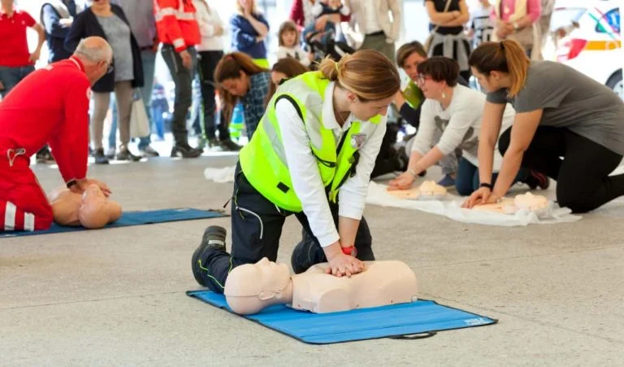
Sending staff out one at a time is hard to schedule and even harder to cover. Group training brings the course to you:
- Your whole team learns together, which builds confidence as a group
- You practise in your own space, so everyone knows exactly where the kit and AED are
- Scheduling is easier, because you pick a time that fits your business
- Everyone hears the same plan, from managers to part-time staff
Blended options help too. Staff complete the theory online at their own pace, then attend a shorter hands-on session with an instructor. Less time off the floor makes it easier to keep your business running while your team gets certified.
What Does a Simple First Aid Checklist Look Like?
If you only do a few things this quarter, make it these:
- Count your workers on every shift, including your busiest one.
- Confirm you have the right level of trained first aider on each shift.
- Write down every certificate’s expiry date and set reminders.
- Check that your first aid kit is stocked and easy to find.
- Find out whether your building has an AED, and where it is.
That’s it. An hour of planning closes most of the gaps small businesses face.
Where Can Oakville Businesses Find Training?
If you are looking for corporate first aid training near South Service Road East, the QEW corridor, or surrounding areas in Oakville, you may reach out to Coast2Coast First Aid & Aquatics in that area. You can also view the CPR course schedule and plan training around your team’s shifts.
FAQS
Q: Do small businesses in Ontario need a trained first aider?
A: Most do. Under WSIB Regulation 1101, a shift with 1 to 5 workers needs at least one worker with Basic First Aid, and a shift with 6 or more workers needs at least one worker with Intermediate First Aid.
Q: Does WSIB count total employees or workers per shift?
A: The rule is based on workers per shift. A business with a large total headcount but small shifts, or with seasonal spikes, needs to plan coverage for each shift it actually runs.
Q: What changed with Ontario first aid rules in June 2026?
A: On 22 June 2026, the WSIB aligned its First Aid Program with CSA Z1210:24. Emergency First Aid became Basic First Aid and Standard First Aid became Intermediate First Aid. The thresholds and three-year validity stayed the same.
Q: How long is a workplace first aid certificate valid in Ontario?
A: Workplace first aid certificates are valid for three years. Tracking expiry dates and setting reminders helps keep coverage WSIB-compliant.
Q: Is on-site group training a good option for small teams?
A: Yes. On-site training lets your whole team learn together in your own space, so everyone knows where the kit and AED are, and it’s easier to schedule around your business hours.
