
Key takeaways
- Learn how ETFs and mutual funds actually differ in structure, not just in name.
- Match your choice to your financial goals and your tolerance for risk before you buy.
- Watch the fees, tax treatment, and trading rules attached to each type, because they compound over time.
Introduction to ETFs and mutual funds
Exchange-Traded Funds (ETFs) and mutual funds are a common starting point for both new and experienced investors. Both let you spread money across many holdings, hand day-to-day decisions to professional managers, and shape your own balance of risk and reward. Each type has its own structure, costs, and mechanics, and those details can change your results more than most people expect. Before you commit, compare ETFs vs mutual funds to see which one fits your goals and habits.
Good decisions start with knowing how these funds behave in real markets. ETFs trade like stocks and usually carry lower expense ratios. Mutual funds pool money for broad diversification and often come with active management. The way each one handles trading, fees, and taxes will shape both your portfolio growth and your day-to-day experience as an investor.
You can buy both through brokers and financial institutions, and the menu runs to thousands of options, from broad market index trackers to narrow, specialized strategies. That range gives you room to build almost any plan, but it also raises the cost of a careless choice. When there are that many funds competing for your attention, being findable is only the first step. You still have to evaluate what sits underneath the label.
Your own situation matters as much as the product. Think about your timeline, your income needs, and how you react when markets fall. The right vehicle should suit the way you want to invest, whether that is hands-off growth, active management, or the freedom to trade during the day.
Investors with more complex needs often hand that decision to a professional, and the newer approaches in wealth management pair established strategies with technology-driven ones rather than replacing one with the other.
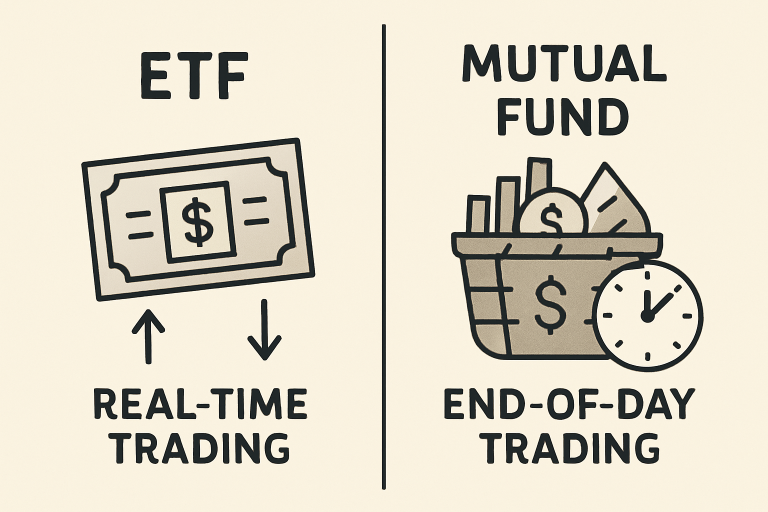
Key differences between ETFs and mutual funds
- Trading flexibility. ETFs can be bought and sold like stocks throughout the trading day, so you can respond to price moves in real time. Mutual funds trade only once a day, after the close, at that day’s net asset value (NAV).
- Cost structure. ETFs generally carry lower expense ratios than mutual funds, a result of their passive style and operational efficiencies. Mutual funds may charge sales loads or set high minimum investments, both rare with ETFs.
- Tax efficiency. Because of how they are built, ETFs usually generate fewer taxable capital gains distributions, which helps investors keep more of their returns. Mutual funds often distribute capital gains once a year, and that can hand you a tax bill even in a year when you never sold a single share.
Assessing your investment goals and risk tolerance
Before you allocate a dollar, step back and look at what you actually want the money to do. Are you saving for retirement, funding a large purchase, or trying to produce current income? And how do you handle a downturn? Some people can ride out volatility without a second thought. Others lose sleep over it.
Your answers define your time horizon and the amount of risk you can live with. ETFs tend to suit investors who prize low costs and the ability to trade during the day. Mutual funds often appeal to people who want a professionally managed, set-it-and-forget-it approach they rarely have to touch.
Understanding fees and expenses
Expenses have a large effect on long-term results. ETFs usually charge lower annual expense ratios than mutual funds, but they carry their own trading costs, including brokerage commissions and bid-ask spreads. Mutual funds may levy front-end or back-end sales loads and can require larger minimum investments.
According to a report by the Associated Press, the average expense ratio for stock mutual funds fell to 0.42% in 2023, while stock ETFs dropped to 0.15%. Those declines track a broad move toward index investing and the scale of the largest funds, which pushes costs lower still. Small annual differences look trivial on paper. Compounded across a couple of decades, they can quietly subtract a meaningful chunk from your final balance, so treat the expense ratio as a real number, not a footnote.
Tax considerations
One of the sharpest contrasts between the two is how they create taxable events. ETFs, thanks to their structure and in-kind redemptions, generally pass through fewer capital gains distributions.
That gives them a tax edge over mutual funds, which may realize and distribute capital gains through rebalancing or when other shareholders redeem, producing a tax bill whether or not you sold anything yourself. If you hold funds in a large taxable account, weigh this carefully. Over time it can matter as much as the expense ratio.
How to research a fund before you buy
Both ETFs and mutual funds publish their holdings, and reading them is one of the cheapest forms of protection you have. Two funds with similar names can hold very different assets, and a strong recent chart tells you nothing about what the fund actually owns today. Check the top holdings, the sector weightings, and the concentration in any single position.
Reputation and independent information carry weight here, the same way they do when people shop for any service online. Rachel Botsman, in “Who Can You Trust?” (2017), describes a shift from trust rooted in local relationships to trust rooted in institutions and then to distributed trust, where ratings, reviews, and platform reputation let strangers extend confidence to businesses they have never dealt with directly. The same instinct applies to a fund provider and the broker you use to reach it. Curated listings, verified track records, and independent ratings help you separate a durable option from one dressed up to look good this quarter. Spend a little time confirming that the fund, the manager, and the platform behind them are what they claim to be.
Common mistakes to avoid
Steering clear of a few familiar traps saves real money. Chasing funds because their recent returns look impressive often means buying high and later selling low. Skipping diversification, or ignoring what a complex or sector-specific ETF actually holds, can add risk that outweighs any upside.
Watch for hidden fees, overconcentration, and thin or costly niche strategies. As CNBC has pointed out, many investors misjudge ETF liquidity or misread a fund’s strategy, and those errors work against their long-term goals.
Putting it together
Built with care, a portfolio of ETFs or mutual funds gives you broad diversification and access to professional management. Weigh the differences that matter, cost, tax treatment, and trading mechanics, and match them to your own circumstances and timeline.
The practical habit is simple to state and harder to keep: research each option, read the actual holdings, confirm the fees, and get professional advice when a decision is large or unclear. Do that consistently and you avoid most of the errors that drag down returns, which is worth more over a lifetime of investing than any single lucky pick.
