
The Evolution of Real-Time Digital News Aggregation
The media landscape has undergone a seismic shift, moving from a world of scheduled broadcasts and daily newspapers to one where information is expected instantaneously. This evolution has been largely driven by the sophisticated mechanisms of real-time digital news aggregation. What began as simple tools for personal content management has blossomed into complex systems capable of processing vast amounts of data, delivering tailored information to a global audience.
Early RSS Feeds to Modern Real-Time Digital News Aggregation
Our journey into real-time news aggregation fundamentally began with technologies like RSS (Really Simple Syndication). In its infancy, RSS provided a standardized way for websites to publish frequently updated information, such as blog entries, news headlines, and audio. These syndication protocols allowed early adopters to subscribe to feeds from their favorite sources, pulling updates into a single reader application. This was a step, as it freed users from the need to constantly visit multiple websites to check for new content. Automated ingestion of these feeds meant that as soon as a publisher released new material, it could be immediately available to subscribers.

However, these early systems were relatively passive. Users had to actively check their feed readers for updates. The transition to modern real-time aggregation involved a significant leap, incorporating push notifications that proactively alert users to new content. Feed parsers became more intelligent, extracting not just headlines but also rich metadata, allowing for better categorization and searchability. This foundational shift paved the way for platforms that could not only gather information but also present it in a dynamic, personalized manner. For instance, if we were tracking every new “toyota camry hybrid review,” modern aggregators would ensure we receive instant alerts, rather than having to manually check dozens of automotive sites daily. This constant, automated flow of information has transformed how we stay informed, making the pursuit of specific, timely content far more efficient.
The Impact of Mobile Ecosystems on Real-Time Digital News Aggregation
The advent of mobile ecosystems fundamentally reshaped the trajectory of real-time digital news aggregation. With smartphones becoming ubiquitous, the expectation for immediate access to information intensified dramatically. Mobile apps emerged as the primary interface for news consumption, offering sleek, intuitive platforms designed for on-the-go usage. These applications leveraged smartphone alerts, delivering breaking news, personalized updates, and topical content directly to our pockets.
The ability to receive instant messaging notifications and quick summaries of important developments meant that news consumption was no longer confined to a desktop or a specific time of day. Content distribution became hyper-localized and highly personalized, catering to individual user preferences based on location, interests, and past interactions. This mobile-first approach not only accelerated the delivery of news but also fostered a new culture of information consumption – one characterized by brevity, immediacy, and constant connectivity. For us, this means that whether we are commuting, waiting in line, or simply relaxing, the latest insights on any topic, from global affairs to a detailed “toyota camry hybrid review,” are just a tap away. The mobile ecosystem has truly democratized and accelerated the reach of real-time news, making it an integral part of our daily lives.
Core Architecture and Technologies Behind News Processing
The seamless experience of real-time news aggregation belies a sophisticated underlying architecture powered by advanced technologies. At its heart, news processing relies on a combination of natural language processing (NLP), machine learning (ML), robust API integration, and increasingly, edge computing. These components work in concert to ingest, analyze, categorize, and deliver vast quantities of information with remarkable speed and accuracy.
Automated Content Scraping and API Parsing
The initial phase of any real-time news aggregation system involves the meticulous gathering of data from myriad sources across the internet. This is primarily achieved through two key methods: automated content scraping and API parsing.
Automated content scraping employs sophisticated crawler bots that systematically browse the web, much like search engine spiders. These bots are programmed to identify and extract specific elements from web pages, such as headlines, article bodies, images, and publication dates. This data extraction process often involves navigating complex website structures, handling dynamic content, and adapting to changes in web design. While powerful, web scraping can be resource-intensive and requires constant maintenance to ensure accuracy as websites evolve.
Complementing scraping, API integration offers a more structured and efficient approach to data acquisition. Many news organizations and content platforms provide Application Programming Interfaces (APIs) that allow third-party aggregators to access their content directly in a standardized format, such as JSON feeds. These APIs define how data can be requested and received, ensuring a consistent flow of information. Webhook integration further enhances this by enabling real-time notifications: instead of continuously polling for new content, aggregators can receive an immediate ping from a source whenever new data is published. This push-based system significantly reduces latency and improves the “real-time” aspect of aggregation, ensuring that the freshest content, like a newly published “toyota camry hybrid review,” is captured without delay.
Algorithmic Deduplication and Filtering
Once raw data is collected, the next critical step is to process and refine it, transforming a deluge of information into a coherent and valuable news feed. This is where algorithmic deduplication and filtering come into play, leveraging advanced machine learning and natural language processing techniques.
The sheer volume of news content means that many sources may report on the same event or topic, often with similar wording. Deduplication algorithms are designed to identify and eliminate these redundant articles. This process often involves topic modeling, where algorithms analyze the semantic content of articles to understand their core subject matter. Semantic analysis goes deeper, assessing the meaning and context of words and phrases to determine if two articles, despite different phrasing, convey essentially the same information. Similarity scoring then quantifies how alike two pieces of content are, allowing the system to group or discard duplicates effectively.
Beyond mere duplication, filtering mechanisms are crucial for maintaining the quality and relevance of the aggregated content. This includes sophisticated spam filtering to weed out irrelevant or malicious content, as well as algorithms that prioritize stories based on their perceived importance, source credibility, or user preferences. For instance, if we are specifically interested in a detailed “toyota camry hybrid review,” the system will filter out general automotive news or reviews of unrelated models, presenting only the most pertinent results. This intelligent filtering ensures that users receive high-quality, relevant information without being overwhelmed by noise. These sophisticated processes are what allow platforms to deliver truly valuable real-time topical news, ensuring that content, whether it’s a critical review or a breaking story, is both unique and relevant to the user’s interests.
Key Benefits for Readers and Publishers
The rise of real-time digital news aggregation has brought about transformative benefits for both the consumers of information and the creators and distributors of content. These platforms act as powerful intermediaries, streamlining access to knowledge while simultaneously expanding the reach of publishers.

Enhancing Reader Experience Through Personalization
For readers, the primary advantage of real-time news aggregation lies in its ability to deliver a highly personalized and efficient information consumption experience. In an era of information overload, these platforms serve as intelligent filters, cutting through the noise to present content that genuinely matters to the individual.
User customization is at the forefront of this enhanced experience. We can actively select our preferred topics, industries, and even specific keywords, allowing the aggregation system to tailor our news feeds precisely. For example, if we’re researching a potential car purchase, we can specify “toyota camry hybrid review” as a key interest, and the aggregator will prioritize content related to that specific query. Interest tags further refine this process, enabling systems to understand nuanced preferences and connect us with relevant articles, analyses, and discussions.
Content curation, powered by sophisticated algorithms, goes beyond explicit preferences. These systems employ behavioral tracking, observing our reading habits, clicks, and engagement patterns to infer our interests. This allows for proactive suggestions of new sources or topics we might find valuable, often uncovering insights we wouldn’t have found through manual searching. The result is a dynamic, evolving news feed that feels uniquely ours, maximizing content discoverability and ensuring that we are always presented with rapid updates on the subjects most important to us. This level of personalization significantly reduces the time and effort required to stay informed, fostering a more engaging and satisfying reading experience.
Strategic Value for Media Outlets and Content Creators
While readers benefit from tailored content, media outlets and content creators gain significant strategic advantages from real-time digital news aggregation. These platforms serve as vital conduits for extending reach, driving traffic, and enhancing brand visibility in a crowded digital marketplace.
One of the most immediate benefits for publishers is traffic generation. Aggregators act as powerful referral sources, directing interested readers back to the original articles on the publisher’s website. This influx of targeted traffic can be invaluable, especially for smaller or niche publications that might struggle to gain visibility independently. For a new “toyota camry hybrid review” published on an emerging automotive blog, aggregation can quickly put that content in front of a relevant audience that might otherwise never discover it.
Beyond direct traffic, aggregation facilitates broad content distribution. By appearing on multiple aggregator platforms, a publisher’s content gains exposure across diverse audiences, significantly increasing its potential readership. This wider distribution naturally contributes to enhanced brand visibility, helping to establish the publisher as an authoritative source within its domain. Over time, this can lead to increased audience retention as readers learn to trust and seek out content from specific brands they first encountered through an aggregator. For many media outlets, the strategic integration with real-time news aggregation platforms is a crucial component of their digital strategy, contributing to subscription growth and overall market presence.

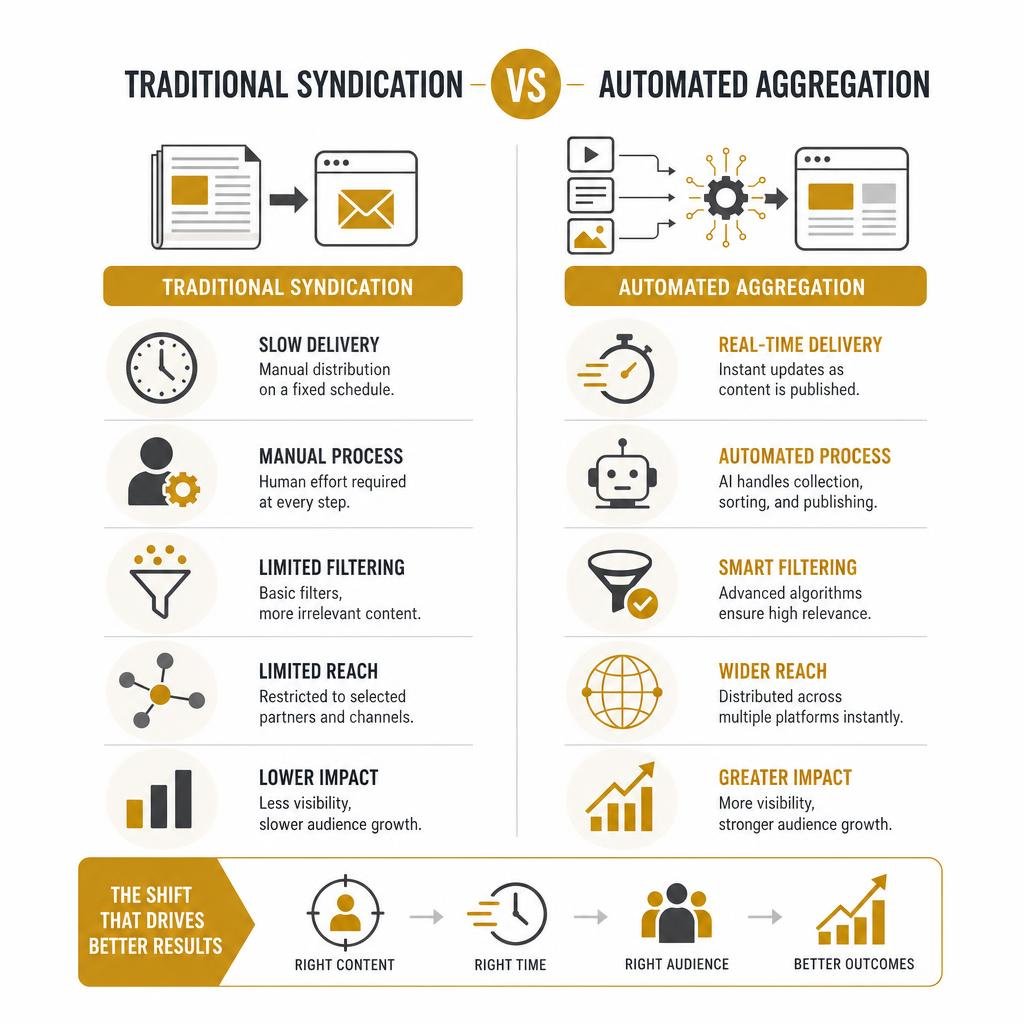
The comparison between traditional syndication and automated aggregation highlights this strategic shift:
Frequently Asked Questions About Digital News Processing
As the landscape of media tech continues to evolve, questions naturally arise about the mechanisms and implications of digital publishing and automated curation. Here, we address some common inquiries regarding real-time digital news aggregation.
What is real-time digital news aggregation?
Real-time digital news aggregation refers to the automated process of collecting, organizing, and delivering up-to-the-minute news and content from a multitude of online sources. At its core, it involves continuous data scraping and API parsing to gather information as soon as it’s published. These systems then use various algorithms to process this raw data, identify key stories, and present them to users, often with instant updates and personalized feeds. The goal is to provide a comprehensive and current overview of specific topics or general news without the user having to manually visit countless websites. For instance, if we’re looking for the very latest “toyota camry hybrid review,” an aggregator will pull that information from various automotive sites, blogs, and news portals, presenting it to us almost instantaneously.
How do news aggregators handle duplicate stories?
Handling duplicate stories is a critical function for news aggregators to ensure a high-quality and efficient user experience. Without effective deduplication, users would be inundated with multiple versions of the same news item from different sources. Aggregators employ sophisticated techniques, primarily leveraging natural language processing (NLP) and machine learning, to address this challenge.
When new content is ingested, algorithms analyze its text, metadata, and even structural elements to determine its core topic and semantic meaning. Clustering algorithms group articles that discuss the same event or subject. More advanced methods use similarity scoring to compare articles word-for-word, phrase-for-phrase, or even concept-for-concept, to identify near-identical or highly similar content. Once duplicates are identified, the aggregator typically selects one article as the primary representation (often based on factors like source authority or completeness) and either suppresses the others or links them as alternative sources for the same story. Crucially, aggregators are designed to respect canonical links, ensuring that credit and referral traffic are directed back to the original publisher of the content. This intelligent filtering ensures that when we search for a “toyota camry hybrid review,” we get a diverse range of unique perspectives rather than multiple identical articles.
How does real-time news aggregation affect original publishers?
The relationship between real-time news aggregation and original publishers is complex and often debated, encompassing both significant benefits and potential challenges.
On the positive side, aggregators serve as powerful drivers of referral traffic. By featuring snippets or headlines of articles and linking back to the original source, aggregators introduce publishers’ content to a broader audience they might not otherwise reach. This increased visibility can lead to higher page views, greater brand recognition, and potentially, new subscribers. For a publisher, having their “toyota camry hybrid review” appear on a prominent aggregator can significantly boost its reach and authority.
However, concerns exist regarding content licensing and copyright attribution. Publishers sometimes worry that aggregators might present too much of their content directly, reducing the incentive for users to click through to the original site. This can lead to a perceived decontextualization of content. Responsible aggregators, however, adhere to strict ethical and legal guidelines, typically displaying only enough information to entice a click, providing clear attribution, and respecting publishers’ terms of service. Many aggregators also establish formal content licensing agreements with publishers. The goal is a symbiotic relationship where aggregators provide valuable content discovery for readers, while simultaneously channeling engaged audiences back to the original creators, supporting the ecosystem of digital journalism.
Conclusion
The journey through the evolution and intricate workings of real-time digital news aggregation reveals a powerful transformation in how we interact with information. From the early days of RSS feeds to today’s sophisticated mobile-first platforms, these systems have consistently evolved to meet our insatiable demand for immediate, relevant, and personalized content. They have become indispensable tools, simplifying the complex task of staying informed in a world awash with data.
We have explored the core technologies that underpin this revolution, from automated content scraping and API parsing to advanced algorithmic deduplication and filtering. These technological marvels ensure that whether we are searching for a comprehensive “toyota camry hybrid review” or tracking global economic shifts, the information delivered is timely, accurate, and free from redundancy. The benefits extend equally to readers, who enjoy unparalleled personalization and content discoverability, and to publishers, who gain invaluable traffic, distribution, and enhanced brand visibility.
Looking ahead, the future outlook for real-time digital news aggregation is one of continued innovation. We anticipate even deeper AI integration, leading to more nuanced content curation, predictive insights, and truly intelligent assistants that anticipate our information needs. The emphasis on verified sources will undoubtedly grow, with aggregators playing a crucial role in combating misinformation and upholding the integrity of digital journalism. As the digital media network continues to expand, real-time news aggregation will remain at the forefront, ensuring that we are always connected to the pulse of the world, making sense of its complexities, and discovering the insights that matter most to us.