
The Caribbean seems tailor-made for exploration. One island is all about beaches and snorkelling, whilst another is renowned for its colourful historic streets and fantastic local cuisine. So, if you’re making the journey anyway, why stop at just one?
On the other hand, more destinations also mean more connections, hotel changes and extra hours spent travelling, which eat into your holiday time. This is where smarter, more efficient planning comes into its own.
Start with the hub, not the list of islands
When planning a trip to the Caribbean, it’s natural to start by listing all the islands you want to see. The problem is that destinations which seem close on the map aren’t always as well connected as you’d like.
There’s a good chance you’ll end up retracing your steps, dealing with frustrating stopovers, or wasting more than a day travelling from one stop to the next.
A smarter approach is to choose your main travel hub first and build your itinerary around it. For those travelling from the United States, Miami is a very logical hub. Miami International Airport currently offers direct flights to a wide range of Caribbean destinations, including Aruba, Jamaica, Barbados, St Lucia and Grand Cayman.
San Juan also works well as a regional departure point, as many airlines operate both US and Caribbean routes from there.
When comparing hubs, however, location is just the start. Also look at the frequency of direct flights, cruise departures, hotel options and how easily you can get between the airport, the port and your accommodation.
It’s also worth treating the hub as part of your holiday. A night spent there gives you a bit of a breather between the major legs of your journey. Plus, you’ve got another city to explore.
Think in terms of groups of islands
The next step is to group your destinations geographically. This way, you keep travel time under control whilst still enjoying the variety you’re looking for. Examples of popular groupings include Puerto Rico with the Virgin Islands, or Aruba, Curaçao and Bonaire.
If you’re setting off from Miami, the Bahamas are always a good choice, but if you focus on the western Caribbean, you can combine stops such as Grand Cayman and Cozumel.
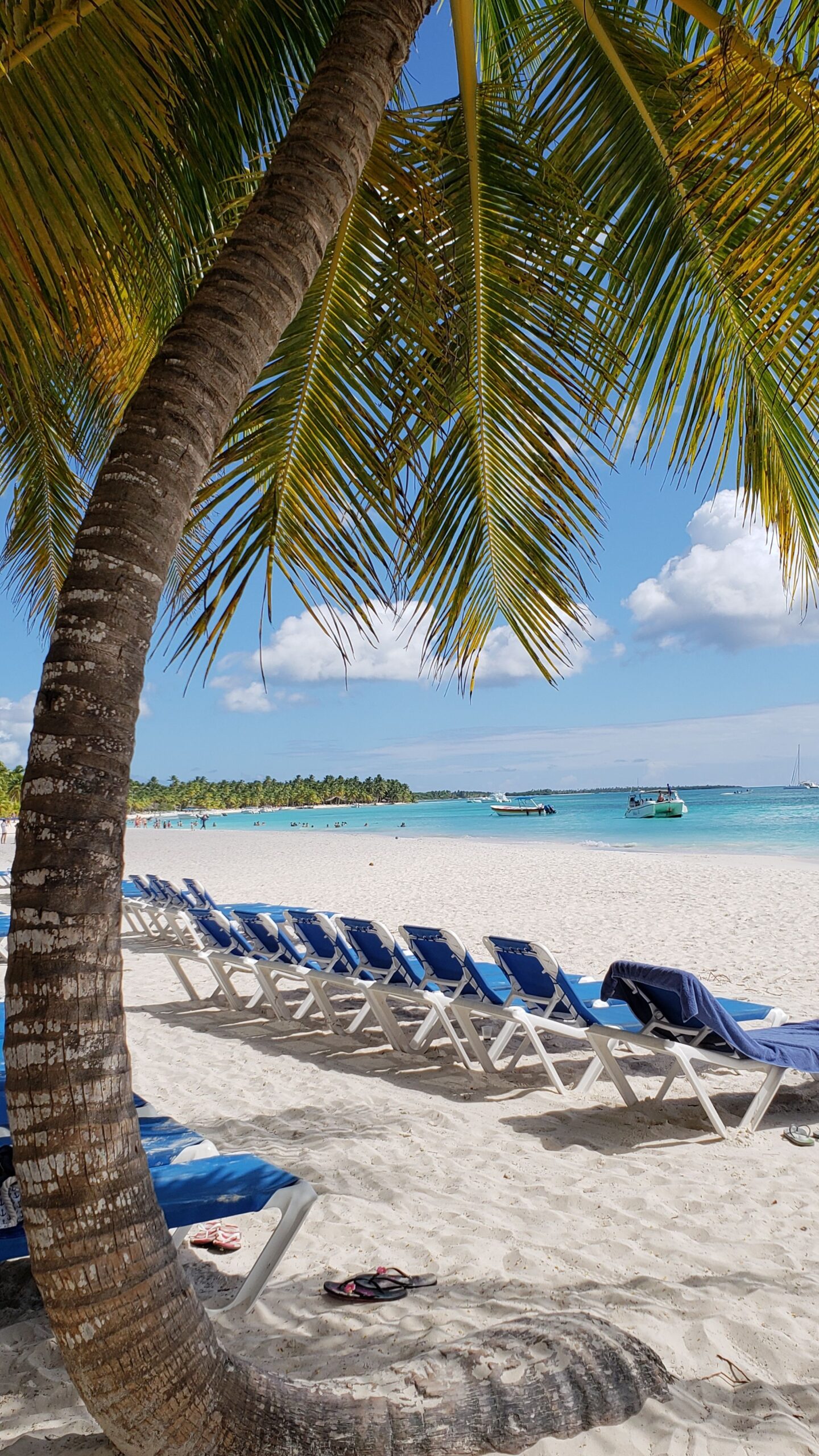
A cruise can make this multi-destination style of travel even simpler, as much of the journey between ports takes place whilst you’re eating or sleeping. Looking at an itinerary for cruises from Miami is a way of seeing how a single departure point can connect you to several of the stops you have in mind.
Book the most fixed connection first
Now that your destinations are marked on the map, the question is: what should you book first? Bear in mind that the different parts of such a trip don’t all offer the same flexibility.
You might find dozens of hotels on an island, but only one ferry that fits your plans. Similarly, a direct flight might only operate a few times a week. What you want to do is identify the least flexible part of the route and make that your fixed point.
Once that connection is secured, you can organise your accommodation and transport around it.
This approach is much safer than booking hotels first and assuming the connections will fall into place by themselves. Always check how often a route runs. It’s not enough for a ferry or flight to exist if it doesn’t run on the day you need it.
Leave some breathing space in your itinerary
A packed itinerary looks great on paper, but leaves no room for real-world mishaps. A delayed flight, a cancelled ferry or a spell of bad weather can throw a spanner in the works for everything you’ve booked afterwards.
It helps a lot to build in some breathing space around the parts of your trip you can’t afford to miss. Arriving in the cruise embarkation city a day early, for example, gives you a safety net if things don’t go to plan.
The weather is another factor to consider. The Atlantic hurricane season officially runs from 1 June to 30 November, so during this period it’s a good idea to keep an eye on the forecasts on the National Hurricane Centre’s website.
When one more island is just one too many
There comes a point when adding yet another island to your list makes your trip more inefficient than anything else.
Before adding a stopover, ask yourself what it brings to the trip. Ideally, each destination should offer you a slightly different experience, so hopping between similar resorts might not justify the extra journey.
Do the maths before you book
Even the best-planned trip needs to make financial sense, but there are a few caveats. The cheapest flight between two destinations may seem like a bargain until you factor in checked-in luggage, airport transfers, a long stopover and perhaps even an extra night’s hotel stay due to the timetable.
It’s important to compare the total cost of travelling from one destination to another, including flights or ferries, transfers, meals during long layovers, and any accommodation you wouldn’t otherwise need.
And if you’re weighing up a cruise against travelling independently from island to island, take into account what’s already included, rather than just comparing transport costs.
It’s also worth looking at the cost per day of your holiday. Spending a little more on a direct route might be worth it if it gives you an extra afternoon on the beach instead of one spent at the airport. Finally, check the entry and documentation requirements for each stop on the US Department of State website before finalising your itinerary.
The traveller unwittingly applies a factory-floor theory
The article’s golden rule – ‘secure the tightest link first’ – has a name and a history that stem not from tourism, but from factory floors. In 1984, the Israeli physicist Eliyahu Goldratt published *The Goal*, a business novel that has since become required reading in management schools, and with it, the Theory of Constraints. The central idea can be summed up in a single sentence: the performance of any system is dictated by its narrowest link. Everything must therefore be subordinated to that link. Goldratt called it the ‘drum of the system’: the slowest element sets the pace, and the rest of the resources follow it, however unproductive that may seem on paper.
Translated into the itinerary, the theory sounds familiar. The ferry, which runs twice a week, is the constraint; the hotels, with their dozens of options, are flexible resources that can be adjusted to suit it at any time. Goldratt used to ask factories to build a time buffer before the bottleneck machine, so that upstream delays wouldn’t leave it idle. The article asks you to do exactly that when it sends you to the port of embarkation a day in advance.
Even the warning that one more island could throw a spanner in the works is there. Goldratt developed his theory to counter the instinct to maximise every single activity. Maximising local activity – that is, ticking off as many stops as possible – reduces the overall efficiency, namely your useful holiday hours. The cost per useful day, as proposed by the article in the calculations section, is a proper efficiency metric.
The theory has one more step, which the article carries out without naming it: lifting the constraint. When the bottleneck remains a bottleneck, you pay to widen it, and that is exactly what you do when you spend a little more on the direct route that buys you an afternoon on the beach. With one caveat, also from Goldratt: once you’ve widened a link, the constraint shifts. Once the ferry’s booked, the bottleneck of the journey might become something else – a visa, a transfer, a boat – so it’s worth looking for it again.

The theory has its limitations, which are often discussed even in management literature. It originated on production lines, with stationary machinery and a single bottleneck, and critics have accused it of repackaging older ideas from operations research. Above all, it assumes a stable constraint, whereas on a journey the constraint can shift overnight. A storm turns an ordinary flight into the week’s bottleneck, and time buffers become the only defence. It remains, however, the clearest way to organise your bookings, with one addition that the article fails to make.
On a journey linking several islands, the constraint isn’t always a timetable. Sometimes it’s a service provider: the sole water taxi operator between two small islands, the only transfer company serving a secondary port at the time you land. And unlike the ferry on the official route, you usually know next to nothing about that service provider. Here, planning shifts from being a scheduling issue to a verification issue. And when it comes to verification, unlike with scheduling, no booking engine can help you.
The link you cannot verify
A four-island itinerary involves a host of small-scale service providers: transfers, private boats, guides and guesthouses, scattered across two or three jurisdictions. The Caribbean is an administrative mosaic, with American, British, Dutch and French territories alongside independent states, so there is no single register where you can look them all up. The maths of the chain is equally unforgiving: if each of the four links performs well in nine out of ten cases, the chance of all four performing well drops to two in three.
And the reputation infrastructure is distributed in exactly the opposite way to what is needed. Large hotels and airlines have thousands of reviews; the operator with two boats has three old mentions on a forum. The tourist is, by definition, a stranger; they only pass through once, so the leverage of the returning customer does not apply to them. And this asymmetry is recognised by both sides: the operator knows you won’t be coming back either.
The pressure on this chain is increasing, not decreasing. The Caribbean Tourism Organisation reported in April 2026 that 2025 had been a record year: approximately 35 million overnight arrivals, 2.5 per cent higher than in 2024 and once again above pre-pandemic levels. Cruise visits reached 35.5 million, 16.7 per cent higher than in 2019, with the Bahamas at an all-time high of 10.7 million. The same organisation notes that among the year’s disruptions was Hurricane Melissa – a further argument for the time buffers mentioned above – and forecasts growth of 3 to 4 per cent in overnight arrivals and 5 to 7 per cent in cruise visits for 2026. Rising demand also means new suppliers every season, appearing and disappearing just as quickly; a reputable name mentioned in a conversation two years ago may no longer be available at the counter.
There are two ways to simplify the issue. The first is the one the article has already touched upon: a cruise replaces five small providers with a single, large and verifiable one, with a single contract, a single liability regime and a single refund policy instead of six. A curated category of cruise lines and services, in which every entry has undergone editorial vetting prior to publication, streamlines even this first step.
The second approach concerns independent hopping from island to island and requires a verification process. First, the existence and category of the service, through human-verified sources. Then authorisation, via the relevant authority’s register in each jurisdiction: passenger transport by water is licensed by the maritime authority of each territory, and many tour operators are listed with local tourist offices. Only then comes the price.
What an editorially verified listing guarantees must be stated plainly, especially on a long journey. It confirms that the operator exists, can be contacted, operates in the category shown, and can be found on your return. It does not guarantee the condition of the boat, it is not a substitute for a recommendation, and it does not replace either local authority records or official travel advisories, such as those to which this article itself refers. Each source answers a different question, and going through them all takes less time than a single missed connection. Keep screenshots of the page and the confirmation for each small provider: if everything goes well, you’ll never open them, and if it doesn’t, they’re your only evidence.
The source’s scope must match the scope of the route
The logic of geographical grouping in this article applies even to information sources. A strictly local source has in-depth knowledge, but stops at the edge of its own island; a global aggregator covers everything but verifies nothing. Multi-destination journeys fall precisely into the gap between them, because they require sources whose radius covers the entire route, with the same criteria applied at every point along it. There is a practical analysis regarding the selection of directories based on their geographical scope, and this test can be carried out on any source in ten seconds: how many of my stops does it cover using the same criteria? The scope of the source is chosen according to the scope of the problem.
For the sections between islands – that is, transfers, excursions, guides and the other minor services that link an itinerary – an editorial category of travel services provides the first filter, applying the same criteria across the board: a genuine company, a functional website, and accurate categorisation, regardless of the flag under which the operator operates. From there on, the specific regulations of each territory come into play, followed by direct questions, with written answers required: the exact time and point of embarkation, what happens in bad weather, and what happens to the money in the event of cancellation. A reputable operator answers all three without getting annoyed; one who does get annoyed has, in his own way, answered you too.
For the small operators themselves, the lesson is one they can learn by looking in the mirror, and it can be summed up in two sentences. Their customer is always a stranger who compares three sources on the same evening, so the company’s details must appear identical across all three: the same name, the same telephone number, the same category, the same boat.
In a market that has reached 35 million arrivals a year, where more and more responses are generated by machines that first scan the relevant sources, this consistency is the cheapest form of advertising there is.
And since you’ve learnt from Goldratt to look for the bottleneck, there’s one more, the final one: information. A boat’s actual departure time, the documents required at a minor border crossing, the day on which an operator isn’t working. Your itinerary is only as good as the weakest piece of information in it. So treat checking your sources like any other booking: do it early, do it for every link in the chain, and build in a buffer where a response might be delayed.
A better trip, not a busier one
The best multi-destination trip through the Caribbean should feel like a cohesive journey, not like several holidays stitched together.
Start with a well-connected hub, group together destinations that make sense together, and build your itinerary around the connections with the least flexibility, and you’ll be off to a good start.
Efficiency doesn’t mean ticking off as many islands as possible in a single trip. It means spending less of your holiday travelling between one place and another.
