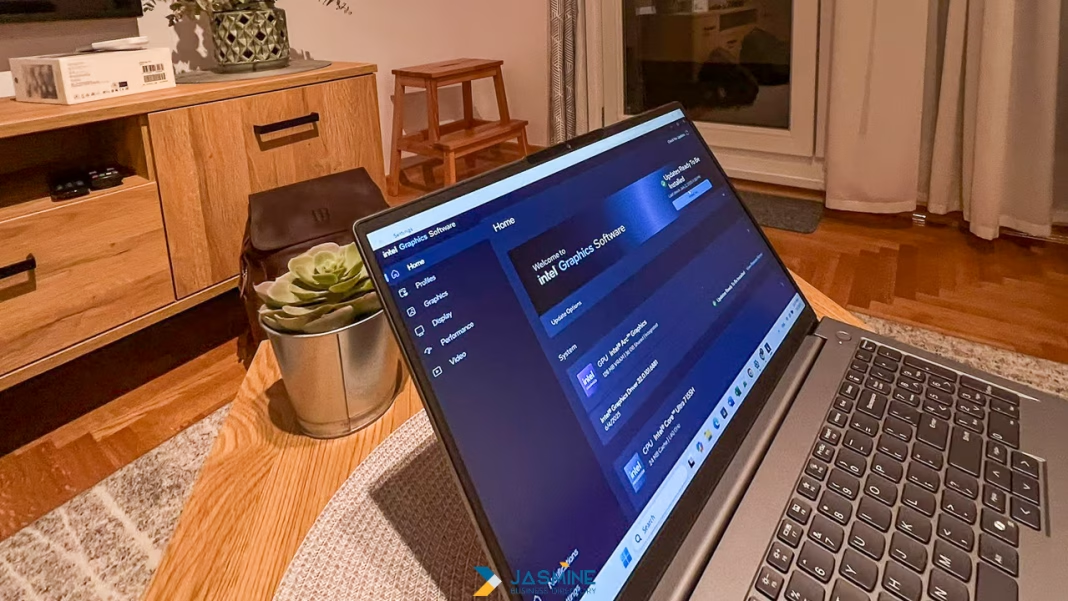
Running a trusted web directory used to be a desk job with two monitors and a full pot of coffee. That model has aged badly. Affiliate offers change overnight, listings quietly turn into 404 pages, and Google’s Helpful Content updates reward fresh, first-hand detail, which often means checking a business from the same city it operates in. Whether you are fact-checking a Singapore SaaS startup or verifying a Cape Town coworking space, reliable data is your oxygen. Plastic SIM cards and unreliable cafe Wi-Fi cannot keep up with the pace of a directory that has to stay accurate.
An eSIM is one practical fix. It is an embedded SIM profile that downloads from a QR code and turns your phone into a working hotspot in a couple of minutes, without a border crossing or an airport kiosk in between. Below is why directory owners, outreach specialists, and SEO consultants are skipping the kiosks, how they cut roaming spend by about 70%, and when an always-on connection stops a broken link from damaging their reputation.
Why directory editors need data everywhere
A directory earns its place by being right. That work does not pause when you leave the office.
- Time-sensitive link checks. A “temporarily unavailable” listing chips away at user trust and rankings. A live connection lets you click through listings on the taxi ride from the airport to a meetup, and pull a dead entry before a reader ever hits it.
- Multimedia proof. Clients like real photos, not stock. Uploading a 4K lobby tour to a listing while you are still standing in the lobby shows the entry is real, and that transparency keeps churn down.
- Geo-specific search results. Local rank tracking needs a local IP address. An eSIM that hops between networks gives you honest search snapshots from where the business actually is, rather than results routed through a data-center proxy.
That last point matters more than it looks. Where people find businesses is rarely neutral. Safiya Umoja Noble, in Algorithms of Oppression (2018), shows that commercial search results are shaped by advertising and private interests, so the first page is not an objective map of what exists. If you are auditing a directory’s coverage, seeing genuine local results, not a personalized or proxied version, is the only way to know what a real user in that market would see.
eSIM versus plastic SIM: the numbers game
| Metric | Traditional SIM Kits | eSIM Profile |
| Purchase time | 15-30 min + passport scan | 2 min QR scan |
| Networks stored | 1 | Multiple, auto-roams |
| Dual-number use | Dual-tray device required | Works on most 2019+ phones |
| Cost (15 days, unlimited) | $60 roaming pass | $47 via Holafly |
| Plastic waste | 4 g PVC | 0 g |
You click buy, scan the code, and you are online. No fiddly trays, no nano-SIM lost under a hostel bunk.
Installing Holafly eSIM plans before you fly
- Pick your bundle. Regional plans cover Asia, Europe, or Latin America, or you can take a Global plan.
- Pay online. No passport, no physical shipping.
- Receive the QR code by email, then screenshot it so you have it offline.
- On iPhone: open Settings, then Cellular, then Add eSIM, then Use QR Code.
- Label the line “Travel Data” and set it as the default for cellular data.
- Disable data roaming on your Canadian or U.S. SIM, but leave voice and SMS active so two-factor logins still reach you.
Total setup time is shorter than the wait for your boarding group to be called.
Field scenarios where an eSIM earns its keep
| Scenario | Problem | eSIM Advantage |
| Live-blogging a Berlin tech expo | Venue Wi-Fi throttles under 5 000 attendees | LTE/5 G stream on Vodafone DE |
| Updating directory maps for a Bangkok coworking hub | Google Maps needs GPS + data | AIS 5 G kicks in as you exit BTS Skytrain |
| Emergency SSL renewal for a client | Hotel Wi-Fi captive portal blocks cPanel | Instant hotspot; renew cert en-route |
| Outreach emails in time-zone crunch | Cafe Wi-Fi closes at 10 p.m. | Data rolls on; hit send before midnight EST |
A seven-day directory audit run shows how this plays out in practice.
| Day | City | Task | Data Moment |
| 1 | Lisbon | Update local SEO listings | SERP screenshots via 5 G |
| 2 | Barcelona | Shoot 360 degrees office tour | Upload 2 GB to Drive |
| 3-4 | Rome | Client meetings | Google Meet over LTE |
| 5 | Athens | On-site backlink audit | Screaming Frog crawl via hotspot |
| 6 | Istanbul | Blog post & photo edits | WordPress push at cafe |
| 7 | Dubai layover | Schedule social promos | Buffer app in taxi |
One Holafly Europe and Middle East eSIM carries you through six countries without a SIM swap at every border.
Cost breakdown versus roaming passes
| Expense (7 days, 6 countries) | Carrier Roaming Pass | Holafly Regional eSIM |
| Data (unlimited) | $10 / day x 7 = $70 | $29 |
| Extra hotspot fee | $5 / day x 5 = $25 | Included |
| SIM kit per country | $10 x 6 = $60 | $0 |
| Total | $155 | $29 |
The saving comes to $126, enough for an extra night in a Lisbon loft or twelve flat whites to keep a link-audit session going.
The SEO case: faster indexation and fewer stale entries
Google’s quality guidelines reward freshness. Updating an address field or logging an HTTPS migration from the field shortens the gap between a change happening and the record showing it. Reliable data means you can ping Search Console straight away, fix a 404 before it lingers, and check Core Web Vitals when you switch an image CDN setting on the road.
Freshness is not a vanity metric. BrightLocal’s Local Consumer Review Survey (2026) found that 31% of consumers would only consider a local business rated 4.5 stars or higher, up from 17% the year before, and that Google remains the most used platform for reading reviews at 71%. Standards keep tightening. A directory listing that points to an old address, a defunct site, or a business that has since closed reads as neglect, and neglect is exactly what a curated directory is supposed to protect readers from. Staying current is the whole job.
It is worth remembering how far this expectation has drifted. Louis Rosenfeld, Peter Morville, and Jorge Arango, in Information Architecture: For the Web and Beyond (2015), argue that how information is organized, labeled, and categorized decides whether people can find it at all, and that browsing structured categories and searching are complementary. A human-edited directory is that structure made deliberate. It only holds up if the entries behind the labels are checked and true, which is the reason editors now travel to verify them.
Sustainability and compliance bonuses
- Less plastic. Moving 30 staff phones to eSIM removes roughly 120 g of PVC per quarter.
- No passport scans at kiosks. Fewer copies of your personal data sit in random shop databases, which helps with GDPR.
- Carbon accounting. Remote audits over livestream cut flight emissions, and a steady eSIM connection keeps those streams from buffering.
Five apps every directory editor should pre-install
| App | Why You Need It | Data Use |
| Screaming Frog Mobile | Quick 500-URL audits | Medium |
| Google Lens | Translate contracts, menus | Low |
| Canva | Thumb-friendly image resizes | Medium |
| Slack | Urgent content approvals | Low |
| Speedtest.net | Verify hostel Wi-Fi; decide to hotspot | Low |
With no data cap hanging over you, you stop asking whether a GIF is worth its 10 MB and just send it.
Common questions
Q: Can I reuse the same QR code on my tablet?
A: One device per QR code. Buy a second plan or tether from your phone.
Q: Will my U.S. number still accept bank texts?
A: Yes. Keep the physical SIM for voice and SMS, and just disable its data roaming.
Q: Is 5G available everywhere?
A: Major capitals, yes. Rural areas fall back to LTE, which is still fine for the work.
The practical takeaway
Managing a living directory means dodging stale links and dead Wi-Fi zones in roughly equal measure. A single QR code from Holafly eSIM plans turns your phone into a portable publishing setup, with no plastic shards, no $15-a-day roaming charge, and no forced hunt for a cafe with signal. Tape that QR code next to your passport, sync your to-do board, and publish from wherever you happen to be.
Readers, links, and search crawlers do not wait, so your data checks should not have to wait for hotel Wi-Fi either. The concrete win is simple: a directory whose listings are correct on the day someone reads them, because the person who verified them was standing in the right place with a working connection.
