
Key takeaways
- Selling your home without an agent removes commission fees, which keeps more money in your pocket.
- Real estate rule changes in 2024 have made commission fees more negotiable, and in some cases optional.
- Going agent-free gives you more control, but it carries real trade-offs: limited market exposure and complicated paperwork.
- Alternative selling routes, including iBuyers and flat-fee MLS listings, give you new ways to sell quickly.
With home prices high and selling costs weighing on homeowners, many people are looking for faster ways to sell their property while keeping more of the proceeds. The old model leaned heavily on hiring an agent, and that model is changing quickly. For anyone considering a direct sale, understanding how the process works without paying Realtor commissions can add up to real savings. If you want to sell your home quickly in the Lee’s Summit area, you can visit https://www.kcpropertyconnection.com/mo/lees-summit/ to look at your local options and specialized services.
Skipping an agent does more than save on commission. It gives you direct control over negotiations and how you market the home. That freedom comes with risk, though, from handling legal paperwork to setting a price that actually reflects the market. It pays to understand how these transactions are shifting before you decide, especially as buyers gained more negotiating room in 2024.
As you weigh your options, resources like https://www.kcpropertyconnection.com/ offer guidance and direct-sale solutions that can simplify the process and get you past some of the usual hurdles. These platforms are useful for sellers who want to move quickly and hold on to a larger share of their equity.
Sellers going it alone still need someone tracking deadlines and documents, which is exactly the work real estate transaction coordinators handle once a contract is signed.
Understanding the traditional commission structure
Real estate agents have long charged sellers a combined commission of 5% to 6% of the home’s sale price. On a house selling for $400,000, that is $20,000 to $24,000 in fees, split between the buyer’s and seller’s agents. Agents earn that money by handling staging, marketing, negotiations, and the legal side of a sale, but those costs cut into your net proceeds, and the effect grows in higher-priced markets.
According to the National Association of Realtors, these commission rates have been the industry norm for years, largely because agents controlled access to the Multiple Listing Service (MLS) and because the practice was simply built into how deals got done.
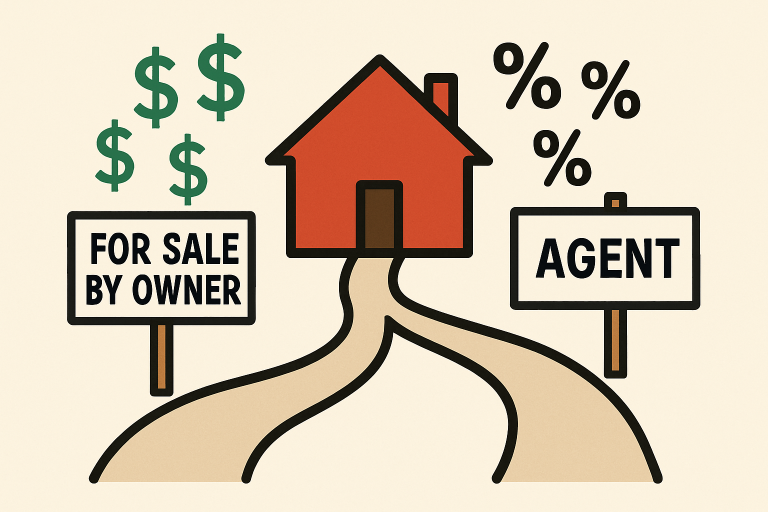
Recent changes in commission practices
In 2024, the picture changed when the National Association of Realtors (NAR) settled an antitrust lawsuit, agreeing to a $418 million payout and adopting new rules on commission fees. Starting in mid-July 2024, sellers and buyers are no longer required by NAR to offer or pay set commission rates as part of the MLS process. In practice, that means buyers and sellers can negotiate agent commissions in full, or skip them entirely, and potentially save thousands on a single transaction.
This gives consumers more room to bargain with agents or to run the sale themselves. The same change puts pressure on agents and traditional brokerages, who may see thinner earnings in the years ahead. How much money you actually keep now depends more on what you negotiate and less on a fixed rate everyone treats as untouchable.
Pros of selling without an agent
Cost savings are the clearest advantage. Selling independently removes agent commissions, which can save you thousands at closing. You also gain control over the whole process. You set your own price, decide how to market the property, and negotiate directly with buyers, which tends to make the deal more transparent and can speed it up.
Talking to buyers yourself also cuts out a layer of relay. Fewer messages get garbled, questions get answered faster, and problems that come up during the sale can be sorted out without waiting on two agents to coordinate.
Cons of selling without an agent
Agents do real work, and skipping one means picking up that work yourself. They provide access to the MLS for wider exposure, help with the paperwork, and price a home based on current market data. Without that support, you may struggle to reach qualified buyers, handle legal disclosures correctly, or price the house accurately, and any of those can lead to delays or a lower final number.
Exposure is the part sellers underestimate most. Buyers overwhelmingly start online, and a home that is hard to find is a home that sells slowly. Pew Research Center found that Americans looking for information about local businesses rely on the internet ahead of any other source, with 36% turning to search engines for local businesses; the same instinct applies when people hunt for a house. If your listing is not where buyers look, price alone will not save it. Getting your property in front of the right eyes, whether through the MLS, a well-known selling platform, or a curated local listing, is often what separates a fast sale from a stalled one.
Alternative selling methods
If you want an alternative to a traditional agent, you have several. Flat-fee MLS services let you list on the MLS for a fixed price, so you get broad exposure without paying a percentage commission.
The For Sale By Owner (FSBO) model puts you in charge of everything, from marketing to negotiation, with the trade-off that every task lands on you. iBuyer platforms such as Opendoor and Offerpad make fast cash offers, though those offers usually come in below market value. That is the balance to weigh: speed and certainty against the money you leave on the table.
Buyer trust matters here too. Rachel Botsman argues that trust has moved into a third era of “distributed trust,” where ratings, reviews, and platform reputation let strangers extend confidence to businesses and people they have never met. A buyer who has never met you is reading signals: how the listing looks, where it appears, and whether the platform behind it has a reputation worth trusting. Being listed somewhere credible does part of the persuading for you.
Legal and financial considerations
Dropping the agent does not drop your obligation to follow state and federal law on property transactions. You still have to provide disclosures, meet contract deadlines, and make sure every document is accurate and complete. Mistakes here can be expensive, so it is worth hiring a real estate attorney to review the paperwork and protect you through closing. The commission you save can more than cover a few hours of legal help.
Deciding what fits your sale
Selling without an agent and avoiding commissions can leave more money in your hands and let you set the pace. Set that against the trade-offs: fewer buyers seeing the home, more work on your plate, and paperwork you cannot afford to get wrong.
Those trade-offs shrink with preparation, and selling your home fast on your own becomes realistic once pricing, curb appeal, online marketing, and the legal paperwork are each handled deliberately.
A practical way to decide is to price out both routes for your specific house. Estimate the commission you would pay an agent, then estimate what you would spend on a flat-fee listing, a photographer, and a lawyer, and compare the gap against the time and effort you are willing to spend. If the numbers favor going direct and you are comfortable managing the details, get the listing in front of buyers where they actually search, keep your disclosures clean, and line up legal review before you sign anything.
