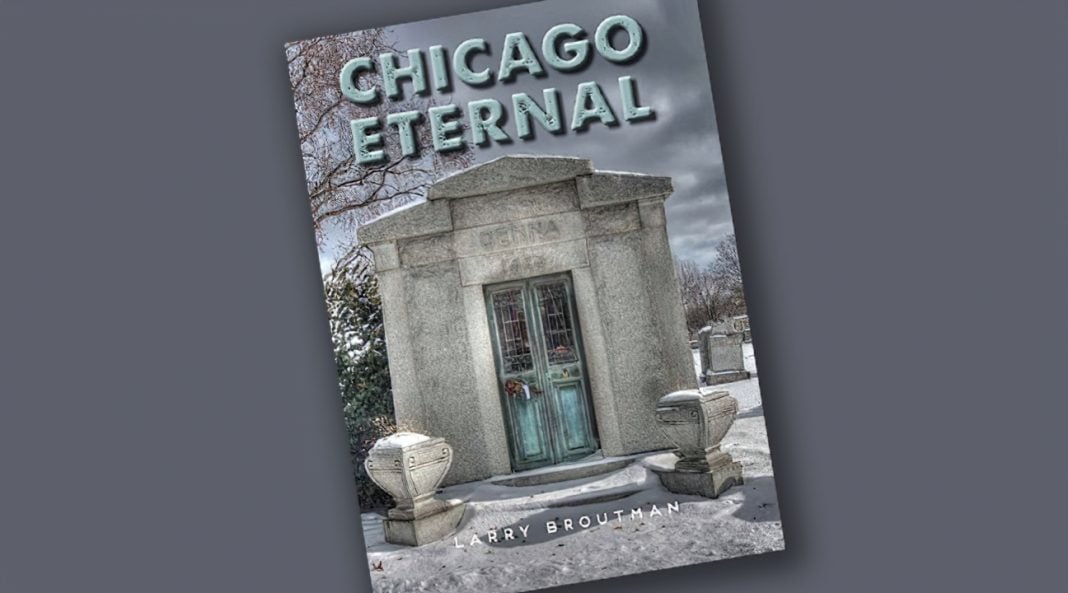
With your newest photography book, “Chicago Eternal”, the city’s history comes alive through photographs of gravestones and monuments. The full-color hardcover explores more than thirty Chicago area cemeteries, covering the famous, the notorious, and the long-forgotten. Have you always been interested in cemeteries, or is this a new fascination for you?
Larry Broutman: A cemetery is a history lesson combined with an art gallery, and it is open to the public. Yet few take advantage of everything a visit to their local graveyard can offer.
My interest in cemeteries began while I was working on my previous book of photography, “Chicago Monumental”, which looked at the Windy City’s public art. Researching well-known sculptors from the late 1800s to the early 1900s, I found that some of their work was located in Rosehill and Graceland cemeteries. Daniel Chester French, who designed the Lincoln Memorial, also designed Marshall Field’s monument at Graceland. When I went to the cemeteries four years ago to photograph the sculptures, I was struck by the visual beauty of the monuments and mausoleums, and by their history. That is when I knew I had found the subject for my next book.
As a photographer, I was first drawn to cemeteries because of the visual richness of their monuments. As I did more research, though, I realized that the stories of the people behind these grave markers mattered as much as the photographs. Over the decades and centuries, Chicagoans have found many ways to express their loss and to share part of a loved one’s personality through these monuments and headstones.
Chicago is unusual because, even though it is a fairly young city, it was home to, and is the final resting place for, a remarkable number of people who made global contributions in the arts, sciences, industry, politics, and sports. It also holds some notorious gangsters and murderers from high-profile cases.
I did not limit myself to celebrities. I wanted to tell the often-overlooked stories of everyday families who suffered tragic loss far too early because of disease and fire, and the stories of our military dead. Telling the stories of the people buried in Chicago’s cemeteries is a way of telling the history of the city itself.
Why cemeteries reward a slower kind of looking
A monument was commissioned to say something. The choice of stone, the sculptor hired, the epitaph carved, the size relative to the neighbors: each decision recorded what a family could afford and what it wanted remembered. Read that way, a headstone is a small primary document. A visitor who slows down starts to notice patterns, the sudden clusters of dates that mark an epidemic, the modest markers beside grand mausoleums, the shift in taste from ornate Victorian carving to plainer twentieth-century design.
Broutman’s method points to a practical lesson for anyone photographing places like these. The picture is a doorway, not the destination. A striking image of an angel over a grave gets a viewer to stop, but the caption that names the person underneath and explains who they were is what turns a pretty photograph into a piece of history. That is the difference between a book of scenery and a book that teaches you something about the city it covers.
Finding the stories, and finding the sites
Cemeteries such as Rosehill and Graceland were not built to be hidden. Many operate public tours, publish maps of notable graves, and keep records that genealogists and local historians draw on. The obstacle is rarely secrecy; it is knowing where to look. This is the same problem people face with almost any local resource, from a historic site to a specialist repair shop: the thing exists, but the path to it is not obvious. Structured directories and curated lists solve part of that. Louis Rosenfeld, Peter Morville, and Jorge Arango, in “Information Architecture: For the Web and Beyond” (2015), make the point that how information is organized, labeled, and categorized decides whether people can find it at all, and that browsing categories and searching are complementary ways to locate what you need. A cemetery’s own map and a well-kept online listing do the same job for a visitor: they turn a vague sense that something is out there into directions you can follow.
That connection matters beyond graveyards. Americans have long treated the internet as the first place to check for information about local places. Pew Research Center’s 2011 study “Where People Get Information About Restaurants and Other Local Businesses” found that 38% of adults turn to search engines for information on restaurants, bars, and clubs, and 36% use search engines for other local businesses. A cemetery hoping for visitors, or a small museum, competes for that same attention, and being findable and clearly described is most of the battle.
What a book like this asks of a photographer
Shooting outdoors in a cemetery means working with light you do not control. Stone reads very differently at dawn than at noon, and weathering that looks flat in harsh sun can gain depth in softer, angled light. Weather, season, and the direction a monument faces all shape the result, so a serious project means returning to the same spot more than once. Photographing across more than thirty sites, as Broutman did, is as much a scheduling exercise as an artistic one.
Access is the other half. Many cemeteries welcome photographers but have rules about tripods, commercial use, and respect for services and mourners in progress. Sorting that out in advance, and treating the grounds as the working cemeteries they still are, is part of the job. The finished book carries the weight of that groundwork even when the reader never sees it.
About Larry Broutman
Larry Broutman attended MIT, where he received his S.B., S.M., and doctorate in Materials Engineering and Science in 1963. During his career in Polymer Engineering and Science he was an active researcher, a teacher at the Illinois Institute of Technology, and the author of more than 150 technical articles. He also wrote technical reference books and college textbooks on composite materials. Broutman has received many honors in plastics engineering and was recently elected to the Plastics Hall of Fame.
In the early 1990s his avocation became wildlife and landscape photography, and he traveled the world to photograph his subjects. He has published his work in magazines including Africa Geographic and BBC Wildlife. Photography is now his full-time profession, and he has completed projects for the Lincoln Park Zoo in Chicago, the Children’s Memorial Hospital Clinic, and the Ann and Robert H. Lurie Children’s Hospital of Chicago. The Lurie projects grew into his first photo book, a playful combination of wildlife and Chicago landscapes titled “Chicago Unleashed”.
His next book, “Chicago Monumental”, a photographic survey of more than 250 statues, fountains, memorials, and familiar and forgotten works of public art in the Windy City, drew praise from Chicago television and radio programs and from national art magazines. It won a Midwest Book Award for best interior design, an IPPY Award in the Great Lakes Nonfiction category, and the gold medal in AuthorsDB’s Book Cover Contest.
If Broutman’s approach carries a takeaway for readers, it is a simple one: your local cemetery is open, free, and full of stories, and an afternoon walking it with a map and a little curiosity will teach you more about your city than most guidebooks can.
