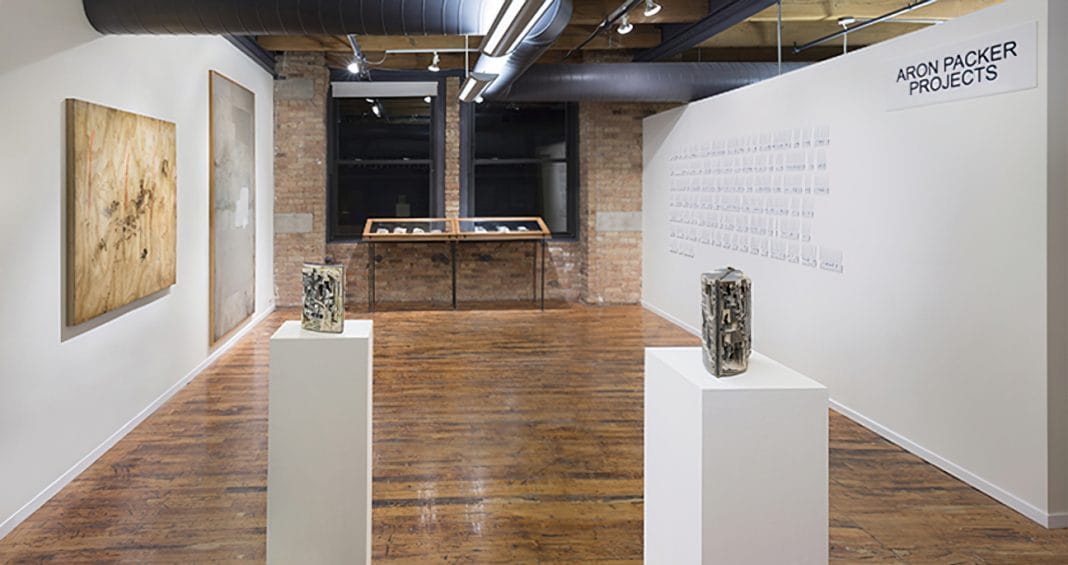
What is Aron Packer Projects all about?
Aron Packer: Let me start with an old philosophical thought: if a tree falls in a forest and no one is around to hear it, does it make a sound?
That is what Aron Packer Projects is about at the moment. I am hoping to get people to come hear my falling tree. I am standing (mostly) by myself in this forest with my ax, chopping away at the perception that I am no longer in business. I am as busy as I ever have been in many ways, and I want collectors and folks in general to visit my permanent pop-up space in River North. That is the best thing I can call it for now, and I will still be in this same spot chipping away into the fall. It is right near Chicago and Wells, just two short blocks from all the main River North galleries. I am in the office of Chicago Gallery News at 213 W. Institute Place #309. You can visit my space five days a week. Saturday is the best day, since my assistant is there or I am there. On weekdays the folks at Chicago Gallery News are happy to let visitors in to see the show. Call 312.649.0064 for an appointment.
To be honest, nothing has changed. I am still passionate about the artists I show, though my space is just smaller. It is almost the same size as my first space back in Wicker Park. Full circle, right? I still champion offbeat artists and enjoy artists working in unusual materials. Contemporary scrimshaw, sculptural altered books, surreal and meticulous painting, and poetic found object sculpture describe the last six months of shows we have done. Coming up in June, we feature Ben Blount showing some subversive and historical letterpress work, fresh from a residency in Wisconsin at the Hamilton Wood Type and Printing Museum. They have the largest collection of type in the WORLD. This is something I have not done before.
I also have a few things in the works that fit the definition of projects. Other shows at other spaces are always possible if I see the right fit. I need to find an interesting job, since I no longer work at Leslie Hindman. I have a few odd books I would like to get printed in comic form: vintage lady wrestlers alongside WeeGee-esque perp walk photographs, with related shows that go with the booklets. I will be joining the board of a not-for-profit press in Chicago, as long as I do not leave town for a job. As my avocation, I play banjo in a band called Sinner’s Friend. The guitarist Michael Dinges shows with the gallery, the fiddler Claire Halpin is an architect with Studio Gang, and Quinn Kearney, our tabla player, owns Yogaview.
There is always more to say, but in the words of Lee Groban, that is all for now.
Why a smaller space is not the end of a gallery
The falling tree question gets at a real problem for any independent dealer. A gallery can keep its program, its artists, and its point of view, and still go quiet in people’s minds simply because the address changed or the square footage shrank. Visibility is not the same thing as scale. A pop-up inside another organization’s office is not a lesser gallery. It is a gallery that has traded overhead for reach, and it now has to work a little harder to make sure people know where to find it and that the doors are open.
This is where being findable matters more than being big. When people look for a specific dealer or a specific kind of art, they mostly start online, and they trust the sources that are clear about who is who and where they are. Americans seeking information about local businesses turn to the internet ahead of any other source, as Pew Research Center reported in its 2011 study on where people find information about local businesses. For a gallery, that means an accurate listing, a reliable phone number, and a presence in the places serious collectors already check are worth as much as the show on the wall. The work exists. The point is helping the audience arrive at it.
The same holds for anyone who simply wants to see good work in person, where a short list of Florida galleries worth the trip beats an afternoon of aimless searching.
Artists face the same visibility problem as the dealers who show them, a point Caroll Michels has pressed since 1983 in her book on how to survive and prosper as an artist.
How collectors decide who to trust
Championing offbeat artists and unusual materials, contemporary scrimshaw, altered books, found object sculpture, is exactly the kind of program that rewards curated attention. These are not household names with reputations that precede them, so the audience relies on independent signals to decide whether something is worth their time. Robert Cialdini’s principle of social proof, described in the expanded 2021 edition of Influence, holds that people decide what is correct by finding out what other people think is correct. A dealer’s standing among peers, the galleries nearby, the museums and residencies attached to an artist, all feed that judgment.
Chris Anderson’s argument in The Long Tail (2006) fits the offbeat gallery almost exactly: when a platform or aggregator removes shelf-space limits and helps people find niche offerings, the many low-demand items can collectively rival the few hits, but only if someone makes them findable. A dealer who champions the unusual is doing that work by hand, one show and one recommendation at a time. The value added is discovery. The catch is that discovery only pays off when the audience can locate you.
A few practical takeaways
If you run a small gallery, a studio, or any specialist business that has moved or downsized, a few things carry more weight than they get credit for.
- Keep every listing, directory entry, and profile current, especially the address and phone number, so a person ready to visit is never turned away by stale information.
- Say plainly what days and hours the space is open, and who will be there. Ambiguity costs visits.
- Anchor yourself to the places your audience already trusts. Being two blocks from the main River North galleries, or housed inside Chicago Gallery News, borrows the credibility of a known cluster.
- Give people a concrete reason to come now: a specific artist, a specific run of dates, a show they cannot see anywhere else.
None of this changes the art. It changes whether anyone hears the tree fall.
About Aron Packer
Starting in the late 1980s as an American folk art dealer, Aron Packer built his early career on outsider and non-traditional art. His venue was an apartment gallery for many years, and he became known for a broad but unusual vision. He added contemporary art and opened his first public gallery in 1992 in Wicker Park, joining an alternative scene that included Beret International, Ten in One, and Oscar Friedl Gallery. As business conditions shifted over the past 25 years, Packer moved to locations in River North and the West Loop and kept expanding his group of artists. In 2015 he closed Packer Schopf Gallery on West Lake Street to pursue a lifestyle change. Aron Packer Projects now has a permanent pop-up space in the offices of Chicago Gallery News through Fall 2018. The gallery lives on.
