Give us some background history on yourself.
Matt Ballou: I grew up in way upstate New York. I’d always been a creative kid: drawing, building elaborate LEGO sets, burning things, running around in the woods. Being raised in the boondocks and beneath the poverty line meant that I had to create most of my own entertainment. I really think many of my current interests came out of necessity back then, at age 8 or 10. When I was seven I remember being tremendously excited about the illustrations in an edition of “The Epic of Gilgamesh” we had lying around. The next year we traveled across the States over one whole summer and I recall standing beneath the Sears Tower in astonishment. When I was nine we moved to a college town for a year, and I was allowed to wander the halls of the Anthropology Department, through rows and rows of skulls. That same year I read a huge Time Life-like series on American history and drew a four-foot-long diagram that examined and tried to explain what had caused the Challenger shuttle disaster (we watched it live in my classroom). I could go on and on, year after year.
So many things fed my interest in the universe, how we know what we know, why we do what we do, and how I fit into all of that. Eventually my interests settled into cosmology, philosophy, theology, and art. Not really the typical concerns of teenagers from the black hole mill town where I grew up. After graduating from high school, with no money for college and little encouragement to go forward with any of my interests, I worked for two years. During a particularly rough shift on the job (at 2:30 in the morning, no less) I realized I just needed to get going and let the money and logistics work themselves out. The next day I applied to the program at Munson Williams Proctor Institute of Art, now an extension of Pratt Institute.
I was accepted and eventually got a scholarship to the School of the Art Institute in Chicago. After earning my BFA, I spent a summer at Ox-Bow on a fellowship, then moved to Evanston, IL. I worked at Goods of Evanston for a while. Got married, went to grad school at Indiana University, and then came back to Evanston. I worked on my own writing and painting for two years before being offered a Visiting Professorship at the University of Missouri in Columbia, MO. Looks like we’ll be there for a while, and I’m greatly enjoying the faculty and students there.
Why is painting important to you?
MB: For me making art is a serious, moral activity. It has a function meant to tap into a common sense of being, an aspect that goes beyond enjoyment or ornament (both of which may be valid avenues for art, but not of as much interest to me). I want to resonate with what is and what has been. I want to take part in a history and tradition of human thought by working within a particular form (painting) that has its own history and philosophical weight, and by bringing in notions from beyond painting: semiotics, theology, mathematics, cosmology.
I want awareness, engagement, and investigation. I’ll admit that I often wonder whether painting can really speak to the issues of our contemporary world. But again and again I answer that question yes, in large part because of painting’s track record and formal authority. In spite of all our developments and changes, painting, as a physical artifact of philosophy and cognition, keeps an amazing power to throw us back upon ourselves in reverie, contemplation, wonder, inquiry, doubt, fear, and hope.
Describe your current work.
MB: As a painter I definitely claim the label of Symbolist. In that word I’m declaring something about my overall project of using strongly relational and metaphoric imagery, and about the kind of art-historical lineage I’m trying to work within. Right now I’m doing mostly oil painting and graphite drawing. The paintings run in two general tracks: larger symbolist, figure-based works and small symbolic still life pieces.
The drawings have shifted recently, becoming smaller, more rendered images rather than the very expansive and colorful works I was making over the last couple of years. I’ve also started using reductive or subtractive methods on the drawings, which is pretty new for me. I’ve been thinking about moving into some sculptural applications too, mainly as an aid to my overall painting project, but perhaps even as objects in themselves. I also do some printmaking from time to time; I particularly like layering mono-prints.
I write quite a bit and have a number of essays nearly finished or in the works. The writing is generally focused on art theory or on specific artists. Writing always helps me integrate aspects of what I’m thinking about in my own work and relate them to a wider range of artists and practices.
My piece on Odd Nerdrum that appeared in Image Journal in 2006 is my most prominent work of writing, but my essay examining and critiquing James Elkins’ “Re-Enchantment” symposium at the Art Institute of Chicago last year has been perhaps my most gratifying piece to date, since it brought in such a range of reactions and discussions from all across the US. At the moment I’m finishing the graphic design elements on a short book titled “A Mnemonic of Longing.” I consider the text of “A Mnemonic of Longing” the best work of any I’ve made, whether written, drawn, or painted.
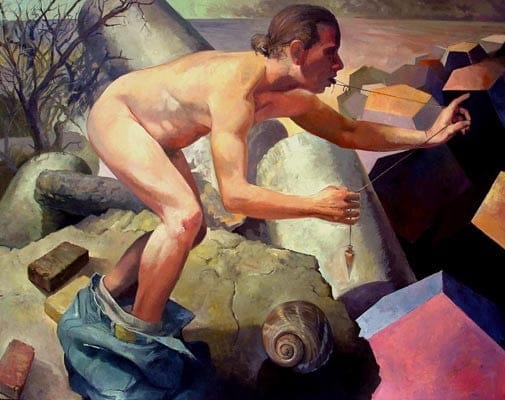
We are especially intrigued with Taming the Tongue. Can you go into more depth with this particular painting?
MB: Taming the Tongue came out of a decision I made a few years ago to never make moral statements without also aiming them at myself. It’s easy to make proclamations and claim the moral high ground, or to act as if one has the corner on truth or understanding.
So in a lot of my recent paintings I’ve steered away from a kind of universal address and focused more on speaking some truth at myself with the work. My hope is that the content of the work will come clear, that people will read my intention and contemplate the issues I’m raising without feeling as if I’m wielding some authoritarian hammer. My intention is to be moral without being a moralist, if you accept the distinction there.
So Taming the Tongue is literally about a figure balanced at a point between an inward-looking state and an outward-looking state. Without going into all of the symbology I’m using here, the left side of the picture represents the conceit of knowing that we are trained to receive and accept, while the right side is more about a vast arena of contemplation. On the left there is hard ground, strewn bricks, and the figure is stepping out of his clothes, metaphors for the conventional elements of life. At that midline – which is really the edge between those two arenas, is the shell, which always represents the divine in the world.
Stretching off into the distance on the right is a field of dodecahedrons, which have been seen since the time of Plato as a symbol for the cosmos (both physically and metaphysically) and as a form useful for inspiring the social consciousness. This idea is key to reading the dodecahedrons in my works because, though the dodecahedron stands in for the amoral stage that is the cosmos, it can be a starting point for a very moral contemplation of the relationships within that stage. Simply put, the figure is at the moment between seeing himself as a singular “island” and recognizing that we’re all in the same boat (forgive my triteness).
The unstable nature of the figure’s posture says something about how precarious these kinds of questions are. I love using bent, torqued, twisting, uncomfortable figures. They are so full of relational impact because we all know what it’s like to be off balance, out of sorts, or constrained. I want viewers to connect with the figure, to relate it to themselves in some way. Ultimately the tongue, pierced with a plumb line and tied to its weight, is the focal metaphor. Controlling or constraining the tongue becomes a picture of a broader kind of restraint. Here the negotiation is shown to be not so much an external one as an internal one. The question aimed inward: will I project myself into the world with consideration, humility, thoughtfulness, and helpfulness, or will I defy my connections to everyone else? I have to ask myself these kinds of questions.
This picture is certainly a reference to the idea of mortification of the flesh, but here I’m claiming that it’s the flesh of the heart (from which all our uttering arises) that needs mortification, not some masochistic ritual enacted upon the body itself.
 Where do you see your work taking you in the future?
MB: A few weeks ago I gave a talk at Indiana University-Bloomington and ever since have been struck by how negative my works are, not so much the smaller paintings and drawings, but rather the larger, more directed pieces. Some of this is just part of the global situation we are all in right now. I’m concerned about a great many of the issues that have come up over the last decade, not the least of which is the war and its ramifications, socially, economically, and politically.
My work comes out of what I’m thinking about, reading about, mulling over. Given the contemporary world we’re in, things are inevitably going to come off a little bleak. What I’m hoping to do is find a way to bring some more positive elements into the work, but I’ve got no clear direction on how to do this yet. I’m actively thinking about it every day and hope to find a breakthrough.
Beyond that sense of negativity, I feel like there is just so much to explore in my different bodies of work. The proliferation of ideas and my ability to progress with works has greatly increased since I started teaching full time last year. So who knows? I’ve got a lot of different arenas of inspiration, a lot of different interests and things to focus on. It’s only a matter of time until the works change, becoming more than I could imagine or know. I hope to change with them.
Note: This interview appeared on Neoteric Art, in 2008. Neoteric Art was purchased by Jasmine Directory in 2020.
