The construction industry is constantly evolving, and post-frame building construction is no exception. As we move into 2026, builders and designers are exploring new ways to make post-frame buildings more efficient, versatile, and suited to a variety of uses. These structures, known for their strong support system and straightforward assembly, continue to adapt to modern needs, offering practical solutions for commercial, agricultural, and residential projects.
One of the key trends in post frame building construction is the integration of flexible layouts and energy-conscious designs. Builders are focusing on creating spaces that can serve multiple purposes while also considering sustainability and cost efficiency.
From improved insulation methods to smarter material choices, these innovations aim to make post-frame structures more durable and functional. Understanding these trends can help property owners and developers plan buildings that meet both current demands and future expectations.
Embracing Sustainable Materials
A shift toward sustainable construction is reshaping material selection in the post-frame industry. Builders are prioritizing resources with a lower environmental footprint, such as recycled steel, reclaimed lumber, and wood certified by organizations like the Forest Stewardship Council.
This approach not only responds to calls for eco-friendly building practices but also appeals to environmentally conscious buyers. Increasingly, local building codes and incentive programs are supporting green initiatives, making sustainable choices not just preferable but often essential for new projects.
Integration of Smart Technology
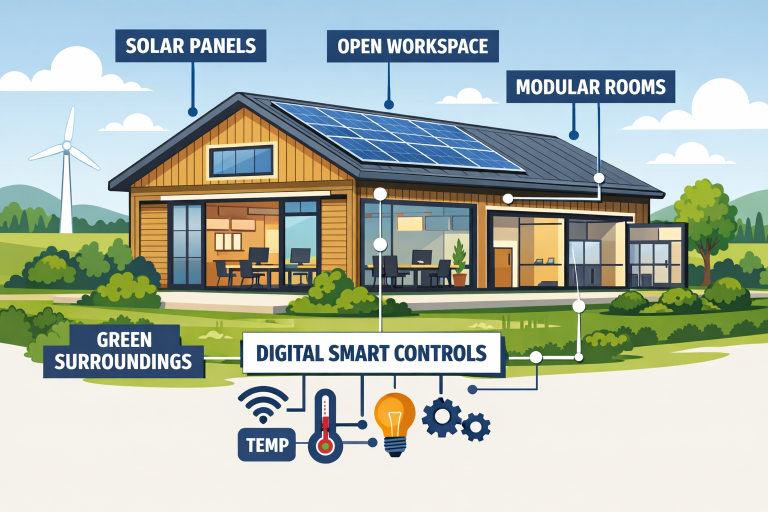
Smart technology is redefining building management in post-frame construction. Automation systems are now standard, enabling remote control of lights, HVAC, security cameras, and entryways. Building management systems allow for streamlined energy use and can adapt to schedule or weather changes, reducing unnecessary costs.
The integration of sensors and artificial intelligence creates safer, more efficient environments, while smart locks and cameras address security concerns. These technological upgrades are making post-frame buildings adaptable and highly efficient, whether used for residential access or monitoring commercial activity.
Designing Multi-Functional Spaces
Versatility is a hallmark of contemporary post-frame design. Owners increasingly seek buildings that can adapt to evolving needs, and architects are responding with open layouts and flexible interiors. For example, a building might serve as a large workspace by day and transition into an event space or storage in the evening.
Roll-up doors, movable dividers, and modular office pods are frequent features in these designs. Multi-functionality is not only about maximizing the value of a structure but also about future-proofing for changing requirements over time.
Incorporating Architectural Enhancements
Gone are the days of purely utilitarian post-frame buildings. Architectural features now play a key role in elevating the visual appeal and value of these structures. Customized touches such as stylish cupolas, inviting porches, enhanced rooflines, and decorative trim blend aesthetics with practicality.
These enhancements help post-frame buildings harmonize with surrounding properties, making them suitable for a broader range of uses, from upscale rural homes to retail and community centers. Incorporating expressive design elements ensures that post-frame structures not only function well but also look attractive and welcoming, enhancing curb appeal and resale value.
Prioritizing Energy Efficiency
Keeping operational costs low and maintaining comfortable indoor environments have become top priorities in recent years. Post-frame builders are responding by specifying high-performance insulation, thermal windows, and efficient doors, resulting in tighter, better-sealed building envelopes. Improving air sealing and reducing thermal bridging is key to achieving consistent indoor temperatures and lowering heating and cooling expenses.
Many post-frame designs now also factor in solar orientation and incorporate features such as daylighting and passive ventilation, delivering year-round energy performance without sacrificing usability or appearance.
Advancements in Prefabrication Techniques
Prefabricated construction is making waves across multiple building sectors, and post-frame construction is no exception. By manufacturing wall panels, roof trusses, and even entire building sections off-site, builders achieve remarkable consistency, precision, and speed. Prefabrication minimizes construction delays caused by adverse weather while also reducing material waste and labor costs.
Once components arrive at the project site, assembly is fast and efficient, enabling owners to occupy or use their new building in record time. In the face of ongoing labor shortages and cost challenges, prefabrication is likely to see even greater adoption throughout the industry in the coming years.
Innovative Trends in Post-Frame Building Design for 2026
1. Structural Hybridization: Post-Frame Meets Engineered Wood
Perhaps the most consequential technical development in contemporary post-frame design is the integration of mass timber components — specifically cross-laminated timber (CLT) panels and laminated veneer lumber (LVL) — into traditional post-frame structural systems. Where conventional post-frame relied on dimensional lumber columns, girts, and purlins, hybrid configurations now permit longer clear spans, improved load distribution, and superior dimensional stability under variable moisture conditions.
Bohnhoff (2014), whose body of work at the University of Wisconsin-Madison remains foundational to post-frame engineering research, identified early that column embedment depth and base fixity conditions were the primary variables governing lateral load resistance. Subsequent research has extended this framework to account for engineered column assemblies that dramatically increase allowable design values while reducing material volume — a meaningful advantage in contexts where embodied carbon accounting is increasingly mandated or incentivized.
The ASABE Standard EP484.3 (Diaphragm Design of Metal-Clad, Post-Frame Rectangular Buildings) provides the normative basis for lateral force resistance calculations in this building type, and its provisions are being revisited in the context of hybrid assemblies where CLT roof diaphragms replace traditional metal cladding — producing stiffer, better-insulated, and acoustically superior enclosures.
2. Energy Code Compliance and the Thermal Envelope Problem
Post-frame buildings have historically underperformed in thermal envelope metrics relative to light-frame wood construction, primarily because the structural columns penetrate the insulation plane — creating systematic thermal bridging. As the International Energy Conservation Code (IECC) tightens performance requirements through each cycle, this vulnerability has shifted from an afterthought to a central design challenge.
The emerging solution is continuous exterior insulation (ci) integrated with advanced weather-resistive barriers — a strategy well-documented in the broader building science literature (Lstiburek, 2010, Building Science Digest) and now being adapted specifically for post-frame geometries. Rigid mineral wool panels applied outboard of the structural framing eliminate the bridging path entirely, and their vapor-open characteristics are particularly relevant in the mixed-humid climates where post-frame construction is most prevalent. The performance outcome is a building envelope that can credibly meet or exceed IECC 2021 requirements without abandoning the structural logic that makes post-frame economically attractive.
3. Computational Design and BIM Integration
Building Information Modeling (BIM) adoption in post-frame design has lagged behind light-frame and steel construction, largely because proprietary post-frame design software — platforms such as FrameCAD and manufacturer-specific tools — operated in relative isolation from interoperable BIM workflows. That isolation is eroding. In 2024–2026, IFC-compatible export capabilities and API-accessible structural calculation engines are being integrated into post-frame design platforms, enabling the kind of multi-discipline coordination (architectural, structural, mechanical) previously reserved for commercial construction.
The practical consequence is reduced design error, improved prefabrication accuracy, and — critically — the ability to perform whole-building energy modeling on post-frame structures with the same rigor applied to conventional typologies. This removes a persistent disadvantage post-frame has faced in institutional procurement, where computational documentation of performance is often a prerequisite.
4. Residential Post-Frame and the Barndominium Maturation
The residential post-frame sector — colloquially driven by barndominium demand — is maturing from a niche aesthetic trend into a building type with codified design guidance and insurance frameworks. The National Frame Building Association (NFBA) has responded with updated residential-specific technical resources, and jurisdictions that previously offered no clear permitting pathway for post-frame residential construction are developing them.
The architectural implications are significant. Post-frame’s inherent capacity for wide, column-free interior spaces is generating residential plans of genuine spatial quality — not merely barn conversions, but purpose-designed dwellings that exploit structural logic to produce environments that conventional stud-frame construction cannot achieve at comparable cost.
References available upon request; principal sources include Bohnhoff (2014), ASABE EP484.3, IECC 2021, and NFBA Technical Guide Series.
Conclusion
Post-frame building design is experiencing remarkable evolution as we head into 2026. Driven by a combination of sustainability, technology, and the need for flexible, multi-purpose environments, these structures are now dynamic solutions for modern property owners.
The ongoing integration of smarter, more sustainable practices and architectural creativity ensures that post-frame construction remains a competitive and desirable option.
By embracing these trends, builders, architects, and owners are shaping a future where lasting value, functionality, and environmental responsibility go hand in hand.
