
The pillars of digital marketing and SEO in B2B
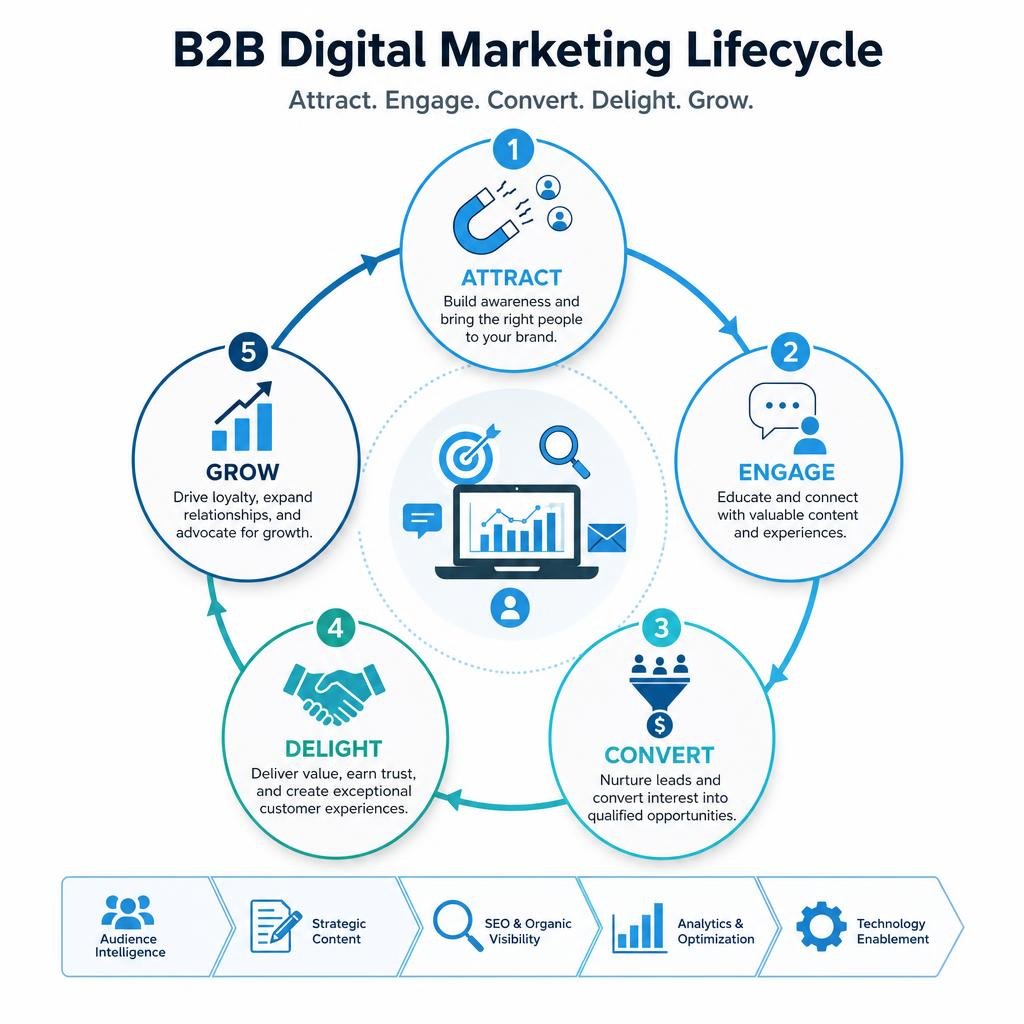
Today, business buyers conduct their own research long before speaking to a sales representative, and the traditional sales funnel has evolved alongside them. That is why digital marketing and SEO have become essential for growth, rather than optional, for B2B companies.
Procurement committees are diverse and sales cycles are long, so an online presence alone is not enough. A strategic framework is needed to attract, engage and convert the right business customers. This guide explains the differences between B2B and B2C marketing, the benefits of a well-structured digital strategy, the tactics with the greatest impact on leads and search rankings, and the trends reshaping the industry, from artificial intelligence to optimisation for generative search engines. The aim is an integrated demand generation and SEO strategy with measurable results.
B2B digital marketing encompasses all online efforts through which products or services are promoted to other companies. Unlike B2C marketing, which often targets an individual’s emotional response, B2B marketing demonstrates business value, return on investment and the potential for long-term partnerships. It builds trust, establishes authority and solves complex problems for a sophisticated procurement committee, usually comprising several people.
Manufacturers sit at the far end of that spectrum, where committees are larger and decisions slower, so marketing built for long industrial sales cycles needs tactics of its own.
The starting point is precise audience targeting, which usually begins with firmographic segmentation: grouping potential customers according to company attributes such as industry, size, turnover, location and the technologies used. Most B2B teams work with such segmentations, as they enable messages and channels tailored to the needs of each type of company.
Beyond targeting, clear brand positioning is crucial. In a crowded B2B market, differentiation is key. The digital strategy must clearly state what makes the solution unique, what problems it solves and what concrete benefits it brings to other companies, whilst the channels – from search engines and social media to email and content platforms – deliver this value proposition to the right decision-makers at the right time.
Fundamental B2B strategies and how they differ from B2C
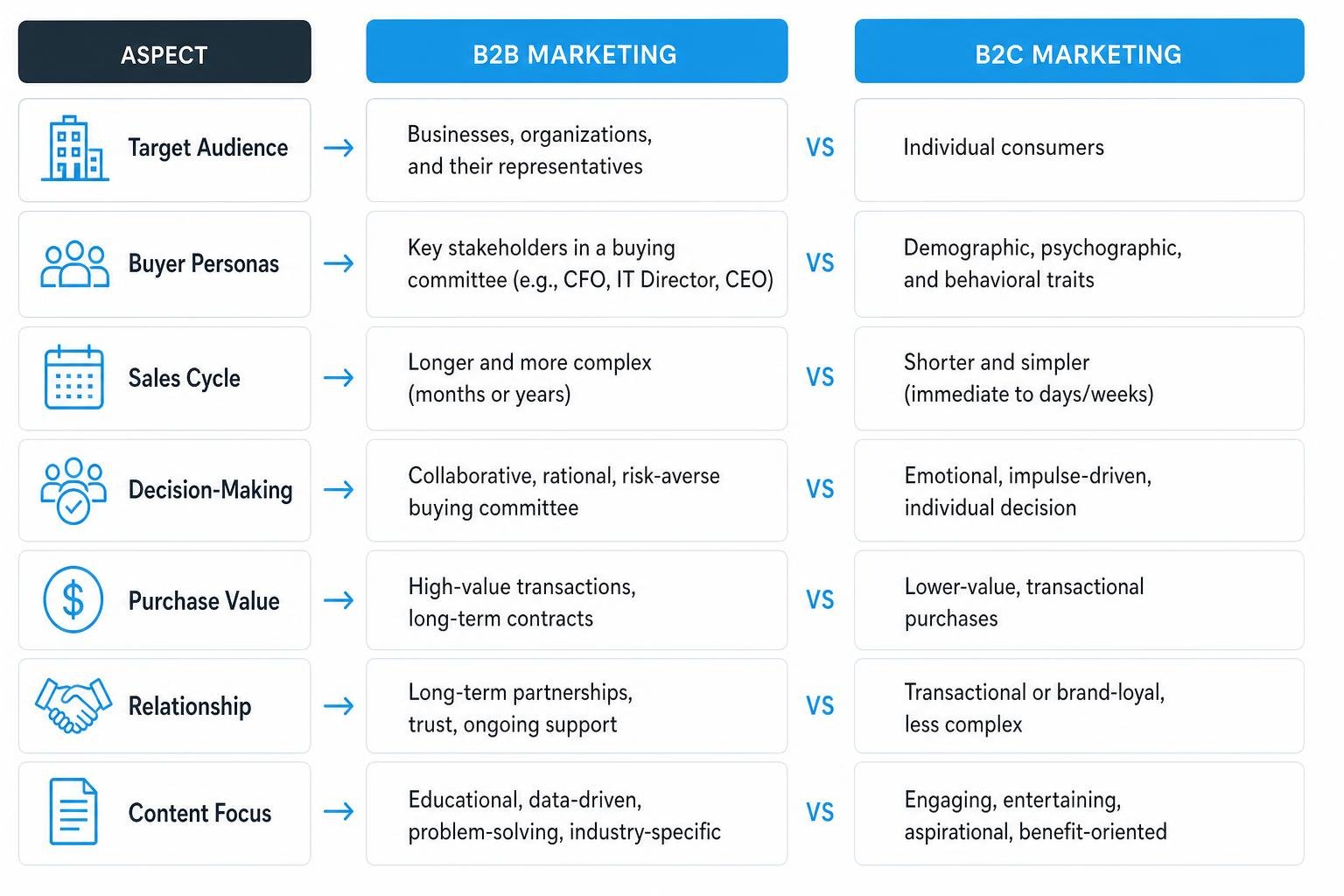
The fundamental difference between B2B and B2C lies in the nature of the buyer, the purchasing process and the motivations behind it. Understanding these distinctions makes effective strategies possible.
In B2B, the target audience consists of companies, organisations and their representatives, whilst buyer personas describe the stakeholders involved in a procurement committee – from the finance director to the IT director or the managing director – with their professional objectives, challenges and decision-making authority. The sales cycle is typically long and complex, spanning months or even years and involving numerous touchpoints and approvals. The decision is collaborative, rational and prudent, made by several people who evaluate solutions based on logic, return on investment and long-term strategic fit. Transactions are high-value, involving substantial financial investments and long-term contracts, and the relationship emphasises partnership, trust and ongoing support. The content is educational, data-driven, problem-solving oriented and industry-specific.
In B2C, the audience is the individual consumer, and buyer personas are built on demographic, psychographic and behavioural traits. The sales cycle is short, often immediate or lasting a few days or weeks. The decision is often emotional, impulsive and individual, although influenced by social factors. Purchases are typically of low value and transactional in nature; the relationship may be transactional or based on brand loyalty, but is rarely as complex as in B2B, and the content is engaging, entertaining, aspirational and benefit-centred.
The rise of digitally native buyers – Millennials and Generation Z – who, according to recent surveys by analytics firms, are taking an increasing role on procurement committees, is blurring some boundaries but reinforcing the need for digital sophistication. These buyers expect frictionless online experiences and extensive self-service options, just as in their B2C interactions. However, their professional motivations and the complexity of the B2B procurement process remain the same.
The 95-5 rule and demand generation
A central concept of B2B strategy, and one that will be all the more relevant in 2026, is the 95-5 rule. It states that, at any given time, only 5 per cent of the target audience is actively in the market, ready to buy. The remaining 95 per cent are outside the market: they are not currently looking for a solution like yours.
This rule profoundly changes the way we approach digital marketing. It highlights the need for a balance between capturing demand, on the one hand, and brand awareness and demand generation, on the other. Traditional performance marketing, such as PPC, aims to capture the 5 per cent who are actively searching, but a significant portion of efforts must be dedicated to the 95 per cent who are not yet in the market.
This involves building the brand for the long term, through value, expert insight and solutions to common industry problems, even when prospects aren’t buying, so that the brand is the first to spring to mind when they enter the market. It involves educating and influencing them through content, social media and SEO, which subtly position the offering as the natural choice. And it requires a constant presence, so that those 95 per cent already know who you are by the time they become buyers.
Those who ignore the 95 per cent forgo future opportunities and rely solely on the small fraction of immediate buyers. An effective B2B strategy therefore integrates short-term demand-generation tactics with long-term brand-building initiatives, to create a sustainable sales pipeline.
Integrating SEO and content marketing for lead generation
In a B2B market where purchasing decisions are carefully weighed up and researched, content marketing is the engine that drives SEO, and together they generate leads. Content marketing is more than just blog posts: it involves the strategic development and distribution of valuable, relevant and consistent content that attracts and retains a clearly defined audience and ultimately drives them towards profitable action.
The role of content in SEO and B2B lead generation is multifaceted:
- Attracting organic traffic. High-quality, search-optimised content answers questions, solves problems and offers insights that B2B buyers are actively seeking. It helps the website rank higher and drives organic traffic.
- Educating throughout the buying journey. B2B buyers conduct extensive research. Effective content covers every stage, from problem awareness to solution evaluation and the final decision, through articles, studies, client case studies, webinars and interactive tools. Industry surveys consistently show that a significant proportion of content teams attribute poor results to a failure to align their efforts with the customer journey – a common mistake.
- Building authority. Expert content, produced consistently, positions the company as a leader in its field and builds the credibility and trust on which B2B relationships depend.
- Lead generation. Content with restricted access, such as white papers or templates, enables the collection of contact details and transforms anonymous visitors into identifiable leads. For many B2B companies, SEO ranks among the primary sources of leads, with a direct impact on the sales pipeline.
- Sales support. Sales teams use content to nurture leads, address objections and provide prospects with the information they need to move forward.
Aligning your content strategy with keywords and the information needs of your target audience significantly improves search rankings and delivers a steady stream of high-quality organic leads.

Optimising digital marketing and SEO for modern search engines
For SEO to generate leads and improve rankings, B2B companies need an approach that goes beyond keywords. Modern SEO comprises several critical components:
- Strategic keyword research: identifying high-volume terms, as well as long-tail queries with strong intent that indicate a specific problem or stage in the buying cycle. Competitor analysis tools help to uncover them.
- Technical excellence: a technically sound website is the foundation. Speed, mobile responsiveness, crawlability, indexability and structured data. If the website is slow or difficult to navigate, even the best content will not rank.
- On-page optimisation: each page features relevant keywords in titles, subheadings, meta descriptions and the body text, whilst ensuring readability and value for the reader.
- Off-page SEO and link building: building authority through high-quality backlinks from reputable industry websites, signalling to search engines that the site is trustworthy and valuable.
- Local SEO, where applicable: for B2B companies with a physical presence or specific geographical regions they serve, optimisation for local search terms is crucial.
The aim is a website that is easily discoverable by search engines whilst also providing a high-quality experience for the discerning B2B buyer. For companies seeking specialised expertise in strengthening their online presence, dedicated SEO services and content marketing can provide the necessary strategic direction and execution.
Generative Engine Optimisation (GEO) and AI Trends
The industry is undergoing a major transformation with the rapid advance of artificial intelligence and the emergence of generative engine optimisation (GEO). The adoption of AI in B2B organisations has become the norm, particularly for content creation and data analysis, and is reshaping the way companies approach marketing.
GEO refers to the strategies through which content and digital assets are optimised for generative models and conversational search interfaces. In February 2024, Gartner predicted that by 2026 the volume of traditional searches would fall by 25 per cent, as users turn to tools such as ChatGPT, Gemini or Copilot. That time has come, and whilst the decline has not occurred on the scale predicted, the shift of a proportion of queries towards response engines is real and ongoing.
For B2B marketers, this means:
- Focus on conversational search: content must be structured to answer complex, multi-part questions in a natural tone, anticipating how AI models synthesise information.
- Fact-based authority: AI models favour accuracy and authoritative sources. B2B content must be carefully researched, cited and written by someone who knows what they are talking about.
- Structured data and semantic SEO: schema markup and semantic relationships between topics help AI understand the context and relevance of content.
- Unique perspectives and value: AI can generate vast amounts of text, so B2B companies differentiate themselves through their own perspectives, original data and expert opinion that a machine cannot replicate. Most marketers are already using AI in their content strategies, and the focus is shifting from quantity to quality and distinctiveness.
GEO does not replace traditional SEO, but complements it. SEO ensures discoverability through keywords; GEO ensures content is understood and utilised by the new generation of search tools, so that the brand remains present in the evolving search ecosystem.
High-impact execution: email automation, social media and key metrics
Beyond attracting visitors through SEO and content, B2B digital marketing requires robust strategies for engaging, nurturing and converting leads. This is where email marketing, automation and the strategic use of social media become indispensable, all underpinned by rigorous performance analysis.
Nurturing via email and paid channels
Email marketing remains one of the most powerful tools in the B2B marketer’s arsenal, with one of the best returns on investment across all channels in industry surveys. In B2B, its strength lies in lead nurturing and long-term relationships.
- Personalised nurturing sequences: after capturing a lead, for example through gated content, automated sequences deliver tailored content, customer case studies and product information based on the lead’s industry, role and expressed interests, and move them through the sales funnel.
- Segmentation: dividing lists by firmographics, behaviour or stage of the buyer’s journey enables highly relevant communication.
- Automation: automation platforms send personalised emails, schedule follow-ups and measure engagement at scale, without manual intervention, so that teams can focus on strategy.
- Account-based marketing: email can be a central component of ABM strategies, with personalised messages for specific accounts or decision-makers.
In addition to organic strategies, paid channels such as PPC advertising play an important role in capturing B2B demand. PPC enables precise targeting of buyers who are actively in the market, using high-intent keywords, so that the solution appears at the top of the results exactly when prospects are ready to buy. The PPC budgets of a medium-sized B2B company typically exceed the monthly cost of an SEO project several times over, a difference that reflects the immediate nature of direct response.
Social media is no longer just for B2C. A significant proportion of B2B buyers use platforms such as LinkedIn, X or YouTube prior to making a purchase to research suppliers, gather feedback from peers and track trends. A strong social media presence builds credibility and provides yet another point of contact. For an approach that integrates these diverse strategies, partnering with a full-service marketing and creative services agency can be of great help.

B2B metrics and measurement
Without clear metrics, strategies cannot be optimised, performance cannot be demonstrated, and the next investment cannot be justified. Of the many possible metrics, a few are critical in B2B:
- Conversion rate: probably the most important. It measures the percentage of visitors or leads who take the desired action, from downloading a resource to completing a form or requesting a demonstration. A high rate indicates that the marketing resonates with the audience and leads them towards a sales conversation.
- Customer acquisition cost: the total cost of sales and marketing for a new customer. A low cost is essential for profitability.
- Lifetime value: the estimated revenue a customer will generate over the course of the relationship. In B2B, where relationships are long-term, a high lifetime value justifies a higher initial acquisition cost.
- Return on advertising spend: the revenue generated for every dollar spent on adverts, essential for evaluating PPC and other paid campaigns.
- Qualified marketing and sales leads: the quantity and quality of leads generated by marketing, and how many of these are accepted and followed up by sales.
- Website traffic and engagement: whilst not a revenue metric, the source of traffic – whether organic, paid or social – and how users behave, as indicated by bounce rate and time on page, reveal a great deal about the effectiveness of the content and the user experience.
By monitoring these indicators, B2B marketers continuously refine their strategies, allocate resources efficiently and demonstrate the tangible impact of their digital efforts on financial results.
Frequently Asked Questions
How do digital marketing and SEO generate long-term revenue in B2B?
Through an online presence that consistently attracts and nurtures qualified leads. Sustained efforts in content creation, technical optimisation and strategic promotion deliver greater organic visibility and position the company as an industry leader. This results in a steady flow of high-quality leads, a more efficient sales pipeline and, ultimately, predictable revenue growth, built on authority and trust accumulated over time.
How long does it take to see SEO results in B2B?
SEO in B2B is a long-term investment. Some improvements in rankings and traffic may appear within a few months, but consistent results usually take between 6 and 12 months – the time it takes for indexing to take place, to build domain authority through quality content and backlinks, and to carry out optimisation in successive stages. Patience and consistent effort are essential.
What is the 95-5 rule in B2B marketing?
The rule states that only 5 per cent of the target audience is actively in the market at any given time. The remaining 95 per cent are not currently looking for a solution. Hence the need to strike a balance between capturing short-term demand – for the 5 per cent – and building the brand and generating long-term demand – for the 95 per cent. A successful B2B strategy works with both segments.
Positioning: in the buyer’s mind and in the machine’s memory
The 95-5 rule in the guide has an older counterpart, formulated half a century before anyone spoke of response engines. In 1972, Al Ries and Jack Trout published in *Advertising Age* a series of articles that would go on to become, in 1981, the book *Positioning: The Battle for Your Mind*, with a simple yet uncomfortable thesis. Positioning is not something you do to the product, but something you do to the prospect’s mind. In an over-communicated society, the mind defends itself by simplifying; it retains a single word for each brand and rejects any information that does not tie in with what it already knows. The 95 per cent who aren’t buying today aren’t an audience to be persuaded, but a space in their memory to be occupied before they start searching. The thesis was written with consumer goods in mind, but it illustrates the B2B context even better, as a committee remembers even less than an individual.
Read in this light, the guide above takes on a new perspective. Content for the 95 per cent does not educate, but rather places a word on a shelf in the mind that only opens on the day the need arises. The positioning that the guide identifies as one of the primary conditions is precisely this word, and Ries and Trout add the warning that B2B marketing most often overlooks: the shelf has only one space. A company that wants to be the cheapest, the safest and the most innovative does not occupy three shelves, but none at all. The guide says the same thing in other words when it calls for differentiation; Ries and Trout merely add that differentiation is measured in the customer’s mind, not in a brochure.
The theory has its limitations, as its critics have pointed out since the 1980s. It is built on case studies and aphorisms, not on experiments. It relies on a psychology of memory that research since then has refined, and was written for an era in which the message came from above, via advertising, not from the buyer’s active search. It is precisely this last limitation, however, that makes it relevant once again, in a way its authors could not have foreseen. Today, the B2B buyer consults two sources of memory: their own and that of a machine.
A response engine – be it an overview on a search results page or a conversational assistant – constructs a representation of each company, pieced together from everything it has read about it. This representation is, in the terms of Ries and Trout, a positioning – with a game-changing difference. A prospective customer’s mind could once be influenced by repetition. The machine constructs its representation from sources, weighs them up according to how verifiable they are, and has no reason to believe what a company says about itself. For the machine, repetition without sources is just noise.
What a search engine cannot verify
The section on GEO in the guide calls for fact-based authority, cited content and structured data. All of these are correct, and all share the same weakness: they are self-descriptions. The schema markup states what the company claims about itself, not what is true. A system that took such claims at face value would be easy to fool, so it doesn’t. It triangulates: it searches for the same entity in independent sources, checks whether the name, address, category and description match, and favours sources where someone has already verified the entry before publication. The way in which AI overviews select the directories they cite is extensively documented, and the pattern is consistent: editorial provenance, consistent data, and a stable history. For a B2B firm, this list is a to-do list, not a theory.
The difference between curated and automated sources matters here more than anywhere else. An aggregator that lists anyone who pays generates noise that the machine learns to ignore; a directory in which a human editor has rejected what they could not verify generates a signal. The comparison between curated and automated directories in terms of AI citation performance puts the phenomenon into figures, and the conclusion matches the guide word for word: in the GEO era, authority is not self-declared, but confirmed from outside.
It is also worth mentioning what happened to the prediction cited by the guide, as it says something about the discipline of facts. Gartner announced in February 2024 that the volume of traditional searches would fall by 25 per cent by 2026, in favour of conversational assistants. The year has come and gone, and the figures published in 2026 show that the dominant search engine retains over 90 per cent of the market. The decline did not occur on the scale announced, although a significant proportion of queries did indeed shift to conversational interfaces. The lesson for a guide that demands fact-based authority is that a prediction cited without its date becomes, after two years, a false statement. A verified fact requires a source, a date and, once the timeframe has expired, a review of it. Guides that remain online for years on end inherit the predictions they have quoted.
The same discipline applies to the choice of marketing providers. SEO and content agencies, including those to which the guide refers, sell a service that is difficult to assess in advance, with results visible after 6 to 12 months, as the FAQs section itself states. Verification follows a specific order. Existence and category come first. An editorial category of search engine optimisation agencies and services, in which every entry has been verified by a human before publication, answers this question without making any further claims. Next comes the test that no agency can avoid: the ranking of its own website for the services it sells. Then come references with names and a written scope of work, including deliverables, not promises of rankings. A written objective with deliverables can be verified in six months’ time; a promise of a top-of-the-page ranking can never be verified, because the top of the page is different for every search term.
Directories, paid adverts and the 95%
The guide places PPC in the 5 per cent category and brand building in the 95 per cent category – a fair division, but one that leaves a gap. Paid advertising disappears the moment the budget runs out, whilst brand content only reaches the 95 per cent if they come across it. Between the two lies a layer that B2B marketing has neglected for a decade. It is a verifiable and sustainable presence – the one a buyer encounters on the day they enter the market, without the company having paid for a click on that particular day. The comparison between directory listings and paid adverts highlights this difference in terms of cost, duration and the type of buyer reached. Her conclusion complements the guide, rather than contradicting it: advertising captures attention, but a verified presence endures. Those 95 per cent aren’t looking for today’s advert; when they enter the market, they find the presence that remained from yesterday.
For B2B companies, this layer takes a specific form. The company’s details must appear identically across all sources – name, address, category and description. A procurement committee compares, within the same week, the website, the social media profile, a director’s profile and a generated response; any contradiction between them costs more than just a lost contract. A listing in an editorial category such as marketing and advertising services is useful only insofar as it says the same thing as the other sources; one that contradicts the company’s own website is a liability. The check takes an hour per quarter and is carried out by searching for the company as a stranger would.
The B2B buyer, in turn, has their own problem with discoverability, and the guide describes it without naming it when discussing the committees’ lengthy research. The companies with which such a committee works – suppliers, partners and service providers – are searched for using the same tools and with the same scepticism. A curated category of suppliers and services for companies does for the buyer what the categories above do for the agency: it confirms existence, category and contact details before any other judgement is made. This shortens precisely the research phase that the guide describes as being the longest. Anyone selling to one committee is, at the same time, being bought by another, and both roles use the same sources.
What this layer cannot do must be stated just as clearly. An editorially verified listing confirms that a firm exists, that it can be contacted, that it operates in the category shown and that it can still be found in a year’s time. It does not guarantee the quality of services, it does not serve as a substitute for references, and it replaces neither the test of one’s own position nor the written work objective. Each layer answers a different question, and the test remains with the buyer, with questions set out in writing. In the words of Ries and Trout, all of these together do one thing: they keep the company’s word on its shelf, in the buyer’s mind and in the machine’s memory, until the day when the 95 per cent become the 5 per cent.
Conclusion
Digital marketing and SEO in B2B are dynamic, complex and full of potential for those willing to adapt. In 2026, the need for B2B companies to adopt sophisticated digital strategies is clearer than ever, from understanding the differences between B2B and B2C buyers to utilising artificial intelligence and optimisation for generative search engines, with strategic planning and continuous optimisation.
By focusing on the core pillars – precise targeting, robust content marketing, technical SEO and intelligent automation, companies are building a resilient digital presence that generates leads and cultivates long-lasting relationships. The 95-5 rule reminds us that, alongside capturing immediate demand, nurturing future buyers through consistent brand-building is just as important for sustainable growth. Beyond traffic and rankings, what matters is measurable business outcomes, greater value from each customer, and a brand that remains competitive and relevant in an increasingly digital world. Aligning the digital strategy with the company’s overall objectives paves the way for growth and genuine digital transformation.
