Project owners want delivery that moves faster and carries less risk. Click here to learn how design-build construction changes the process by putting design and construction under a single contract, which makes collaboration and accountability easier to manage.
Traditional methods split those roles across separate contracts. Design-build combines them, so there are fewer handoffs where information gets lost and fewer moments where one party blames another for a problem neither wants to own. That shortens timelines, which is why both private developers and public agencies choose it.
The approach has spread among developers, municipalities, and institutions because it removes duplicated work and gives stakeholders one workflow to follow. Fewer delays and lighter administrative load follow from that single point of responsibility.
Digital tools add to the case. Modeling and coordination software let a design-build team refine quality and schedule earlier, which makes the method a practical alternative to design-bid-build and construction-manager-at-risk arrangements.
You see the value most clearly in publicly funded work, public-private partnerships, and large infrastructure builds. As agencies get comfortable with it, its share of the market keeps rising. For more on project delivery models and current practice, this ENR resource offers a detailed look at how firms are working today.
What is design-build?
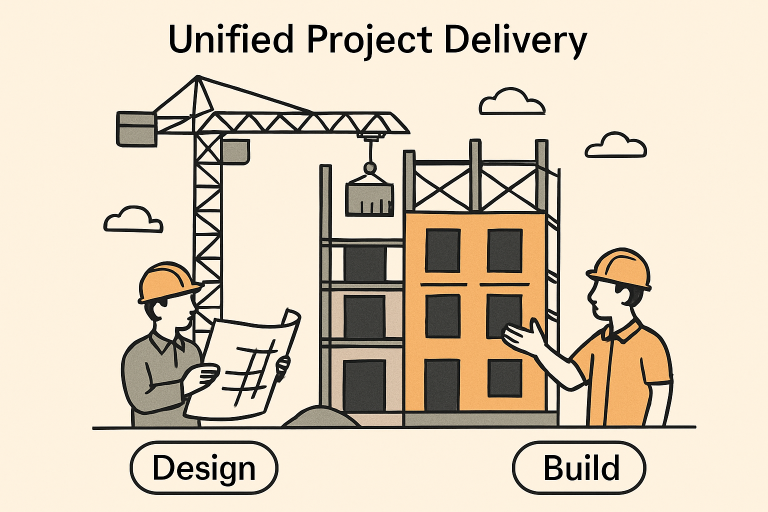
Design-build is a delivery method in which one entity, the design-build team, runs both the design and construction phases. Combining those responsibilities removes the silos that usually stand between architects, engineers, and contractors, which cuts down on the conflicts and miscommunication that slow work or push up cost.
Compared with design-bid-build, design-build brings everyone to the table early. Architects, engineers, and builders can test ideas, spot problems, and tighten the workflow from the first day. That matters most on complex projects that need creative solutions and steady adjustment as they progress.
Benefits of design-build
Owners, architects, and builders turn to design-build for several concrete reasons:
- Faster completion. Data from the Design-Build Institute of America shows projects finish about 12% faster than those run with traditional methods.
- Cost savings. Early collaboration surfaces ways to trim expenses, hold budgets, and avoid the expensive changes that surface mid-construction.
- Better collaboration. A single team shares goals and owns the outcome together, which tends to produce cleaner results and more satisfied stakeholders.
These gains hold up in both commercial and infrastructure work, as McKinsey and Company’s research on construction productivity confirms.
Design-build in public projects
Government agencies and public bodies increasingly use design-build to boost efficiency and hit tight deadlines. New York City is a clear example: across 42 projects, the city saved an estimated 50 years of project time and $1.4 billion in cost. Those numbers show what the method can do for schedule and budget on major public works.
Transparency and accountability also appeal to public-sector managers, who work under close scrutiny and strict regulation. When one team catches and settles issues early, agencies deliver complex infrastructure with more confidence and fewer change orders.
Technological advancements in design-build
New technology sharpens what design-build already does well. Building Information Modeling (BIM) gives every stakeholder an accurate, data-rich digital version of the project, so coordination happens on screen before it happens on site. Digital twins, virtual replicas of physical assets, support real-time monitoring and predictive analysis, which cuts down on surprises during construction and later operation.
Cloud-based platforms and modern software connect field crews with office staff, so updates, clash detection, and plan changes move in real time. The result is less rework and tighter quality control across the whole schedule.
How owners find and vet a design-build team
The method only works if you can find a capable team and check its track record before signing. That is harder than it sounds, because the search results you see are not a neutral map of every firm that exists. Safiya Umoja Noble, in Algorithms of Oppression (2018), shows that commercial search rankings are shaped by advertising and private interests, so treating a search engine’s first page as the full picture is a mistake. Owners who rely on it alone can miss well-qualified firms that simply rank lower.
That is why curated listings, professional association rosters, and human-edited directories still earn their keep. A vetted list narrows the field to firms that meet a stated bar, which saves you from wading through pages ranked by ad spend rather than fitness for the job. Reviews and reputation carry weight here too. Rachel Botsman, in Who Can You Trust? (2017), describes a shift toward what she calls distributed trust, where ratings and platform reputation let people extend confidence to firms they have never worked with. For a design-build selection, that means reading past clients carefully, checking how a firm handled disputes, and confirming its claims against independent sources rather than its own marketing.
Challenges and considerations
Design-build has real drawbacks to plan for. Contractual roles and risk allocation need clear definition up front. Without well-drafted agreements, disputes can grow over scope, cost, or who is responsible for what. Owners and design-build teams should spend time structuring contracts that protect everyone and spell out expectations in plain terms.
Quality control is the other watch point. Collaboration helps, but it does not replace oversight. Steady communication and firm standards during and after construction are what keep the finished project at the level the owner paid for. Proactive quality management protects long-term value long after the crew leaves.
Future of design-build
Forecasts point to continued growth. The method is expected to account for more than 47% of U.S. construction spending by 2028, driven by the rising complexity of modern projects and owners who want speed, cost, and quality in one package.
Spending on design-build is projected to top $1.1 trillion in the coming years, which reflects how central it has become to how the industry builds.
As digital coordination, sustainability requirements, and modular construction advance, design-build offers a flexible framework for meeting new demands while keeping results predictable. If you are weighing it for your next project, start with the contract and the team: define risk allocation in writing, then vet candidates through independent sources rather than a single ranked page. Get those two things right and the schedule and budget advantages follow.
