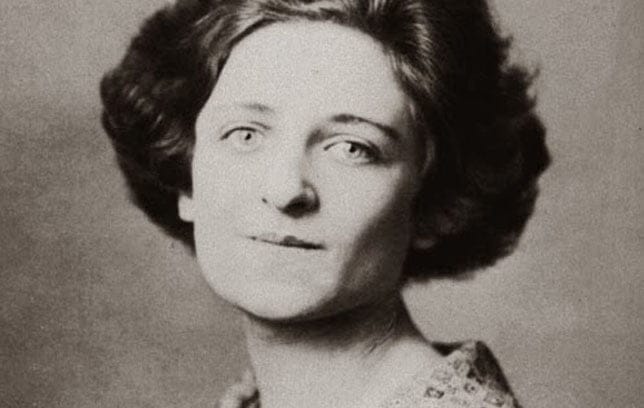
Few people in any lifetime are gifted enough to start a movement or reach an entire generation through the written word. Laura Riding had that ability, and she held readers largely because of how she approached literature. Her fresh take on expression, her stark views on life, and her habit of layering meaning gave readers a reason to stop. That pause gave the reader time to think and work through each layer of a piece. Once the layers were peeled back, and they all had to be peeled back to feel the full effect, you could see her source of inspiration and her goal for a given piece of writing.
Early life in the United States of America 1901-1925
Laura was born on January 16, 1901, in New York, and Laura Reichenthal was her family name, given to her by a family of Austrian Jewish immigrants. At seventeen she was accepted to Cornell University, where her love for writing poetry began to grow. It was also at Cornell that she first married, in 1920, to a history professor named Louis Gottschalk. During this early marriage many of her early works were published under the name Laura Riding Gottschalk. As the years went on, her editorial name changed as her personal situation changed.
Laura learned the craft of publishing, and her work drew the attention of The Fugitives, a scholarly and literary magazine. The Fugitives operated on the Vanderbilt University campus, and although its run was short (1922-1925), it is still counted among the most influential American publications. Its work, and Laura’s additions in particular, became the foundation of the New Criticism literary movement.
A turning point came in 1925, when she divorced the professor and moved to Europe at the invitation of the married couple Robert Graves and Nancy Nicholson. Fourteen years passed before Laura returned to her home country.
A productive mid-life and European tour (1926-1939)
Laura Reichenthal published her first collection of poetry, The Close Chaplet, in 1926, then adopted the surname Riding the following year. Although this came before the book she co-authored with Graves, A Survey of Modernist Poetry, the views on poetry she would express there were already public and taking hold in this early work. The Close Chaplet was also where her distinctive use of free verse over conventional meters, which added complexity and multiple meanings to a piece, was first noticed.
Riding’s life on the Continent began in London, where she and Graves worked together on “A Survey of Modernist Poetry and a Pamphlet Against Anthologies,” published by the Seizin Press in 1927. Its commentary treated poetry as a body of work that grows and matures. Poets were urged to drop worn out styles of writing and to hold off the death by suicide symptom in the life of a poem. The text left a simple but pointed instruction:
“It must be admitted that excessive interest in the mere technique of the poem can become morbid both in the poet and the reader, like the composing and solving of crossword puzzles. Once the sense of a poem with a technical soul, so to speak, is unriddled and its patterns plainly seen, it is not fit for re-reading; as with the Sphinx in the fable, allowing its riddle to be guessed is equivalent to suicide. A poem of this kind is nevertheless able to stave off death by continually revealing, under examination, an unexpected reserve of new riddles; and as long as it is able to supply these it can continue to live as a poem.” (p. 25)
From Laura Riding and Robert Graves, A Survey of Modernist Poetry, rpt. (St. Claires Shores, MI: Scholarly Press, 1972).
Encouraging a writer to keep stacking complex and hidden meaning within a text does open up greater discussion, stretches the intellect, and adds to the conversation happening within a society.
During this period Laura’s life fell into the self-destructive habits found in most people but often amplified in the gifted. While living in London she became intimately involved with Graves, which led to his divorce from Nicholson. Feeling guilty for her part in the breakup, Riding attempted suicide in 1927. She survived, and in 1935 she published Progress of Stories, a compilation of 18 stories with an additional 13 that she selected. After the failed suicide attempt and the end of Graves’s marriage, both Riding and Graves decided to move to Majorca, Spain, staying until the outbreak of the Spanish Civil War in 1936.
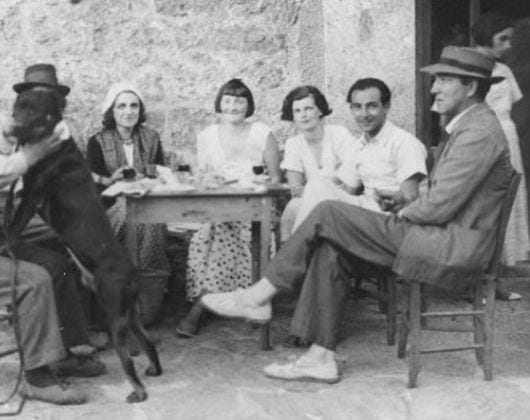
The eight years spent in Spain were highly productive, with visits and collaborations involving artists such as Honor Wyatt, John Aldridge, Jacob Bronowski, James Reeves, Len Lye, and Norman Cameron. The house the artists used was eventually turned into a museum in their honor.
An overlapping period of moving and writing ran through 1935-1938, when the Seizin Press published a hardbound magazine called Epilogue. This critical magazine was edited by Riding, with Graves as associate editor. During the war and for three years after, Riding continued her European tour, visiting Switzerland, France, and returning to England before finally going home with Graves to the USA in 1939.
Laura’s final years in the USA (1939-1991)
Riding and Graves’s time in the USA began in New Hope, Pennsylvania, and lasted until their final split later that same year. Two years later, in 1941, Laura married Schuyler Jackson and moved to Wabasso, Florida, where she stayed until her death in 1991.
1941 was an infamous year for Laura because of several major decisions that changed her life. The first big one was her clean break from writing and the literary community, all at once. She never gave a clear or official explanation for this sudden and shocking departure. For some years a book reference in 1955 hinted at her reasons. Then, in 1962 on the BBC Third Programme, Laura read “Introduction for a Broadcast,” which laid out her first official reason for renouncing poetry.
The closing chapters of Laura Jackson’s, nee Riding’s, life had their own drama. In 1968 her husband died, and the home they had occupied was later renovated and preserved by the Laura (Riding) Jackson Foundation. Her former partner published a book called The White Goddess; a review of it upset Riding greatly because of her indirect help in its making.
The personal impact of Laura Riding’s work
The poem below shows the range of Riding’s writing, with a suggested reading based on the personal interpretation and impact felt after reading it.
Yes and No
Across a continent imaginary
Because it cannot be discovered now
Upon this fully apprehended planet
No more applicants considered,
Alas, alas
Ran an animal unzoological,
Without a fate, without a fact,
Its private history intact
Against the travesty
Of an anatomy.
Not visible not invisible,
Removed by dayless night,
Did it ever fly its ground
Out of fancy into light,
Into space to replace
Its unwritable decease?
Ah, the minutes twinkle in and out
And in and out come and go
One by one, none by none,
What we know, what we don’t know.
The mystery of being Laura, paired with the mystery of being a highly functioning woman in a world of hard limits, comes through clearly here. She sets up a contrast: mankind can travel across the world and know the physical planet intimately, yet fails completely to understand the struggles of “an animal unzoological,” meaning a woman. This is not her only comment on her struggles as an artist and a woman, but it points to the thing that unites all humans, the passing of time and the worlds known and unknown.
The personal impact here is heightened by her very early principle of adding complex ideas with multiple meanings and interpretations to each poem. You would expect that at different stages of life, or through personal experience, the hidden meaning or meanings become plainer. That makes reading for life an engaging and rewarding relationship.
