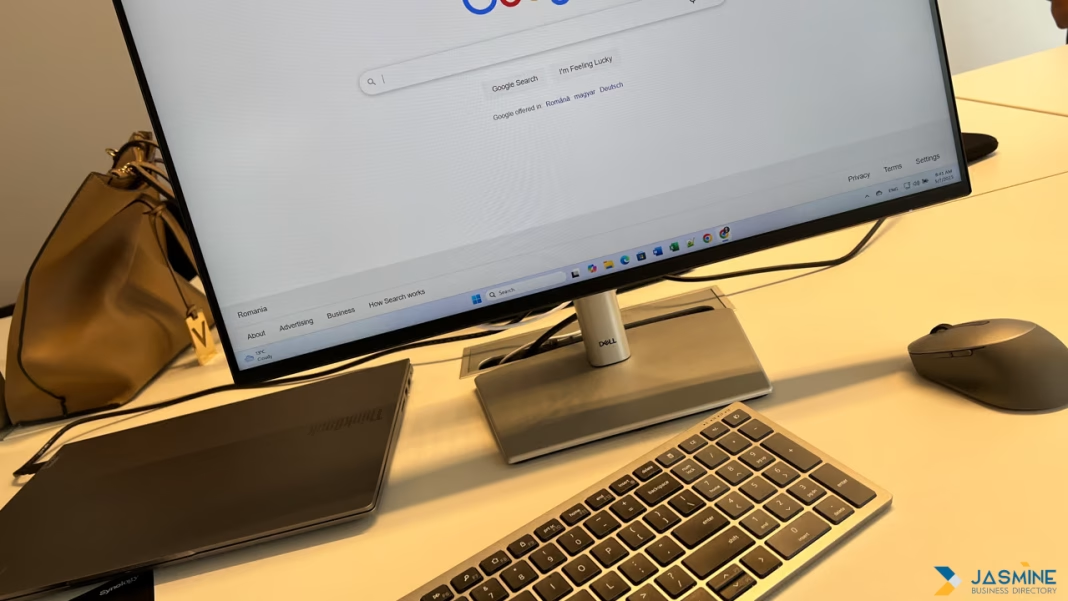
The numbers are hard to ignore. According to a industry professionals on Reddit, even established websites with decade-long histories are seeing sharp traffic declines as AI-generated responses replace organic search results. This isn’t limited to content farms or questionable sites. Legitimate small businesses are feeling the impact across sectors.
For a small business owner, competing with AI doesn’t mean fighting it. It means working alongside it while building advantages that automated systems cannot copy. This article gives you practical, evidence-based strategies for small businesses to not just survive but thrive in this new SEO reality.
Predictions about 2025 and beyond rest on current trends and expert analysis, so the actual future may differ.
Essential strategies for strategy
The fundamental approach to SEO has shifted a lot in 2025. Here are the core strategies small businesses should put in place:
1. Hyper-local optimisation
AI systems are good at general information but often miss local detail. The U.S. Small Business Administration stresses gathering demographic information to understand where you can gain customers in specific locations.
- Create content that addresses neighbourhood-specific concerns and opportunities
- Build relationships with other local businesses for cross-promotion
- Develop location-specific landing pages with genuine value (not duplicate content)
- Take part in community events and document them on your site
2. E-E-A-T enhancement
Experience, Expertise, Authoritativeness, and Trustworthiness (E-E-A-T) matter more than ever in 2025. AI can compile information but cannot actually experience your industry or build real expertise.
- Show team credentials, certifications, and real-world experience prominently
- Document case studies with specific metrics and outcomes
- Get and highlight industry recognitions and awards
- Contribute to industry publications
- Write a detailed “About Us” section that tells your real story
3. Strategic directory listings
Quality business directories have regained importance in 2025 because they give AI systems structured, verified business data. Being listed in reputable directories like jasminedirectory.com gives small businesses extra visibility outside the increasingly crowded organic search results.
The main benefits:
- Better local search visibility
- Extra citation sources that AI systems reference
- Quality backlinks from established domains
- More trust signals for search algorithms
Actionable facts for businesses
To build effective counter-strategies, you need to understand the current state of AI in search. Here are evidence-based facts to guide your approach:
Competition has changed in a few key ways:
| SEO Factor | Pre-AI Impact (2022) | Current AI Impact (2025) | Small Business Strategy |
|---|---|---|---|
| Featured Snippets | Featured position with click-through potential | AI often answers questions directly, reducing clicks | Focus on complex queries AI can’t fully answer |
| Local Search | Map pack + organic results | AI-curated recommendations with fewer options shown | Maximise reviews, local citations, and community engagement |
| Content Depth | Comprehensive content ranked well | AI summarises multiple sources, reducing need for in-depth reading | Create experience-based content AI cannot replicate |
| Keyword Targeting | Specific keyword matching was effective | AI understands intent beyond keywords | Focus on solving specific problems rather than keyword density |
| Backlink Quality | Primary ranking factor | Important but balanced with user engagement signals | Build relationships for genuine endorsements |
AI’s current limitations
Even with recent advances, AI systems in 2025 still struggle with:
- Real-time information: Most AI systems have knowledge cutoffs and aren’t continuously updated
- Highly specialised expertise: Niche industry knowledge often lacks sufficient training data
- Emotional intelligence: Reading customer sentiment and responding appropriately
- Hyperlocal knowledge: Details about very specific localities or communities
- Experiential insights: First-hand accounts and personal experiences
Practical analysis for strategy
Here is how small businesses can put AI-resistant SEO strategies into practice:
Conduct an AI vulnerability audit
Start by working out which parts of your online presence are most exposed to AI disruption:
- Query assessment: Identify your top-performing keywords and test them in AI-enhanced search engines. Are your queries now answered directly by AI without requiring a click to your site?
- Content uniqueness: Check whether your current content offers information that AI systems can easily compile from multiple sources.
- Experience documentation: Decide if your content effectively communicates experiences and expertise that AI cannot replicate.
- Local presence strength: Assess how complete and consistent your local business information is across platforms.
Develop AI-resistant content types
Some content formats have held up better against AI displacement:
- Original research: Primary data collection and analysis that isn’t available elsewhere
- Experience narratives: Detailed accounts of processes, challenges, and solutions from direct experience
- Community-specific content: Information tailored to specific local communities or niche audiences
- Interactive tools: Calculators, assessments, or configurators that give personalised outputs
- Visual demonstrations: Original photography, video tutorials, or visual guides
Implement structured data strategically
Structured data has become even more important in 2025 because it helps AI systems categorise and represent your business correctly:
- Add Schema.org markup for your business type, products, services, and events
- Use FAQ schema for common questions to improve your chances of being referenced by AI
- Add HowTo schema for process-oriented content
- Include Review schema (where appropriate and following guidelines)
- Make sure LocalBusiness schema is complete and accurate
Valuable insight for operations
Beyond technical SEO, small businesses need operational adjustments to do well in the AI-dominated market of 2025:
Hybrid customer service models
According to the World Trade Organization’s research on small business champions, small businesses that run hybrid customer service models, combining AI efficiency with human expertise, are gaining ground. This approach allows:
- Automated handling of common inquiries, which frees staff for complex issues
- Human input at critical decision points in the customer journey
- Personalised follow-up that AI systems cannot replicate
- Documentation of customer interactions that create unique content opportunities
Collaborative AI use
Rather than treating AI as purely a competitor, some small businesses are using AI tools themselves to:
- Analyse market gaps that larger businesses miss
- Spot emerging customer questions and concerns
- Generate content outlines that human experts then improve with unique insights
- Improve existing content for AI interpretation while keeping its human value
- Monitor brand mentions across the web more efficiently
Community-building focus
Building real communities around your business creates a moat that AI systems struggle to cross:
- Develop members-only content and experiences
- Host regular events (virtual or physical) that build connections
- Create places for customers to share experiences with each other
- Run loyalty programmes with community-based rewards
- Document community activities as unique content
The FDIC’s 2024 Report notes that small businesses with strong community ties hold up better against digital disruption, including AI-driven changes to search and discovery.
Essential benefits for strategy
An AI-resistant SEO strategy gives small businesses several clear advantages:
Less dependency on search algorithms
When you diversify traffic sources and build direct relationships, algorithm changes hurt less:
- Email marketing to an engaged subscriber base
- Community platforms where members actively take part
- Directory listings that provide consistent traffic
- Direct referral networks from complementary businesses
- Social media channels where genuine engagement happens
Stronger brand differentiation
As AI turns information into a commodity, standing out as a brand becomes more valuable:
- Clearly stated brand values that resonate with specific audiences
- A distinctive voice and perspective in all communications
- Consistent visual identity across platforms
- Documented impact and community contributions
- Personality-driven content that AI cannot replicate
Better customer relationships
The TriNet insights on small business competitiveness show that businesses focused on relationship quality rather than quantity are seeing higher customer lifetime values and more referrals, which offsets some of the traffic loss from AI-dominated search results.
The specific benefits:
- Higher customer retention rates
- Higher average transaction values
- More frequent word-of-mouth referrals
- More willingness to provide reviews and testimonials
- Less price sensitivity
Actionable perspective for strategy
To compete against AI in 2025, small businesses need new ways of thinking about their digital presence:
From keywords to problem-solving
The old keyword-centric approach works less well now. Instead:
- Identify specific problems your customers face that need careful solutions
- Create content that addresses these problems fully
- Document real-world applications and results
- Update solutions as customer feedback changes
- Stress the parts that require human judgment or experience
From volume to value
Content volume has given way to demonstrable value as the main ranking factor:
- Focus on fewer, higher-quality pieces that offer real insight
- Include proprietary data or research wherever you can
- Document measurable outcomes and results
- Add expert perspectives that give depth
- Update existing content regularly rather than adding new, thin pages
From isolation to ecosystem
Small businesses that succeed in 2025 treat their online presence as part of a connected ecosystem:
- Develop partnerships with complementary businesses
- Take an active part in industry associations
- Contribute to community initiatives and document the impact
- Keep information consistent across platforms and directories
- Create content that references and builds on other trusted sources
The U.S. Small Business Administration stresses this ecosystem approach in its latest competitive analysis guidelines, noting that businesses with strong network connections hold up better against digital disruptions.
Practical facts for strategy
Here are concrete, evidence-based facts to guide your AI-resistant SEO strategy:
Technical SEO stays critical
Content strategy has changed, but the technical SEO fundamentals matter more than before:
- Page speed: Sites loading in under 2 seconds now have a real advantage
- Mobile optimisation: Mobile-first indexing now comes with device-specific relevance signals
- Core Web Vitals: These metrics directly affect how AI systems judge site quality
- Structured data: Needed for proper interpretation by AI systems
- Security: HTTPS is mandatory, and other security signals are gaining weight
User signals carry more weight
AI systems increasingly factor user behaviour into their evaluation:
- Engagement metrics: Time on site, pages per session, and interaction rates
- Return visitor rate: A sign of value and satisfaction
- Brand searches: Direct searches for your business name signal trust
- Click-through rates: Higher CTRs from search results point to relevance
- Social sharing: A sign the content is worth referencing
Content freshness has new meaning
What counts as “fresh” content has changed in the AI era:
- Regular updates to existing content beat new, thin content
- Recent user-generated content (comments, reviews) signals relevance
- Newly added case studies or examples strengthen credibility
- Current data and statistics add to reference value
- Timely responses to industry developments show expertise
Strategic case study for market
Here is a real example of a small business competing against AI in 2025:
Greenleaf Garden Supply, a regional garden centre with three physical locations, saw a 43% drop in organic traffic after a major search engine update in late 2023 that added AI-generated answers for gardening queries.
Rather than competing directly with AI for general gardening information, they made a strategic pivot:
- Hyperlocal content strategy: They wrote detailed growing guides for their region’s microclimate, including local soil conditions and pest challenges that general AI responses handled poorly.
- Experience documentation: Staff gardeners recorded their own experiences with various plants and techniques through video, photography, and detailed journals, content AI couldn’t replicate.
- Community building: They set up a “Greenleaf Growers” membership programme with exclusive content, events, and a private forum where members shared their own experiences.
- Strategic partnerships: They worked with local farms, landscapers, and garden designers to build a network of cross-referrals and content sharing.
- Directory presence: They kept consistent, detailed listings across business directories, including jasminedirectory.com services with strong domain authority.
Results after 12 months:
- Organic traffic recovered to 85% of pre-update levels
- Direct traffic increased by 67%
- The membership programme grew to 2,500 active members
- In-store sales rose 23% despite reduced overall traffic
- Customer retention rate improved from 62% to 78%
The lesson: by focusing on hyperlocal, experience-based content that AI couldn’t replicate, and building direct customer relationships, Greenleaf adapted to the AI-dominated search landscape.
What drove the results
Several factors contributed to Greenleaf’s turnaround:
- Differentiation through specificity: Their content answered needs too specific for general AI responses
- Experience emphasis: They highlighted the human expertise and direct experience of their team
- Community value: They gave customers reasons to engage directly rather than through search
- Ecosystem development: They built partnerships that gave them visibility independent of the algorithm
- Multi-channel presence: They stayed visible across directories and platforms
Conclusion
In the AI-dominated search landscape of 2025, small businesses face both challenges and opportunities. The shift isn’t about fighting AI but adapting your strategies to complement and stand apart from what AI can offer.
The small businesses doing best in this environment are the ones that:
- Emphasise their human expertise, experiences, and judgment
- Create content that AI systems reference rather than replace
- Build direct customer relationships that don’t depend on search
- Keep information consistent across platforms and directories
- Use AI tools themselves while keeping their human edge
With the strategies in this article, small businesses can survive and do well in a changing digital market. The ones that adapt best will treat AI not as a threat but as a reason to refocus on their most human, distinctive qualities.
The World Trade Organization’s research on small business champions backs this up, noting that businesses that adapt to technological change by emphasising their unique human elements consistently outperform those that try to compete directly with technology on its own terms.
Predictions about 2025 and beyond rest on current trends and expert analysis, so the actual future may differ. The basics of providing genuine value, building direct relationships, and emphasising human expertise will stay relevant no matter how AI technology develops.
Implementation checklist
- Run an AI vulnerability audit of your current content and keywords
- Develop a hyperlocal content strategy specific to your business location
- Document and show the expertise and experience of your team
- Add comprehensive structured data markup
- Keep business information consistent across quality directories
- Create a community-building strategy to develop direct customer relationships
- Identify content gaps where AI gives poor answers
- Develop partnerships with complementary local businesses
- Set up a hybrid customer service model
- Monitor and adapt to changes in AI capabilities and search patterns
With these strategies in place, small businesses can face the AI-dominated search landscape of 2025 with confidence.
