Key takeaways
- Choosing the right pipe fittings and materials raises system reliability.
- Smart pipe fittings add efficiency and continuous monitoring.
- Regular maintenance and skilled installation extend the lifespan of a system.
Why pipe fittings decide reliability
Industrial systems run on a network of pipelines and components that must hold up under changing pressures, temperatures, and conditions. Pipe fittings connect, redirect, and extend those pipelines so flow stays consistent and the whole system performs as designed. When a fitting is wrong for the job, the failure rarely stays local: a single weak joint can shut down a line, contaminate a batch, or endanger the people working nearby.
Choosing a trusted supplier such as Cruco Mill & Industrial Supply matters because the quality of the fitting sets the ceiling for everything downstream. Fittings built to withstand industrial demands help you avoid the costly failures that come from cheaper substitutes. Inspection, compatibility, and newer technologies all feed into the selection decision. Alongside the mechanical fit, correct material selection and sound installation methods limit maintenance needs and reduce downtime. Working with a knowledgeable partner, for example Cruco Mill and Industrial Supply, gives teams a way to check those choices against real operating requirements before anything goes into the ground or up on a rack.
The same care pays off above ground, where pipe railing parts that simplify installation keep height, spacing and support consistent instead of leaving crews to correct small fitting errors on site.
Component quality setting the ceiling is not unique to piping, and the unseen side of premium manufacturing is settled long before anyone sees a finished product.
Types of pipe fittings
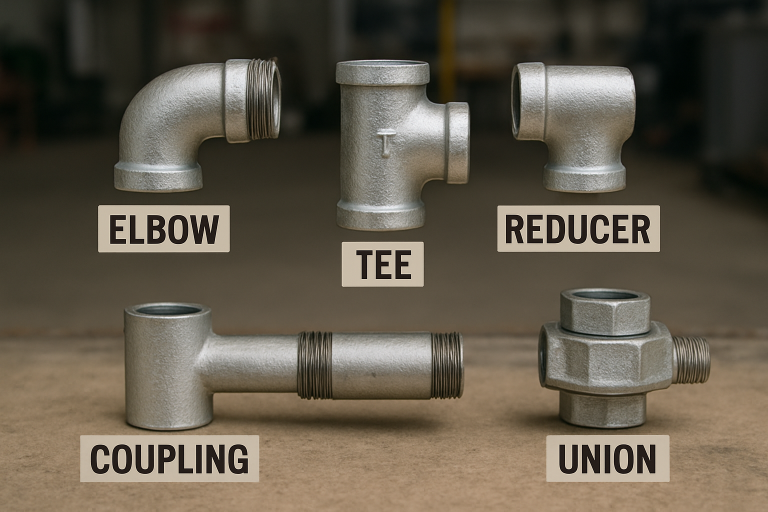
A range of pipe fittings handles the layouts that industrial piping demands. Each type solves a specific connection or flow problem.
- Elbows. Elbows change the direction of a pipe run so a line can route around obstacles or fit into tight space. Common versions turn 45 or 90 degrees.
- Tees. A tee splits or combines flow, letting a line branch to different parts of a facility.
- Reducers. When pipes of different diameters meet, a reducer manages the transition smoothly and limits turbulence and pressure loss.
- Couplings. Simple but necessary, couplings join two straight pipe sections for permanent or temporary assemblies.
- Unions. Unlike couplings, unions come apart easily, which makes them valuable for sections that need routine maintenance or inspection.
Match the fitting to the system design, operating pressure, media (fluid or gas), and how often you need access for maintenance. The same run might use a union where a technician expects to break the line monthly, and a welded coupling where the joint should never move.
Material considerations
The operating environment drives the material choice. A proper assessment confirms that fittings resist corrosion, take the operational stresses, and stay compatible with whatever moves through them. Common options include:
- Steel. Strong and able to handle high pressures and temperatures, steel is common in oil, gas, and heavy industrial work.
- Brass. Corrosion resistant and easy to machine, brass suits water systems, HVAC, and many chemical applications.
- Plastic. Light and resistant to a wide set of chemicals, plastic fittings work well for corrosive process media and, in some cases, potable water.
Understanding the environment, including temperature ranges, pressure cycles, and chemical exposure, is what separates a fitting that lasts from one that fails early. The wrong material invites premature failures, hazardous leaks, and expensive repairs. For a fuller material guide, review the reference material from Engineering Toolbox.
Installation best practices
Good installations start with careful planning and attention to detail. Even the best fittings underperform if installed carelessly or without following the guidelines. Solid practice includes:
- Keep every pipe end free of burrs, dirt, and damage. Clean, square cuts give a tight fit and reduce leak risk.
- Use the right sealing method for the fitting. Threaded fittings often need PTFE tape or pipe dope, while flanged fittings rely on the correct gasket.
- Follow the manufacturer torque and alignment figures. Overtightening can crack a fitting, and loose joints leak.
Following proven standards also protects operators and the facility, and it makes later inspections easier and safer to carry out.
Maintenance and inspection
However carefully fittings are selected and installed, regular maintenance is what maximizes lifespan and heads off emergencies. A sound routine covers:
- Scheduled inspections, especially in high-risk zones where corrosion or vibration is likely.
- Immediate replacement of worn, corroded, or damaged fittings before a small problem becomes a catastrophic one.
- Detailed records of repairs, replacements, and inspections. A maintenance log helps you predict future needs and supports compliance with industry standards.
As groups like the Manufacturing Enterprise Solutions Association (MESA) describe, proactive maintenance lowers the risk of unscheduled downtime, protects workers, and keeps operating costs under control.
How buyers judge a supplier
The reliability of a piping system starts before installation, at the point where a team decides who to buy from. That decision now happens largely online, and the way people evaluate a fitting supplier looks a lot like the way they evaluate any business. Pew Research Center found in its 2016 study on online shopping that 82% of U.S. adults at least sometimes read online customer ratings or reviews before buying something for the first time, and 40% say they almost always do. Industrial procurement teams are no different: they read the review text, check how a supplier handles complaints, and look for signs that the firm actually knows its products.
This is where being listed in curated, human-reviewed places earns its keep. A directory entry or a set of consistent, verifiable listings gives a buyer a fixed point to check specifications, certifications, and contact details against. Robert Cialdini calls the underlying mechanism social proof: people decide what is correct partly by finding out what other people think is correct, which is exactly why ratings and references carry weight in a purchase where a wrong choice can cost a shutdown. For a supplier, the practical lesson is to be findable, be consistent across the places buyers look, and give reviewers something honest to talk about.
Innovations in pipe fitting technology
Industry is adopting new technology quickly. As described in a detailed research study, newer pipe systems build digital sensors into the fittings themselves, giving real-time readings of pressure, flow, and potential leaks. These systems support predictive maintenance by alerting operators before a small issue escalates, which improves safety and energy efficiency over time.
Housing stock benefits from the same signals, and reducing downtime in rental buildings increasingly depends on instrumentation as much as on a scheduled walk-round.
Benefits of smart pipe systems
- Early leak detection that prevents environmental contamination and equipment damage
- Continuous data analytics for process optimization
- Lower labor costs from more targeted maintenance
As automation and remote monitoring become standard, teams that invest in these tools tend to see gains in performance, sustainability, and risk management.
Putting it together
Selecting the right pipe fittings, from steel elbows in high-pressure lines to plastic couplings in corrosive environments, is the foundation of a reliable industrial system. Build relationships with capable suppliers like Cruco Mill and Industrial Supply, hold to good installation practice, and keep up regular maintenance, and you give a plant the best chance of running efficiently and safely. Keep one habit above the rest: document what you install and why, so the next person to open a line knows exactly what fitting is there, what it is made of, and when it was last checked.
