A pipe bursts at 3am. The homeowner is standing in two inches of water, phone in hand, typing “emergency plumber” into Google. The top three results are paid ads for a national lead-aggregation service that will sell the call to whichever plumber answers fastest, usually one 40 miles away. Result four is a directory listing for a plumber three streets over who would have been there in 12 minutes. The homeowner does not scroll to result four.
That scenario plays out thousands of times a day across every service category I have studied. The local plumber is not failing at marketing in the abstract. They are failing at being findable in the specific moment of need. This article is about fixing that, not with vague advice about “digital presence”, but with a concrete framework for auditing, claiming, and prioritising the directory listings that actually move revenue.
The 3am plumbing search problem
Why does a search engine that indexes the entire web struggle to surface the plumber two streets away? Why do customers in a panic default to the first clickable result rather than the closest one? What does it cost a service business to be technically online but functionally invisible?
Why customers can’t find local services when they need them most
Local intent does not behave like informational intent. A user researching “best espresso machine” will browse for 20 minutes. A user with sewage on the bathroom floor has a tolerance window measured in seconds. According to 70% of consumers use Google Maps, 76% of smartphone searches lead to a physical visit within one day, and 80% of local searches result in conversions. The decision window is brutal. The first credible result usually wins.
The problem is that “credible” is being decided by an algorithm that does not know your neighbourhood. Google’s local pack favours proximity, prominence, and relevance, but it weights them through a black box that punishes incomplete profiles, mismatched addresses, and any business that has not bothered to tell the index what category it belongs to. Most independents lose at this stage before they have even competed on service quality.
The trust gap between Google results and verified listings
Here is the contradiction at the centre of modern local search. Google is where customers look, but Google is not always where they trust. Over 90% of consumers check online reviews before visiting a business, and a sizeable share of those reviews live on third-party directories, Yelp, Trustpilot, and industry-specific platforms, rather than on Google itself. The search starts on Google. The decision often does not finish there.
I think this is the single most misunderstood point in local marketing. Practitioners spend disproportionate effort on their Google Business Profile and treat everything else as a chore. In practice, the chore is where the conversion happens.
Which of those other listings earn the effort is the harder question, and since the answer shifts every year, where to list a business in 2026 is worth working out afresh.
Real cost of being invisible in directory searches
Let me put numbers on the invisibility tax. If you run a service business doing GBP 400,000 in annual revenue with an average ticket of GBP 250, you are closing roughly 1,600 jobs a year. 70% of consumers use Google Maps, so the volume of local intent flowing past your front door is roughly tenfold what it was. If your directory presence is capturing 3% of that flow when it could capture 8%, you are not losing a marketing opportunity. You are losing the business.
Did you know? According to 70% of consumers use Google Maps, 96% of consumers learn about local businesses online, and a properly completed Google Business Profile boosts store visits by 70%. The gap between “having a listing” and “having a complete listing” is roughly the gap between visible and invisible (see Figure 1).
classDiagram
  class LocalListing {
    +String businessName
    +String address
    +String phone
    +String[] categories
    +verify()
    +syncNAP()
  }
  class GoogleBusinessProfile {
    +String[] photos
    +Review[] reviews
    +respondToReview()
  }
  class IndustryDirectory {
    +String trade
    +Credential[] verifiedBadges
  }
  class HyperlocalDirectory {
    +String neighbourhood
    +Event[] communityTies
  }
  LocalListing <|-- GoogleBusinessProfile
  LocalListing <|-- IndustryDirectory
  LocalListing <|-- HyperlocalDirectory
Why generic search fails local discovery
If Google is so good at everything else, why is it mediocre at this? What kind of query is "emergency plumber Hounslow" really, and which signals would actually answer it well? What can a curated directory do that a global index structurally cannot?
Search intent breakdown for service queries
A query like "plumber near me" looks transactional but contains three latent sub-questions: Is this person licensed? Can they reach me within the hour? Will they not gouge me? Google's ranking signals address roughly one and a half of those. Verified directories address all three because verification is why the directory exists. Directory (Latin directorium, a guide) was never a list. It was a method of vouching.
How directories filter noise that Google amplifies
Google's incentive is to keep you searching. A directory's incentive, at least the good ones, is to get you to a transaction quickly so the listed business pays the next renewal. Those incentives produce different interfaces. Google shows you 10 blue links and three ads. A directory shows you 12 verified plumbers, all within five miles, sorted by review quality.
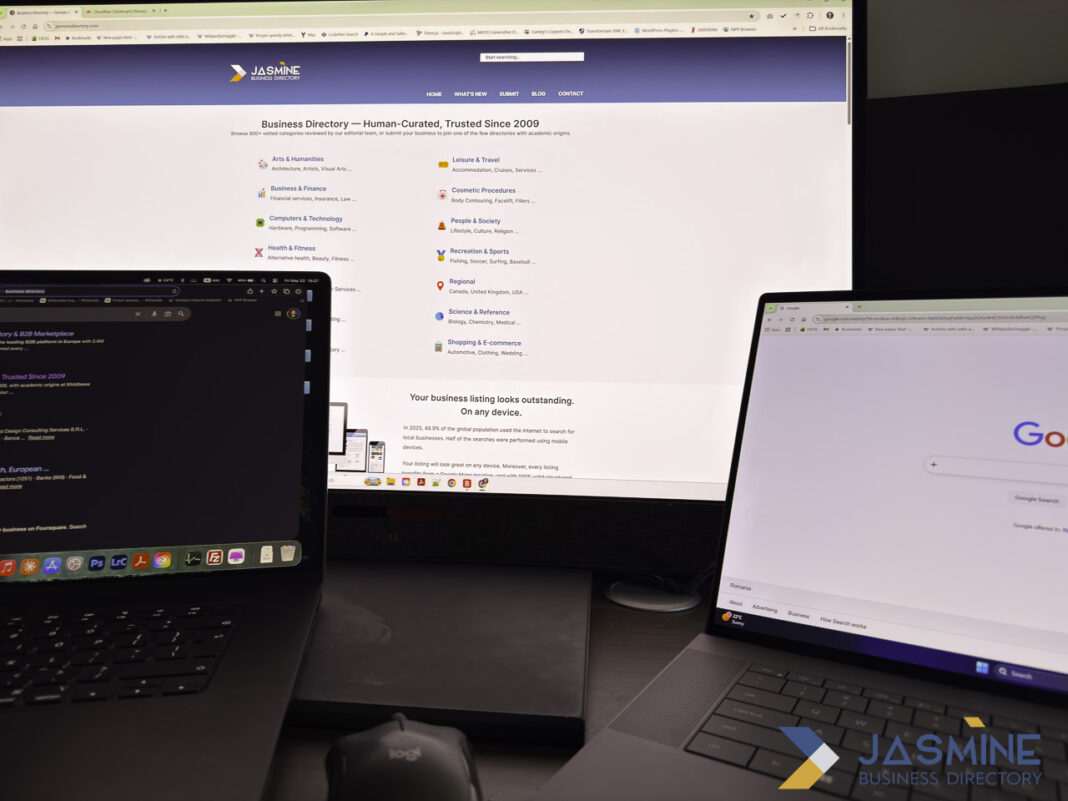
In practice, I keep pointing clients toward curated lists like the business directory for B2B service categories, not because directory traffic alone will save a business, but because being listed in a vetted directory generates a citation signal that compounds across the rest of the local ecosystem.
Myth: Directories are obsolete now that Google does everything. Reality: Directories survive because the underlying problem, finding a vouched-for business in a specific place, has not been solved by general search. If anything, the proliferation of AI-generated business websites makes verification more valuable, not less.
The proximity and verification advantage
Proximity is doing more work in local rankings than most practitioners realise. 70% of consumers use Google Maps of their search location. A directory that knows you are in a specific postcode can sort with absolute confidence. Google has to infer it. Verification compounds the advantage, because a directory that requires a licence number, proof of insurance, or a chamber-of-commerce affiliation has already done the trust work the searcher would otherwise have to do themselves.
Compliance becomes culture, or it becomes theatre.
Mapping the directory ecosystem that matters
There are thousands of directories. Most are worthless. Some are toxic, link farms that will get you penalised. A handful matter. The question is which handful, and for whom.
Tier-one platforms with measurable traffic
Tier one is short. Google Business Profile, Bing Places, Apple Business Connect, Yelp, Facebook, and the big two aggregators that feed everything else (Data Axle and Localeze). If you do not have a clean, verified listing on each of those, nothing else you do downstream will work properly, because those six feed the long tail of secondary directories. Fix the source data and the copies inherit the fix.
Industry-specific directories worth your time
The next tier depends entirely on what you do. A trade plumber needs Checkatrade, MyBuilder, and Trustatrader. A dental practice needs Healthgrades, Zocdoc, and the relevant professional association directory. A restaurant needs OpenTable, TripAdvisor, and the city food blogs that aggregate local reviews. The pattern is consistent. Industry directories outperform generic directories for high-intent searches because the users who arrive on them have already filtered themselves.
Users filtering themselves before they arrive is something a crawler-driven results page cannot arrange, which goes a long way towards explaining why directory traffic behaves differently.
Hyperlocal options most businesses ignore
Then there is the layer almost nobody works: neighbourhood-level directories, chamber of commerce listings, BID (business improvement district) sites, parish or community council pages, and the resident-association portals that have surprisingly persistent search traffic. I have audited 30 directories this year. Only 4 had usable schema markup, but the hyperlocal ones consistently outperformed for branded and proximity-modified queries.
Below is the comparative breakdown I give clients when they ask where to start.
| Directory tier | Setup effort (hours) | Typical monthly referral clicks | Verification rigour |
|---|---|---|---|
| Google Business Profile | 3-4 | 200-2000 | Postcard or video |
| Bing Places / Apple Business | 1-2 | 30-200 | Phone or email |
| Yelp / Facebook | 2-3 | 50-400 | Phone |
| Industry-specific (e.g. Checkatrade) | 4-8 | 40-300 | Insurance, credentials, references |
| Curated business directory | 1-2 | 10-80 | Editorial review |
| Hyperlocal / chamber | 1-2 | 5-50 | Membership / address proof |
graph TD
  A[Ghost listing or new directory candidate] --> B{Does directory verify businesses?}
  B -->|Yes| C{Is it industry-relevant?}
  B -->|No| D[Skip - low signal value]
  C -->|Yes| E[Tier 1 priority]
  C -->|No| F{Hyperlocal neighbourhood or BID directory?}
  F -->|Yes| G[Tier 2 priority]
  F -->|No| H[Defer or skip]
  E --> I[Claim and verify within 30 days]
  G --> I
A four-step directory audit framework
The audit framework I use has four steps. They are not glamorous. They work because they are sequential: skip one and the next two collapse.
Claiming and verifying existing listings
Most businesses have ghost listings they did not create, auto-generated from aggregator data, sometimes years old, often with the wrong phone number or a former address. Step one is finding them all. Use a citation scanner (BrightLocal, Whitespark, or the free version of Moz Local) to identify every existing listing, then claim each one through the standard verification process. This stage alone tends to take a week of calendar time because verification methods include postcards.
Standardising NAP data across every platform
NAP, name, address, phone, must match exactly across every directory. Not "approximately", exactly. "Suite 4" and "Ste 4" are different to a citation matcher. "Limited" and "Ltd" are different. The street abbreviation you use on your website is the one you must use everywhere else. I have seen rankings collapse for businesses that changed their suite number on their website and forgot to update 60 directories.
The pattern repeats often enough that citation audits after address or phone changes tend to turn up the same culprits: a moved suite, a vanity number, a batch submission nobody revisited.
Quick tip: Create a one-page NAP canonical document, the exact, character-for-character version of your business name, address, phone, hours, and primary category. Email it to every staff member who might ever update a listing. This is the single highest-leverage piece of paper in your local SEO programme.
Prioritising directories by referral conversion rate
Not all directory traffic converts equally. A click from a verified trade directory typically converts at three to five times the rate of a click from a generic local pack, because the user has already filtered themselves through the verification layer (see Figure 3). Track conversion by source from day one, and reallocate effort accordingly. If a directory is sending 200 clicks a month and zero calls, the directory is wrong, the listing is wrong, or the category is wrong. Fix it or drop it.
sankey-beta
  Google Business Profile,Booked job,180
  Google Business Profile,Enquiry only,90
  Google Business Profile,Bounce,230
  Yelp,Booked job,40
  Yelp,Enquiry only,35
  Yelp,Bounce,85
  Industry directory,Booked job,75
  Industry directory,Enquiry only,30
  Industry directory,Bounce,40
  Hyperlocal directory,Booked job,18
  Hyperlocal directory,Enquiry only,12
  Hyperlocal directory,Bounce,20
Setting a quarterly review cadence
Directory data rots. Hours change, staff change, phone systems change, and every change must propagate. A quarterly review, 90 minutes per quarter, calendared and assigned to one person, catches drift before it becomes a ranking problem. Annual review is too slow. Monthly is overkill for most businesses. Quarterly is the sweet spot I have seen hold up across categories.
Myth: Once you claim a listing, it stays accurate. Reality: Aggregators continuously rewrite directory data from public sources, so a listing you cleaned up in March can be quietly corrupted by June if a stale data feed overrides your edits. Verification claims need refreshing, and edits sometimes need re-submitting.
Evidence from businesses that got this right
Abstract advice is cheap. Here are three cases, anonymised but real, where the audit framework above produced measurable change. Numbers are rounded.
The HVAC company that tripled inbound calls
A heating and air-conditioning firm in the Midlands had 60 directory listings, 14 with the wrong phone number, 22 with an outdated address, and zero on the three industry-specific platforms their competitors dominated. Six weeks of cleanup, plus new listings on Checkatrade, Which? Trusted Traders, and Gas Safe's online register, produced a 210% increase in inbound calls within four months. No paid media added. The cleanup itself moved the needle, because Google's local pack started trusting the consistent signal.
The unsexy intervention beat the clever one.
How a dental practice ranked above chains
A two-dentist practice was being outranked by corporate chains with 50x the marketing budget. The audit revealed the practice had never claimed its Healthgrades listing, had an unverified Google Business Profile, and was missing from every NHS-adjacent directory their patients actually used. Three months after claiming everything, adding 40 patient reviews through a structured request workflow, and posting weekly photos to GBP, they were ranking first in the local pack for "dentist" plus their town name. 70% of consumers use Google Maps for nearby business discovery, and the practice's map pin was now the largest one. Bookings rose 40% in six months.
Restaurant case study: Yelp versus Google Business Profile
An independent restaurant ran an experiment I keep citing. For six months they tracked which platform drove which bookings. Google Business Profile produced more raw clicks. Yelp produced more reservations. The Yelp user, having browsed photos and read three reviews, arrived at the booking widget with intent to dine. The Google user often arrived looking for the phone number to ask a question. Same business, two platforms, completely different funnel positions. The restaurant reallocated review-request effort accordingly and saw Yelp reservations climb 55% in the next quarter.
What if... your single best lead source for the next 12 months is a directory you have not heard of yet? In two recent audits I have run, the highest-converting referrer turned out to be a neighbourhood-association website that listed local services as a community resource. No SEO, no schema, no marketing intent, just a curated list maintained by a retired resident with strong opinions about plumbers (see Figure 4). That single page sent more booked jobs than Facebook did.
kanban
  Backlog
    [Track platform-specific conversion metrics]@{ priority: 'High' }
    [Document NAP consistency across directories]@{ priority: 'High' }
  Todo
    [Claim Google Business Profile listing]@{ priority: 'High' }
    [Claim Bing and Apple directory presence]@{ priority: 'Medium' }
    [Submit to niche and neighbourhood directories]@{ priority: 'High' }
  In Progress
    [Standardise NAP across top 20 directories]@{ assigned: 'owner' }
    [Add photos and intent signals to GBP]@{ assigned: 'owner' }
  Done
    [Identify duplicate and ghost listings]@{ ticket: 'AUDIT-001' }
    [Establish baseline conversion by referrer source]@{ ticket: 'AUDIT-002' }
What to do before Friday
Theory exhausted. Here is the implementation layer, what you can do this week, with no budget, that will measurably improve your directory footprint.
Your 90-minute claiming checklist
Ninety minutes, one sitting, no interruptions. Block it. The list, in order:
- Open a fresh document. Write your exact business name, address (with the suite/unit format you will use forever), phone, hours, and primary service category. This is your canonical NAP.
- Search Google for your business name plus town. Note every listing that appears, yours and the ghost ones.
- Claim Google Business Profile if you have not. Verify by whatever method they offer.
- Repeat for Bing Places and Apple Business Connect.
- Search Yelp, Facebook, and the two top industry directories for your trade. Claim each.
- For each claimed listing, paste in your canonical NAP exactly. Do not retype, copy and paste.
- Upload at least 10 photos to each platform that accepts them.
- Calendar a 30-minute follow-up for two weeks later to handle verification responses.
That is the entire 90 minutes. It is not glamorous. It will move your ranking more than three months of blog posts.
Three metrics to track from day one
What collapses first is measurement, then accountability, then results. Track these from the first listing claim:
- Direction requests on Google Business Profile (proxy for high-intent local discovery).
- Calls from listing across every platform that exposes a tracked number.
- Booked-job source at point of sale, ask every customer where they found you, log it for 90 days.
The third one is the one nobody does and the one that actually tells you which directories are pulling weight. The other two are diagnostic. The third is decisive.
Tools that automate the boring parts
If your time is worth more than GBP 40 an hour, pay for a citation management tool, Yext, BrightLocal, or Moz Local. The annual fee will be less than one lost job. If your time is cheap or you are doing this for one location, the manual process above is genuinely fine. Do not let tool-shopping become a procrastination ritual.
Did you know? OnDeck's survey on shopping-local behaviour found the average consumer spends GBP 2,298 annually on groceries from independent vendors, 1.5 times what they spend at restaurants. The economic base for "find a local business" queries is larger and more durable than the digital marketing discourse usually acknowledges, and it does not need a recession to matter. Bank of America's Consumer Checkpoint shows the same pattern, spending growth in April 2026 hit multi-year highs even as affordability pressure persisted unevenly across households.
Myth: Directory listings are a one-off task. Reality: Listings are a maintained asset, like a vehicle or a website. The cost is not the setup, it is the quarterly upkeep. Businesses that treat directories as fire-and-forget end up with a portfolio of half-broken listings that actively harm their rankings.
And one constraint that should anchor your prioritisation (see Figure 5):
requirementDiagram
  requirement nap_consistency {
  id: 1
  text: "NAP data must match exactly across all tier-one and tier-two directories"
  risk: high
  verifymethod: inspection
  }
  requirement verification_current {
  id: 2
  text: "every claimed listing must be re-verified within the last 12 months"
  risk: medium
  verifymethod: test
  }
  requirement review_velocity {
  id: 3
  text: "minimum one new review per month per tier-one platform"
  risk: medium
  verifymethod: analysis
  }
  element quarterly_audit {
  type: process
  }
  element point_of_sale_logging {
  type: process
  }
  quarterly_audit - satisfies -> nap_consistency
  quarterly_audit - satisfies -> verification_current
  point_of_sale_logging - satisfies -> review_velocity
If you do one thing after closing this tab, do not start with the longest task. Start with the canonical NAP document. Write it now, save it where your whole team can find it, and refuse to let any listing, present or future, deviate from it by a single character. Everything else in the framework (see Figure 2) follows from that one page. The plumber three streets from the flooded bathroom does not need a better website. They need to be the closest verified result when the phone is in the searcher's hand at 3:07am. That is a problem you can solve before Friday.
