
Key takeaways
- Alternative financing gives small businesses more flexibility and easier access to capital.
- Technology has made many funding options faster and less cumbersome than they used to be.
- Weigh the pros and cons of each financing choice before you commit to one.
For small business owners, finding the right funding is often one of the biggest obstacles on the way to a working business. Traditional banks and lenders tend to have strict requirements and slow approval processes, which makes it hard for newer entrepreneurs to reach the capital they need. A range of newer options, such as debt factoring solutions, has filled some of that gap, giving small businesses more flexibility and quicker access to funds.
Many of these newer options use technology to speed up approvals and shape loan terms around businesses of different sizes and histories. Instead of drowning in paperwork and outdated credit criteria, small companies now have more room to pick the financial tools that fit their situation.
With more choices available, owners should think about more than just getting money. Each method carries its own risks, rewards, and long-term consequences. A deliberate approach puts a business in a better spot for stability, expansion, and future opportunities.
Peer-to-peer lending
Peer-to-peer (P2P) lending platforms have reshaped small business borrowing by connecting entrepreneurs directly with investors willing to fund them. These platforms skip some of the rigid steps banks impose, and they often return decisions faster and, in many cases, on better terms.
Businesses using P2P platforms like Biz2Credit can benefit from data-driven matches that pair their needs with suitable investors. With simpler applications and lighter collateral demands, P2P lending has become a common route for growing companies that do not yet meet conventional lending standards.
The comparison lands harder once you see what the traditional route involves, since how banks turn deposits into loans explains much of the caution behind those lending standards.
Crowdfunding
The crowdfunding model lets businesses raise small amounts of money from a large group of people, usually online. Start-ups and early-stage companies often find it useful for more than cash: a campaign doubles as market validation and brand exposure.
By running campaigns on platforms such as Kickstarter or Indiegogo, entrepreneurs can attract supporters who believe in their products. A strong campaign can build a loyal customer base, and some early backers become vocal advocates for the business well after the money is raised.
That advocacy has real weight because most buyers now check what other people say before they act. Robert Cialdini describes the mechanism as social proof: people decide what is correct by finding out what others think is correct, which is why reviews and ratings carry so much influence. A crowdfunding page that shows momentum and early praise gives strangers a reason to trust an unfamiliar company.
Revenue-based financing
Revenue-based financing (RBF) suits growing companies that have strong sales projections but little credit history. Investors provide upfront capital in exchange for a fixed percentage of ongoing gross revenue, and repayment continues until an agreed amount is reached.
Companies like Rapid Finance have digitized and accelerated RBF approval, enabling more businesses to reach capital and meet customer demand or scale operations quickly. Because payments track a share of revenue rather than a fixed monthly bill, the burden eases during slow sales cycles, which is a meaningful advantage for seasonal or uneven businesses.
Merchant cash advances
Merchant cash advances (MCA) provide an immediate lump sum in return for a share of future credit card sales. Many retail and service businesses like the fast turnaround and easy qualification, particularly those with steady transaction volumes but limited collateral.
Be careful with the cost. MCAs can be far more expensive than standard loans, with high effective interest rates and fees. Read the repayment structure closely and calculate the total cost before signing any MCA agreement.
Invoice financing
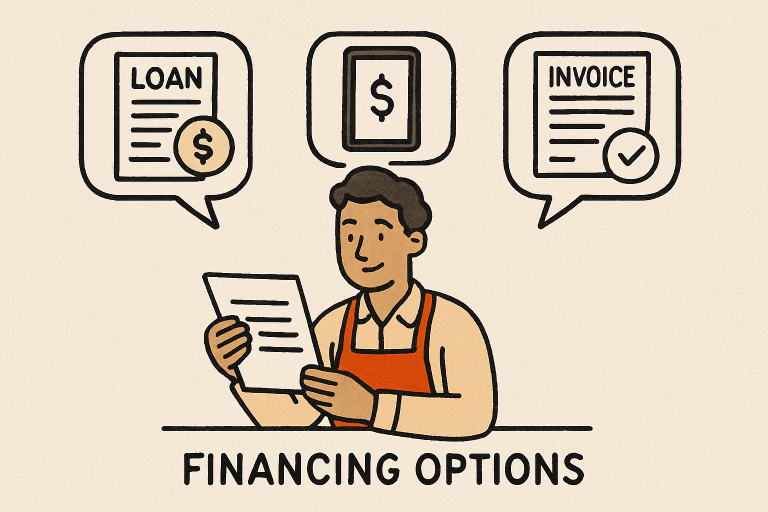
Invoice financing helps businesses that struggle with long payment terms or cash flow gaps. By selling outstanding invoices at a discount to a third-party provider, a company receives immediate liquidity and can keep operating without interruption.
Providers such as ScotPac specialize in this area, turning unpaid invoices into working capital without adding new debt. The method works well for B2B companies with dependable clients and predictable accounts receivable cycles.
Government-backed loans
Many small businesses look to government-backed lending programs for favorable rates and terms. The U.S. Small Business Administration (SBA), for instance, backed more than $56 billion in financing in 2024, a sign of steady public support for entrepreneurs.
These loans usually carry lower interest rates, longer repayment periods, and smaller down payments than conventional financing. Eligibility standards can be demanding, but for businesses that qualify, an SBA-backed loan can support durable growth.
How lenders and customers find you
Financing does not happen in a vacuum. Before an investor, a lender, or a crowdfunding backer commits, they look you up, and what they find shapes their confidence. Distributed trust is part of this. Rachel Botsman argues that trust has moved through three eras, from local trust to institutional trust to distributed trust, where ratings, reviews, and platform reputation let strangers extend confidence to businesses they have never met. A lender skimming your public profile, an investor reading customer feedback, and a backer weighing a campaign are all leaning on that same signal.
This is where being present and reviewable in credible places pays off. A consistent business profile, a track record of honest reviews, and a listing in a curated directory make it easier for the right people to verify that you are real, active, and worth backing. The same visibility that brings in customers also reassures anyone deciding whether to lend or invest.
Choosing the right financing option
Deciding which path to take starts with an honest look at your own situation: how much funding you need, how fast you need it, how flexible the repayments are, and what the capital actually costs once every fee is counted.
A trusted accountant or financial adviser can help you read the fine print and pick a solution that matches your goals. Understanding the upsides and downsides of each method lets you make a confident, informed choice and get back to running the business.
Modern financing tools can make a small business more responsive to shifting conditions. They smooth cash flow management, widen access to capital, and give owners clearer, faster information to work with.
The practical takeaway is simple. Match the funding method to the money problem you actually have, price the total cost before you sign, and keep your public reputation strong so the people you ask for money can see who you are. Do those three things and financing becomes a tool you control rather than a hurdle you clear.
