
The modern workplace is changing fast, pushed by cloud tools, artificial intelligence, and cheap high-speed connectivity. Offices once defined by paperwork, fixed desks, and back-to-back meetings are giving way to more flexible setups that let people work productively from more places. The result is not a gimmick. It is a real shift in how professionals connect, collaborate, and get things done.
Modern offices lean on smarter, faster methods that raise productivity and give staff more flexibility. Organizations that adopt these tools tend to stay competitive, while those that ignore them fall behind. For any organization looking to gain a visible edge online, working with the best SEO agency can help make sure a digital transformation inside the building is matched by stronger visibility outside it.
Across industries, leaders treat workplace technology as a genuine change in daily work rather than a passing trend. These tools help teams do more as the line between in-office and remote work fades. This article looks at how technology redefines office life and how businesses can use these changes to improve performance and employee satisfaction.
Employee satisfaction has non-digital inputs as well, and the office breakroom and its coffee are among the ones staff notice daily.
Remote work and digital collaboration
Remote work has moved from a niche perk to a standard option. High-speed internet, cloud computing, project management platforms, and instant messaging mean work is no longer tied to one address. That flexibility tends to improve morale and work-life balance, and it opens the talent pool well beyond the local commute. It also raises the bar: both employers and employees now need real digital competency, not just a passing familiarity with a few apps.

There is a discovery angle here too. When teams and services stop being tied to a single location, the way clients and partners find them shifts online as well. Pew Research Center, in “Where People Get Information About Restaurants and Other Local Businesses” (2011), found that Americans looking for local businesses turn to the internet before any other source, with 38% using search engines for restaurants, bars, and clubs and 36% for other local businesses. A distributed workforce still has to be findable, and that visibility is now built online rather than on a street corner.
Artificial intelligence and automation
AI is now part of everyday office work. It handles data analysis, scheduling, and routine customer messages through chatbots, which frees people to spend time on strategy and creative problems instead of repetitive tasks. As the technology matures, businesses adopt it to reduce errors, respond faster, and make better decisions. The most effective professionals are not the ones who refuse to touch AI, nor the ones who hand everything over to it. They learn to work alongside it, using it to amplify their own judgment rather than replace it.
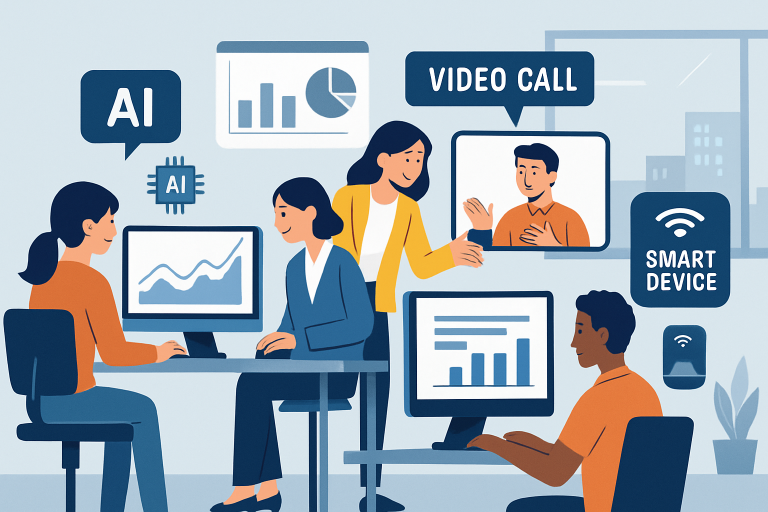
Smart office technologies
Connected offices use IoT devices and biometric systems to tighten security and cut waste. Facial recognition clock-in reduces payroll errors and simplifies timekeeping. Automated lighting and climate control lower energy use, keep staff comfortable, and trim running costs. These systems also support sustainability goals, which increasingly matter to clients and job candidates weighing where to spend their money or their working years.
Data analytics for informed decision making
Good analytics turn everyday activity into Data drives modern business decisions. Analytics enable managers to use real-time data for measuring productivity, forecasting trends, and gauging customer satisfaction. Careful analysis helps organizations spot weak points, streamline workflows, and deploy targeted strategies that move the numbers that matter. Companies that read their data well can change direction sooner and build a habit of steady improvement, which counts for a lot when markets shift under them.
Data has limits worth naming. Every meeting-room booking, badge swipe, and keystroke can generate a record, and smart offices increasingly track space usage, energy consumption, and movement patterns. That information optimizes real things, from meeting room allocation to when the coffee gets restocked. It also raises privacy questions. Staff notice when monitoring feels excessive, so organizations that collect this data owe employees a clear, honest explanation of what is gathered and why.
Health and well-being focus
Employee health has become a real focus of office innovation rather than a poster on the wall. Wearables such as smartwatches give people insight into activity, sleep, and stress. Apps for mindfulness and mental health are common too, especially as the boundary between work and home gets thinner. Constant connectivity is part of the problem here: smartphones and instant messaging create an expectation of always being available, which speeds up problem-solving but can quietly erode rest. The fix is cultural, not technical. Organizations have to set digital boundaries on purpose to prevent burnout.
Wellness tools, used well, reduce absenteeism and turnover and lift satisfaction, which feeds back into productivity. Investing in them signals that a company takes its people seriously, and that reputation travels. Prospective hires read reviews and talk to former colleagues, and how a business treats its staff shapes the trust others extend to it.
The paperless reality and the human element
Digital transformation has finally delivered on an old promise. Documents live in the cloud, signatures happen electronically, and whole workflows exist in digital space. This saves paper, but the bigger win is speed: decisions move faster when nobody is chasing a physical form across three desks.
None of this removes the need for people. The best modern offices use technology to clear away dull, repetitive work so staff can do what humans do well: think creatively, build relationships, and solve messy problems. Technology should support connection, not stand in for it. The office is becoming less a fixed place and more a network of tools that let work happen in more places and at more hours. That demands new skills, new boundaries, and a fresh look at what productivity actually means.
Where this leaves you
Technology is not just tuning the modern office; it is redefining what workplaces look like and how they run. Remote work, AI, connected office systems, sharper analytics, and health-focused wearables together produce workplaces that are more adaptable, more efficient, and more attentive to the people inside them. Organizations that integrate new technologies tend to be the ones that attract talent, keep good staff, and grow on a steady footing.
Technology has also widened the choice of where a team works, and for a small business the decision between a home office, coworking space or private office now shapes hiring, costs and client meetings.
The practical takeaway is simple: pick the tools that remove friction from real work, set clear rules for data and after-hours contact before you need them, and make sure the efficiency you gain inside is matched by being easy to find and trust from the outside. Adopt with intent, and the technology works for you rather than the other way around.
