
Substance use disorders (SUDs) are among the most consequential public health problems worldwide, marked by chronic relapsing patterns and a heavy psychosocial toll. Among the psychosocial treatments studied for achieving and holding onto sobriety, cognitive behavioral therapy (CBT) is one of the most rigorously tested.
CBT combines cognitive restructuring with behavioral modification. It targets the maladaptive thought patterns, emotional dysregulation, and environmental cues that keep substance use going (Carroll & Onken, 2005). This article looks at the evidence for CBT as a durable treatment for maintaining sobriety, describes how it works, and considers how it fits with medication and other therapeutic approaches.
Theoretical foundations
CBT for substance use disorders grows out of Marlatt and Gordon’s (1985) cognitive-behavioral model of relapse prevention (RP). The model holds that relapse is not a single failure but a process shaped by identifiable antecedents: high-risk situations, dysfunctional expectations about the drug, weakened self-efficacy, and the abstinence violation effect (Larimer et al., 1999).
In practice, CBT works with these ideas through functional analysis of substance use triggers, coping skills training, cognitive reappraisal of anticipated positive drug effects, and guided exposure to high-risk scenarios (McHugh et al., 2010). The goal reaches past getting someone to stop; it is to build self-regulation skills that generalize, so the person can use them on their own once treatment ends.
Key takeaways
- CBT teaches people how their thoughts, feelings, and actions connect, which makes triggers and cravings easier to manage.
- Therapy encourages healthy coping tools that build resilience and lower the risk of relapse.
- CBT offers ways to address co-occurring mental health issues, which supports overall well-being.
Holding onto long-term sobriety is hard work, and it helps to understand the tools that support it. One approach with a solid track record is cognitive behavioral therapy (CBT). This therapy focuses on spotting the negative thought patterns and behaviors that can lead to substance use. By learning to recognize and change those patterns, people can build healthier coping strategies and make more deliberate choices in situations that might trigger relapse. CBT gives a structured way to manage cravings, reduce stress, and build skills that support recovery over the long run.
With regular practice and guidance, CBT helps people develop a better relationship with themselves and their choices. It encourages self-reflection and problem-solving, which can keep old habits from creeping back. Anyone considering CBT as part of their recovery may want to find out more now to see how it fits into their overall plan for sobriety. Used consistently, these strategies strengthen a person’s ability to stay in recovery and handle the difficulties that come with it.

Understanding cognitive behavioral therapy
CBT rests on the idea that distorted thinking and self-defeating behaviors feed addiction. It guides clients to notice negative thoughts, question whether they hold up, and replace them with healthier ones, which supports better decisions and more control.
Research backs CBT for both addiction and mental health problems. Its structure breaks problems into manageable steps and sets realistic goals. That process builds a sense of achievement, which helps change stick. Because it can be tailored, clients can track their progress, stay motivated, and mark their successes.
That structure does its best work alongside peer groups and community, since the proven strategies for overcoming addiction with lasting support succeed best in combination rather than alone.
Identifying and managing triggers
One core benefit of CBT is helping people identify the specific triggers that lead to substance use. Triggers might be people, places, emotions, or even certain times of day. Through guided exploration, therapists help clients map these high-risk situations and build strategies to head them off. Learning and practicing mindfulness, using stress management tools, and rehearsing how to say “no” in tempting moments all lower the chance of relapse. Handling triggers this way, before they escalate, is central to ongoing recovery.
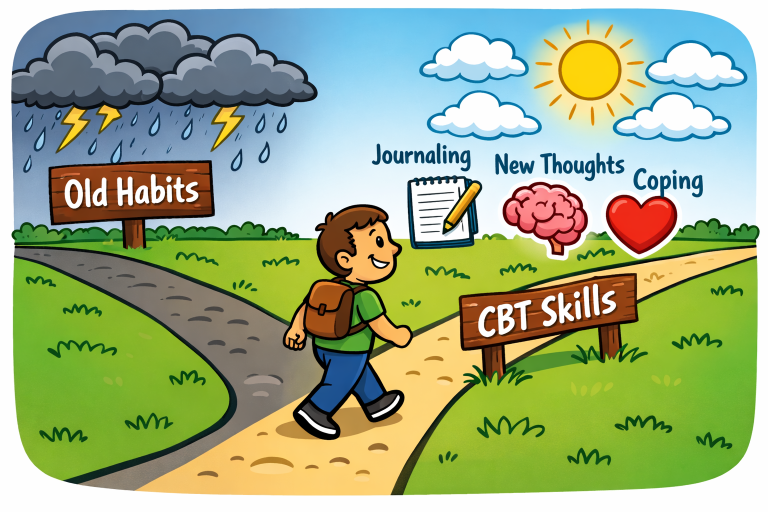
Journaling or thought records help clients notice their high-risk patterns and, over time, respond to them more effectively. Pairing real-world practice with ongoing therapy helps the skills learned in sessions carry over into daily life. This manages the immediate risk of relapse and gives people a clearer sense of their own weak points and strengths.
Efficacy evidence from meta-analytic reviews
The evidence for CBT in SUDs comes from decades of randomised controlled trials and later quantitative reviews. McHugh et al. (2010) ran a meta-analytic review of 34 randomised controlled trials covering 2,340 patients and found an overall effect size in the moderate range (d = 0.45), with results varying by substance: cannabis interventions produced the largest effects, followed by cocaine and opioid use disorders.
Magill et al. (2019) updated the picture with a meta-analysis of 30 randomised controlled trials (5,398 participants), showing that CBT produced statistically significant effects against minimal treatment or nonspecific therapeutic controls.
The effect sizes tracked how strict the comparison was: largest against no treatment, moderate against treatment-as-usual, and nonsignificant against other empirically supported active therapies. That pattern shows up across psychotherapy research and does not weaken CBT’s clinical value. It reflects the rough equivalence often found among well-designed treatments (Wampold & Imel, 2015).
More recently, Boness et al. (2023) applied the American Psychological Association’s Tolin Criteria to CBT for SUDs and issued a “strong recommendation” for classifying it as an empirically supported treatment, based on effect magnitude, evidence quality, and efficacy across diverse populations.
Developing healthy coping mechanisms
Many people in recovery struggle because they once used substances to cope with stress, sadness, boredom, or social pressure. CBT teaches practical skills such as assertiveness, problem-solving, relaxation, and emotional regulation.
As these abilities grow, people feel more capable of meeting challenges without turning to substances. Coping skills like these matter for handling setbacks and adjusting to change, which lowers the chance of relapse. A wider set of tools builds resilience, and that in turn supports healthy relationships and better choices.
Addressing co-occurring disorders
Substance use disorders often travel with mental health concerns like depression, anxiety, or trauma. Left untreated, these co-occurring disorders can chip away at sobriety and make recovery harder. CBT works well here because it can be tailored to target both the addiction and the underlying mental health issues, which treats the whole person rather than one piece. CBT is used widely for anxiety, depression, PTSD, and more, so it is a flexible option for people who need broad support.
Therapists using CBT may draw on specific exercises for trauma, such as exposure therapy or trauma-focused CBT, which gradually reduce the emotional charge tied to difficult memories. Treating co-occurring disorders as ordinary within therapy helps people move past shame and isolation and see that integrated treatment is possible and within reach. This deeper support builds lasting mental and emotional health, which reinforces sobriety.
Where that tailored work happens matters as well; the case for residential rehabilitation in addiction recovery rests partly on delivering therapy like this inside a 24-hour, substance-free setting.
Building resilience to prevent relapse
Recovery does not follow a straight line, and setbacks or cravings are normal. CBT helps people build resilience by changing how they view mistakes. Clients learn to treat a slip as a chance to grow, which strengthens their commitment to sobriety and eases the shame.
Resilience takes self-compassion, problem-solving, and a willingness to adapt. Clients look at their slips, spot warning signs, and write action plans, which supports personal growth and helps them meet challenges beyond addiction.
That reach beyond addiction is no accident; the same CBT framework underpins anxiety therapy in Toronto at clinics such as OC Psychotherapy Centre.
Evidence supporting CBT in addiction recovery
A growing body of research supports the effectiveness of CBT in addiction treatment. Studies have found that people in CBT-based recovery programs are up to 60 percent less likely to relapse than those in traditional treatment. Because CBT is practical and skills-oriented, it adapts to many settings, including group therapy, one-on-one counseling, and digital formats. That range makes it accessible and useful for many kinds of people.
CBT’s flexibility and evidence base have also led to broad use in outpatient, residential, and aftercare settings. Many organizations fold CBT into relapse prevention plans, peer support groups, and app-based programs, so it runs through the whole continuum of care. For people who have relapsed more than once, the structure and encouragement of CBT can offer new hope and a plan for lasting recovery.

The delayed emergence effect
One notable feature of CBT is its delayed emergence effect: treatment gains often become more apparent during follow-up than during the active treatment itself.
Carroll et al. (1994) first documented this in a one-year follow-up of 121 cocaine-dependent outpatients, finding that those who received cognitive-behavioral relapse prevention kept improving relative to clinical management controls in the months after treatment ended.
The delay makes sense: the coping skills learned in CBT need real-world practice to take hold. Unlike medications, whose effects usually fade once a person stops taking them, CBT leaves people with a cognitive-behavioral toolkit that lasts.
Larimer et al. (1999) observed that this pattern of steady or improving outcomes at one year or more post-treatment sets RP-based approaches apart from other methods and points to CBT’s fit for long-term sobriety.
Combined treatment approaches
CBT works even better alongside medication. Ray et al. (2020) ran a systematic review and meta-analysis of CBT combined with pharmacological agents for alcohol and other drug use disorders and concluded that the combined approach produced better outcomes than either one on its own.
The pairing makes sense: medication eases acute craving and withdrawal, steadying the neurobiology, while CBT handles the thoughts and behaviors that keep use going after withdrawal passes.
Adding motivational interviewing (MI) to CBT has also proven useful for the ambivalence common early in treatment. MI-enhanced CBT protocols improve retention and readiness for change, which creates better conditions for learning skills (Carroll & Kiluk, 2017).
Digital extensions and accessibility
Moving CBT into digital formats matters for reaching more people with evidence-based sobriety support. Computerised and web-based CBT programs have produced positive results for reducing alcohol use and may help with access barriers in underserved populations.
Effect sizes for digital delivery tend to be smaller than for face-to-face work, but these programs scale easily and can serve as add-ons to standard care or as standalone options for people who face geographic, financial, or stigma-related barriers to in-person treatment (Magill et al., 2023).
Conclusion
The evidence points one way: cognitive behavioral therapy is among the strongest psychosocial treatments for supporting lasting sobriety. It works across several substance categories, shows the delayed emergence effect, pairs well with medication, and adapts to digital delivery. For clinicians, the takeaway is straightforward: CBT belongs among the first psychosocial treatments to consider for patients seeking durable recovery from substance use disorders.
References
Boness, C. L., Votaw, V. R., Schwebel, F. J., Moniz-Lewis, D. I. K., Hallgren, K. A., Fortney, J. C., & Witkiewitz, K. (2023). An evaluation of cognitive behavioral therapy for substance use disorder: A systematic review and application of the Society of Clinical Psychology criteria for empirically supported treatments. Clinical Psychology: Science and Practice, 30(4), 442-461. https://doi.org/10.1037/cps0000147
Carroll, K. M., & Kiluk, B. D. (2017). Cognitive behavioral interventions for alcohol and drug use disorders: Through the stage model and back again. Psychology of Addictive Behaviors, 31(8), 847-861. https://doi.org/10.1037/adb0000311
Carroll, K. M., & Onken, L. S. (2005). Behavioral therapies for drug abuse. American Journal of Psychiatry, 162(8), 1452-1460. https://doi.org/10.1176/appi.ajp.162.8.1452
Carroll, K. M., Rounsaville, B. J., Nich, C., Gordon, L. T., Wirtz, P. W., & Gawin, F. (1994). One-year follow-up of psychotherapy and pharmacotherapy for cocaine dependence: Delayed emergence of psychotherapy effects. Archives of General Psychiatry, 51(12), 989-997. https://doi.org/10.1001/archpsyc.1994.03950120061010
Larimer, M. E., Palmer, R. S., & Marlatt, G. A. (1999). Relapse prevention: An overview of Marlatt’s cognitive-behavioral model. Alcohol Research & Health, 23(2), 151-160.
Magill, M., McKay, J. R., Mastroleo, N. R., Hoadley, A., Walthers, J., Mooney, A. C., & Haug, N. A. (2023). Efficacy of cognitive behavioral therapy for alcohol and other drug use disorders: Is a one-size-fits-all approach appropriate? Substance Abuse and Rehabilitation, 14, 1-14. https://doi.org/10.2147/SAR.S362864
Magill, M., Ray, L., Kiluk, B., Hoadley, A., Bernstein, M., Tonigan, J. S., & Carroll, K. (2019). A meta-analysis of cognitive-behavioral therapy for alcohol or other drug use disorders: Treatment efficacy by contrast condition. Journal of Consulting and Clinical Psychology, 87(12), 1093-1105. https://doi.org/10.1037/ccp0000447
Marlatt, G. A., & Gordon, J. R. (1985). Relapse prevention: Maintenance strategies in the treatment of addictive behaviors. Guilford Press.
McHugh, R. K., Hearon, B. A., & Otto, M. W. (2010). Cognitive-behavioral therapy for substance use disorders. Psychiatric Clinics of North America, 33(3), 511-525. https://doi.org/10.1016/j.psc.2010.04.012
Ray, L. A., Meredith, L. R., Kiluk, B. D., Walthers, J., Carroll, K. M., & Magill, M. (2020). Combined pharmacotherapy and cognitive behavioral therapy for adults with alcohol or substance use disorders: A systematic review and meta-analysis. JAMA Network Open, 3(6), e208279. https://doi.org/10.1001/jamanetworkopen.2020.8279
Wampold, B. E., & Imel, Z. E. (2015). The great psychotherapy debate: The evidence for what makes psychotherapy work (2nd ed.). Routledge.
