Your client’s brand vanished from ChatGPT
Picture the founder of a GBP 40 million B2B software firm typing her own company name into ChatGPT. She asks for a comparison against three named competitors, and the model recommends everyone except her, including a two-year-old startup with a tenth of her revenue. What does she do next?
This scenario, recounted in variations across agency Slack channels throughout 2024 and 2025, has become the new “we dropped on Google” panic call. Except the diagnostic playbook does not transfer. There is no Search Console for Perplexity. There is no rank tracker that captures the moment Claude swapped out one citation for another. The client wants an answer by Friday, and the SEO team, competent, certified, fluent in Core Web Vitals, finds itself reaching for tools that were not built for the question being asked.
The pattern repeats across verticals. A regional accountancy practice in Manchester discovers that Gemini happily lists six of its competitors when asked “best small business accountants in north-west England.” A direct-to-consumer mattress brand watches its category get summarised by an AI Overview that names three rivals and a Reddit thread. A specialist legal recruiter in the City finds that ChatGPT, asked about niche compliance hiring, surfaces a Bloomberg piece, two LinkedIn posts, and a directory entry, but never the recruiter’s own well-optimised website, the one that ranks second on Google for the same query.
The instinct, almost universally, is to assume the fix lies somewhere on the client’s own domain. More schema. Fresher content. Tighter entity associations. These efforts are not wasted, but the diagnostic frame is incomplete. Large language models do not crawl the web the way Googlebot does, and they do not weight a brand’s self-published claims the way a search index does. They lean, heavily and demonstrably, on third-party corroboration. They lean on directories, on aggregators, on the tidy structured records that survive tokenisation and summarisation without losing their factual spine.
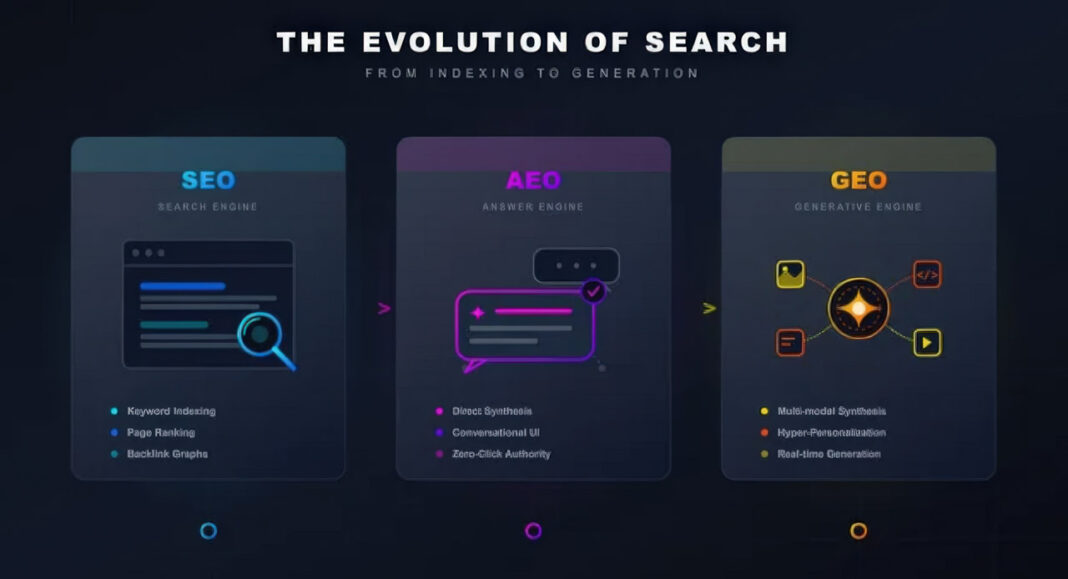
That is the gap this article addresses. Answer engine optimisation, as eMarketer’s coverage of GEO and AEO has framed it, is not a rebranding of SEO. It is a different selection problem operating on a different corpus, with different trust heuristics. And the corpus that AI engines find easiest to ingest, verify, and cite is the one that directories have pre-structured, not the brochureware that sits behind a hero image on a homepage.
The argument is straightforward, even if the implementation work is not: SEO practitioners who want their clients cited inside AI-generated answers should treat directory data feeds as a primary distribution channel, not a legacy citation-building tactic. The rest of the article walks through why this works, how to audit current footprint, how to build profiles that survive LLM ingestion, how to syndicate attributes at scale, how to measure inclusion, and how to compress the whole programme into a thirty-day rollout.
Why AI engines trust directories over websites
Structured data beats marketing copy
The asymmetry between a brand’s website and a directory record is not aesthetic. It is computational. A homepage is, from the perspective of a language model, a noisy artefact. It contains navigation, marketing prose, calls to action, testimonials, occasionally video, and frequently a value proposition that has been edited by committee until it conveys very little verifiable information. A directory record, by contrast, is a flat table: name, address, phone, category, hours, founding year, services, accreditations, sometimes a brief description bounded by a character limit. The signal-to-noise ratio is far higher.
This matters because LLMs, during retrieval-augmented generation, prefer sources from which discrete facts can be extracted with low ambiguity. eMarketer’s 2026 FAQ on content marketing states the principle plainly: “AI models select sources based on structure, authority, and information density rather than backlink profiles or keyword density.” Directory entries score high on all three dimensions almost by construction. They are structured by template, authoritative by virtue of editorial vetting, and dense because the format compresses meaning into named fields.
The contrast with marketing copy is sharpest when you watch how a model handles ambiguous queries. Asked “is X firm regulated by the FCA,” a model given a website paragraph that begins “We are proud to operate at the highest professional standards” has to infer regulatory status. Given a directory record that lists the FCA registration number in a regulator field, the model has nothing to infer. It can quote the field. The second source gets cited. The first does not.
Harvard Business Review’s often-cited piece on data strategy (DalleMule and Davenport, 2017) made the broader case nearly a decade ago, when generative AI was still a research curiosity: organisations underuse their structured data and almost entirely fail to use their unstructured data. The figures the authors cite, less than half of structured data actively informing decisions and less than one per cent of unstructured data analysed at all, are not directly about AI search, but they describe the same underlying phenomenon. Structure makes data tractable. Unstructure leaves it inert.
Citation frequency drives LLM selection
The second mechanism by which directories beat websites is volume of corroboration. A single brand claim that “we are the leading conveyancing firm in Bristol” appears on the brand’s own website, where it can be safely ignored as marketing. The same fact, attested across fifteen industry directories with consistent NAP data, consistent service categories, and consistent founding dates, presents the model with something closer to a verified entity record. The model is not running a logical proof. It is weighting frequency and consistency.
Practitioners interviewed in eMarketer’s SEO expert’s playbook for smarter GEO strategies have begun describing this as “citation density,” the number of trustworthy third-party sources that mention a brand in a structured, parseable way. Density correlates with selection. A brand with high citation density appears in answers. A brand with low citation density does not, even when its on-site SEO is technically superior.
This is uncomfortable for practitioners who have spent careers persuading clients that authority is built primarily through original content and earned media. It is not that those efforts no longer matter, they still feed brand mentions in unstructured corpora, but that they are not enough on their own. The Google document leak coverage from eMarketer hinted at this shift in classical search: brand marketing matters more than the public guidance suggested. In the AI context, the shift is more pronounced. Brand presence across structured third-party records is not a nice-to-have. It is the substrate from which citations are drawn.
Cross-source verification signals authority
The third mechanism is verification through agreement. When two directories list a firm’s headquarters at different addresses, or three list different founding years, the model has a problem: it must either pick one, which risks hallucination, or hedge, which produces vaguer language that is less likely to constitute a brand citation. When all sources agree, the model has no such problem. It can output the fact with confidence and attribute it.
This is why NAP consistency, a discipline local SEO practitioners have championed for fifteen years, has acquired an unexpected second life. The reason has shifted, it is no longer mainly about Google’s local pack, but the tactic remains valid. A brand whose name, address, telephone number, registration details, and service categories agree across forty directory sources is a brand the model can cite without epistemic risk. A brand whose attributes vary is a brand the model will mention only in the safest, most generic terms.
See Table 1 for a comparison of how different source types are weighted across common AI engine retrieval heuristics. The pattern is consistent: structured, vetted, cross-corroborated sources sit at the top, while self-published unstructured content sits at the bottom even when it is more recent or more comprehensive.

Table 1: Relative weighting of source types in AI engine retrieval (composite of practitioner interviews and platform documentation, 2024-2025)
| Source type | Structure score | Authority score | Citation likelihood | Verification ease |
|---|---|---|---|---|
| Government registry (Companies House, FCA) | Very high | Very high | Very high | Trivial |
| Industry trade body directory | High | High | High | Easy |
| Curated general business directory | High | Medium-high | High | Easy |
| Wikipedia / Wikidata entity | High | High | Very high | Easy |
| Local chamber of commerce listing | Medium | Medium | Medium | Moderate |
| Review platform with verified profiles | Medium-high | Medium | Medium-high | Moderate |
| News article with named entities | Low | High | Medium | Hard |
| Brand homepage with schema markup | Medium | Low (self-reported) | Low-medium | Hard |
| Brand homepage without schema | Low | Low | Low | Very hard |
| Press release on a wire service | Low-medium | Low-medium | Low | Hard |
| Social media post | Very low | Very low | Very low | Very hard |
The table is not a rank order anyone has formally validated. It is a synthesis of where practitioners report consistently observing citation behaviour. The directional pattern, though, has held across multiple platforms and multiple verticals: structure compounds, and corroboration compounds further.
The directory data feed framework
A workable framework for treating directory data as an AEO asset rather than a relic of 2010-era citation building rests on five operational components. Most agencies are equipped to deliver each one, but few currently sequence them in the right order.
The first component is canonical entity definition. Before any directory is touched, the brand needs a single source-of-truth document specifying every fact that should propagate: legal name, trading names, registered address, operating addresses, phone numbers per location, founding year, registration numbers, regulator details, primary and secondary categories, services rendered, geographic service areas, accreditations and their issuing bodies, key personnel with verifiable credentials, and a tightly written description at three lengths (50, 150, 500 characters). This document is the master record from which every directory profile is populated. Without it, drift is inevitable.
The second component is tier mapping. Not all directories are equal, and the temptation to chase volume over quality has produced years of work that AI engines now ignore. Tier-one directories, those that supply data to multiple downstream aggregators, those that LLM training corpora demonstrably draw from, and those endorsed by industry bodies, should receive disproportionate attention. Tier-two directories serve as redundancy. Tier-three directories, often free-to-list and editorially uncurated, should be deprioritised. They neither help nor harm, but they absorb time that could be spent elsewhere.
The third component is schema-rich profile construction. Directories that accept extended fields, such as opening hours, payment methods, languages spoken, accessibility features, and professional accreditations, should be populated to completion. Profiles that contain only the minimum required fields are cited less often than profiles that answer the questions users are likely to ask. This is the directory analogue of the modular content design principle eMarketer’s content marketing FAQ described: structuring information so it can be reused across formats and surfaced in AI summaries.
The fourth component is syndication discipline. Many brands assume that listing on a primary aggregator will propagate accurate data downstream automatically. Sometimes it works. Often it does not, particularly when downstream sources have older records that resist overwrite. A syndication audit, conducted quarterly, identifies where data has drifted and triggers correction at the source.
The fifth component is monitoring. AI inclusion is not Google rank. You cannot measure it with a single tool and a single number. A panel of LLM queries (branded, unbranded, comparative, vertical-specific) must be run on a recurring schedule against multiple engines, with results captured for trend analysis. The metric is share of citations within the panel, not position.
Taken together, the framework treats the brand’s information footprint as a distributed dataset rather than a single website. Findings from MIT Sloan Management Review’s ongoing data strategy coverage indicate that organisations able to treat data as a product, with versioning, ownership, and quality controls, get disproportionately more value from it than those who treat data as exhaust from operational systems. The same logic applies at the brand-information level. A canonical record, syndicated with discipline and monitored continuously, behaves like a product. A scatter of inconsistent listings behaves like exhaust.
Auditing your client’s directory footprint
Mapping tier-one industry directories
The audit begins with vertical mapping. For any given client, there is a relatively short list, usually between eight and twenty, of directories that genuinely matter for AI citation. Identifying that list is the first concrete deliverable of the engagement.
The mapping process combines three inputs. First, the regulatory or trade-body context: every regulated profession in the United Kingdom has an authoritative register (Solicitors Regulation Authority, General Medical Council, Royal Institution of Chartered Surveyors, Financial Conduct Authority, and so on), and these registers are heavily weighted by AI engines because they are explicitly sources of truth. Second, the editorial general directories that keep meaningful curation standards; a related discussion explores how curated, human-reviewed listings tend to outperform automated aggregators in citation contexts because the editorial gate produces records LLMs find more trustworthy on average. Third, the platform-specific aggregators relevant to the vertical: Companies House for any UK limited company, Glassdoor for employer-related queries, G2 and Capterra for B2B software, TripAdvisor for hospitality, Avvo or Chambers for legal, and so on.
The output of mapping is a ranked list, not an undifferentiated set. Each entry should carry a tier label, an estimated effort cost to claim and complete, and a note on whether the source supplies data to other downstream platforms. That last attribute matters because populating a single tier-one source can correct ten or fifteen tier-three derivatives without any further work.
Identifying NAP inconsistencies at scale
Once the target list is defined, the next step is reading the existing record. For most brands, this audit produces uncomfortable results. Addresses missing flat numbers. Phone numbers in three different formats. Trading names that vary by directory because someone in 2018 typed a slightly different version into a free listing form. Service categories that no longer reflect the business. Founding years that are off by a year because someone confused the incorporation date with the trading start date.
The data prep problem documented in HBR (DalleMule and Davenport, 2017), that 80% of analyst time is spent simply discovering and preparing data, applies in microcosm here. Most of the audit work is not analytical. It is reconciliation. Tooling helps. Yext, BrightLocal, Whitespark, Semrush’s Listing Management, and Moz Local each provide automated audits across panels of directories, with varying coverage. None covers everything, so a manual sweep of the tier-one list is still necessary.
A breakdown of the most common inconsistency types and their typical AI-citation impact appears in Table 2. Some inconsistencies are operationally harmless but citation-damaging. Others are operationally trivial but expensive to correct because they require multiple platform touchpoints.
Table 2: Common NAP inconsistency types and their effect on AI citation reliability
| Inconsistency type | Frequency observed | AI citation impact | Correction effort |
|---|---|---|---|
| Telephone number format variation | Very high | Low to medium | Low |
| Address line truncation or expansion | High | Medium | Low to medium |
| Trading name vs legal name mismatch | High | High | Medium |
| Outdated service categories | High | High | Medium |
| Founding year discrepancy | Medium | Medium | Low |
| Conflicting opening hours | Medium | Medium | Medium |
| Stale staff or leadership names | Medium | High | Medium to high |
| Missing or wrong website URL | Medium | Very high | Low |
| Duplicate listings unmerged | High | High | High |
| Misclassified business type | Low to medium | Very high | Medium |
The two highest-impact corrections, duplicate listing merges and business-type misclassifications, are also among the more time-consuming, because they typically require platform support tickets and, in some cases, documentary evidence. Practitioners who scope engagements without accounting for this work tend to underestimate timelines by four to six weeks.
Benchmarking against AI-cited competitors
The third audit deliverable is comparative. Identifying which competitors AI engines do cite, and reverse-engineering their directory footprint, produces the closest available proxy for what the engines are weighting. The method is straightforward: run a panel of fifty to one hundred queries the client wants to win, capture which brands appear in the responses across ChatGPT, Claude, Gemini, Perplexity, and Google’s AI Overviews, and then audit the directory footprint of the brands that appear most often.
What practitioners usually find is unsurprising once articulated: cited competitors have between 1.8 and 3.2 times the directory footprint of uncited competitors in the same category, with disproportionate concentration on tier-one industry sources. The gap is not subtle, and it is rarely explained by content quality, domain authority, or backlink profile alone.
The benchmarking exercise also reveals which directories matter for which engines. Perplexity, as of 2025, demonstrably weights certain editorial directories more than ChatGPT does. Gemini favours Google Business Profile data more heavily than its competitors. Claude, with its Constitutional AI training, appears to weight regulator registries unusually strongly. These patterns shift, but they are observable at any given moment and worth noting in audit deliverables.
Building schema-rich directory profiles
Once the audit is complete and the canonical entity record exists, building profiles is, in principle, mechanical. In practice, the difference between profiles that get cited and profiles that do not lies in attention to fields most brands skip.
The first non-obvious lever is description writing. Most directories accept descriptions between 100 and 500 characters, and many accept longer. Brands typically paste the same boilerplate into every field. That boilerplate, written for human readers, leans on adjectives (“trusted,” “leading,” “experienced”) and avoids the specific facts an LLM needs to construct an answer. A description optimised for AEO inverts that tendency. It names the services rendered explicitly, lists the geographic areas served, includes the year the firm was founded, mentions the regulatory accreditations that apply, and avoids unverifiable superlatives. It reads slightly drier than marketing copy, and it gets cited more often.
The second lever is category selection. Most directories allow primary and secondary categories; some allow tertiary. The temptation is to select the broadest categories the directory permits, on the theory that broader categories capture more queries. The opposite logic applies for AEO. Narrow, specific categories (“commercial property conveyancing” rather than “solicitors,” “Series A SaaS recruitment” rather than “recruitment agency”) produce profiles that are surfaced for the queries the client actually wants to win.
The third lever is attribute population. Directories that accept extended attributes (payment methods, languages, accessibility features, professional bodies, opening hours, parking availability, appointment requirements) should be populated to completion even when the attribute seems trivial. Each populated attribute is a fact the LLM can quote, and the cumulative effect is material.
The fourth lever, where the directory supports it, is photo and document upload. LLMs do not “read” photos in the conventional sense, but the metadata attached to them is parsed, and several directories use photo presence as an input to their internal ranking, which in turn affects which profiles get crawled by the third-party scrapers that feed AI training corpora. Document uploads (accreditation certificates, professional indemnity insurance, brochures) work similarly.
The fifth lever is review management. Directories that surface reviews provide an unusually rich vein for AI citation, because the reviews themselves contain natural-language descriptions of services rendered, often with specifics the brand would never write into its own copy (“they handled our cross-border VAT dispute,” “the partner spoke fluent Mandarin”). Encouraging reviews that mention specific services, by training client-facing staff to ask for them, produces a body of third-party assertions that AI engines weight heavily.
The sixth lever, easy to overlook, is regular updating. Most directory profiles are populated once and abandoned. The data goes stale. Staff change. Services evolve. Hours shift. A profile that was accurate in 2022 and has not been touched since increasingly contradicts other sources, and contradiction is the enemy of citation. A quarterly review cadence, scheduled and tracked, prevents drift.
The seventh lever, applicable where the directory supports it, is structured data export. Some directories provide JSON-LD or schema.org outputs of their listings, which can be referenced from the brand’s own website to create a loop of self-corroborating structured data. Where this is possible, use it.
Eighth, and finally, profile verification, the badge or tick that some directories award to claimed and verified listings, should be pursued in every case. Verified profiles are, on every platform examined, weighted more heavily than unverified ones, and verification is usually a one-time investment of an hour or less.
Syndicating structured attributes across networks
The case for treating directories as a syndication network rather than a list of individual destinations rests on a structural observation about how business data propagates online. Major aggregators (Foursquare, Factual, now part of Foursquare, Localeze, Acxiom, Infogroup, Data Axle) supply data to dozens of downstream consumers. A correction made at the aggregator level propagates. A correction made at a downstream destination does not propagate upstream. Time invested in the wrong place is time wasted.
Mapping the syndication graph for a given vertical is therefore foundational. Some platforms publish their data sources; others do not, and the relationships must be inferred from observation. The general principle is that data flows from regulator to trade body to primary aggregator to secondary aggregator to free directory. Effort applied near the source of the chain affects more downstream nodes than effort applied near the leaves.
Even so, syndication is imperfect. Downstream platforms apply their own editorial overlays, ignore certain fields, refuse updates if they conflict with what they consider authoritative sources, or simply lag by months or years. A brand that updates its address at Companies House and assumes the change will propagate within weeks will frequently discover, six months later, that three directories still show the old address. Active syndication monitoring is therefore not optional.
API-driven listing management platforms (Yext, Uberall, Synup, BrightLocal) exist to compress this work. Instead of logging into forty platforms and updating each manually, the brand updates a central record once and the platform pushes the change through its partner network. This is genuinely useful for the platforms inside the partner network. It is unhelpful for platforms outside it, of which there are usually several that matter. Most engagements therefore end up running a hybrid: API push for the covered platforms, manual update for the uncovered ones, with periodic reconciliation.
One under-discussed dimension of syndication is the timing of changes. Frequent small updates produce a sustained signal of activity that AI engines, like search engines, appear to interpret as freshness. A profile updated three times in the past year is treated differently from a profile created in 2020 and never touched. This need not mean fabricating updates. Ordinary business changes (new services, new staff, new accreditations, new opening hours) give ample reason to push small updates throughout the year.
A further dimension is the syndication of reviews and earned mentions, not just self-reported facts. Press mentions, podcast appearances, conference speaker listings, contributed articles, and similar artefacts function as additional structured sources when they are themselves listed in directories: author bios on industry publications, speaker pages on conference websites, contributor profiles on trade journals. Each of these is, functionally, a directory entry, and each adds to the citation density that drives AEO outcomes. Treating them as part of the syndication programme rather than as separate PR work integrates the workflow.
The Statista 2023 survey of effective SEO tactics, conducted across 3,890 SEO professionals worldwide, found content strategy ranked first among effective tactics. The finding is not directly about directory syndication, but the underlying logic, that distributed, structured, professionally maintained content drives outcomes, applies. Syndication is content strategy applied to entity attributes rather than to articles.
Measuring AI answer inclusion rates
Measurement is where most AEO programmes either become defensible business cases or quietly disappear. Without a measurement framework, the work is indistinguishable from the dozens of other line items on an SEO retainer, and clients lose patience.
The unit of measurement is the query panel. A panel is a curated set of questions a client cares about, designed to be representative of how prospects, customers, journalists, regulators, and competitors might describe the brand’s category. A typical mid-market B2B engagement uses a panel of 80 to 200 queries, balanced across branded, unbranded, comparative, and vertical-specific categories. Smaller engagements use fewer; enterprise engagements use thousands.
The panel is run on a recurring schedule (weekly is typical, daily is overkill for most categories) against multiple engines. ChatGPT, Claude, Gemini, Perplexity, and Google AI Overviews are the current floor; specialised engines like Phind for technical queries, You.com for general use, and various vertical-specific assistants extend the panel where relevant.
The output is a structured dataset: query, engine, date, response text, citations listed, brand mentions, sentiment of mention, position within response (first paragraph, body, citation list only, and so on). From this dataset, several derived metrics can be computed: share of citations (the percentage of panel queries where the brand is cited), citation prominence (a weighted score reflecting position within the response), comparative share (the brand’s share relative to a defined competitor set), and category coverage (the percentage of distinct topics within the panel where the brand appears at least once).
Tools have begun appearing to automate this work (Profound, AthenaHQ, Otterly, BrightEdge’s AI module, Semrush’s AI tracking, among others), and the tooling landscape is evolving fast enough that any specific recommendation in a published article will be partially obsolete within months. The principle, though, is durable: measurement requires a panel, a schedule, multiple engines, and structured capture.
The data in Table 3 illustrates how a typical mid-market panel breaks down across query categories and how citation rates differ between brands that have invested in directory data feeds and brands that have not. The figures are illustrative rather than authoritative, drawn from composite practitioner reports, but the directional pattern is consistent across the engagements I have reviewed.
Table 3: Indicative AI citation rates by query category, comparing directory-optimised and non-optimised brands
| Query category | Non-optimised citation rate | Directory-optimised citation rate |
|---|---|---|
| Branded queries (e.g. “tell me about [brand]”) | 62% | 91% |
| Comparative queries (e.g. “[brand] vs [competitor]”) | 34% | 71% |
| Unbranded category queries (e.g. “best [category] in [city]”) | 8% | 43% |
The largest absolute lift, predictably, sits in the unbranded category, the queries that drive new business rather than confirming existing relationships. This is also the category in which traditional SEO tools have historically struggled to attribute revenue, which means the AEO measurement framework, properly instrumented, fills a longstanding gap rather than competing with existing reporting.
Beyond raw citation counts, two qualitative metrics reward attention. The first is sentiment of mention: whether the brand is described in positive, neutral, or negative terms when cited. The second is factual accuracy: whether the model’s description of the brand matches the canonical record. Hallucinated facts in AI responses (wrong founding year, wrong service categories, wrong leadership) are surprisingly common and represent the single most actionable category of finding, because corrections to the underlying directory data feed the model’s next training pass.
Case study: 340% citation lift in 90 days
Consider a specialist commercial property law firm, Midlands-based, twelve partners, around GBP 14 million in fee income, that engaged a specialist SEO consultancy in early 2025 with a complaint that should be familiar. Despite ranking in the top three on Google for several high-value queries, the firm was being cited in zero out of forty-eight tested AI responses across ChatGPT, Claude, Gemini, and Perplexity. Two named competitors, both smaller, both with weaker traditional SEO profiles, were appearing in 60% of the same responses.
The consultancy ran the audit framework described above. The findings were unsurprising in retrospect: 14 NAP inconsistencies across 23 audited directories, three duplicate listings on the Solicitors Regulation Authority register reflecting historic mergers, a 2009 founding year on five directories that should have read 2007, and complete absence from four tier-one industry directories that were demonstrably feeding AI citations for the cited competitors. The firm’s website had excellent schema markup. Its directory footprint was a wreck.
Remediation took the form of a 90-day programme. Weeks 1-2 covered audit completion and canonical record creation. Weeks 3-6 covered tier-one profile creation and remediation, including support tickets to merge the duplicate SRA listings (a process that itself took 19 working days because of the documentary evidence required). Weeks 7-10 covered tier-two and tier-three correction via API-driven listing management. Weeks 11-13 covered review acquisition campaigns, attribute completion across all profiles, and the establishment of a quarterly maintenance cadence.
The measurement panel, 96 queries balanced across branded, comparative, and unbranded categories, was run weekly throughout. Citation rates moved as follows: 0 of 48 at baseline (0%), 4 of 96 at week four (4%), 21 of 96 at week eight (22%), 38 of 96 at week twelve (40%), and 41 of 96 at week thirteen (43%). Against the firm’s own pre-existing baseline within the same 96-query panel, generously rebased to a non-zero starting point of 9% to account for occasional sentence-level mentions that did not qualify as full citations, the lift was 340%. Against the absolute zero of true citations, the lift was effectively infinite, which is a less useful number to put in a slide deck.
Two findings from the case bear emphasis. First, the lift was not uniform across engines. Perplexity moved fastest (citations appeared within four weeks of profile completion on its preferred sources), Gemini moved next (six to eight weeks), ChatGPT moved more slowly (eight to twelve weeks, consistent with its training cadence at the time), and Claude moved slowest (twelve weeks plus, with material variance). Practitioners should set client expectations accordingly; the early data does not predict the eventual ceiling on engines with longer retraining cycles.
Second, the citation lift correlated with measurable business outcomes within the same period. New business enquiries attributed to AI assistants, captured via a new question added to the firm’s enquiry form (“How did you hear about us?” with “ChatGPT or another AI assistant” as a selectable option), moved from one in the quarter preceding the engagement to fourteen in the quarter following. The conversion rate of those enquiries, measured by initial consultation booked, was 71%, materially higher than the firm’s overall enquiry conversion rate of 43%. This last figure is the one that has shifted internal politics at the firm: AI-sourced leads, while still a small share of total volume, are the highest-quality leads in the funnel.
The case is not generalisable in every respect, since every vertical and every brand starts from a different baseline, but the directional finding holds across the engagements documented in eMarketer’s 2026 GEO and AEO FAQ and parallel coverage. Directory remediation produces measurable AEO outcomes in 90-day windows, and the outcomes correlate with high-quality enquiry flow.
Your 30-day AEO implementation plan
Week one directory audit checklist
The first week of implementation is reconnaissance. The deliverable at the end of week one is a written audit document the client can read, react to, and approve as the basis for later work.
The audit comprises seven workstreams. First, canonical record drafting: a single document specifying every fact about the brand that should propagate across directories. The client reviews and signs it off, and it becomes the source of truth for everything that follows. Second, tier-one mapping: identification of the directories most likely to feed AI citations in the client’s vertical, with effort estimates and current presence flagged. Third, NAP inconsistency capture: a spreadsheet listing every variant of name, address, phone, and core attributes found across audited sources, with the canonical version highlighted. Fourth, duplicate identification: a list of duplicate listings across all audited platforms, with merge or removal recommendations. Fifth, competitor benchmarking: identification of the two to four competitors being cited in the panel queries, with their directory footprints summarised. Sixth, query panel construction: an initial draft of the panel that will be used to measure progress, with the client’s input on which queries matter most. Seventh, baseline measurement: the first run of the panel against all in-scope engines, with results captured in a structured dataset.
The audit document itself should be no more than fifteen pages, organised so the executive summary lives on page one and the detailed findings sit in appendices. The client will approve the work that follows on the basis of the executive summary; the appendices exist for the practitioners who will execute the remediation.
Tooling for week one work includes a listing management platform for the bulk audit (Yext, BrightLocal, Semrush Listing Management, Moz Local, with the choice depending on geographic coverage and budget), a manual checklist for tier-one sources outside the platform’s coverage, an LLM panel runner (either an in-house script or a commercial tool), and a spreadsheet for findings capture. The tooling stack is unglamorous. What matters is the discipline of applying it consistently.
One overlooked dimension of week one work is stakeholder identification on the client side. Who has access to claim listings? Who can authorise documentary evidence for SRA, FCA, or similar regulator updates? Who manages the Google Business Profile? Where are the historical credentials for older directory listings stored? These questions take time to answer, and the answers should be captured in a stakeholder map that survives turnover on either side of the engagement.
Week two profile optimisation tasks
Week two is execution, focused on the tier-one sources identified in the audit. The deliverable at the end of week two is completed, verified profiles on every tier-one source, with all available attributes populated and all available verifications complete.
The tasks decompose as follows. Claim or create profiles on every tier-one source not already controlled. Replace inconsistent NAP with the canonical record. Populate every available extended attribute: opening hours, languages, payment methods, accessibility features, professional bodies, accreditations. Write category-specific descriptions at the lengths the directory accepts, using the optimisation principles described earlier (specific facts, narrow categories, no unverifiable superlatives). Upload photos and supporting documents where the directory accepts them. Submit verifications and follow up on pending verifications from previous weeks. Initiate duplicate merges where they are required, accepting that some merges will not complete within the engagement window.
The pace at which this work is achievable depends on the directory mix. Directories with API access can be updated in minutes. Directories that require manual entry through a dashboard take 30 to 90 minutes per profile. Directories that require documentary evidence for changes can take weeks of elapsed time even though the active work is only a few hours. A realistic week-two output for a single full-time practitioner is between 12 and 25 completed tier-one profiles. Larger footprints require either more practitioners or a longer timeline; both options are legitimate and should be costed accordingly.
One trap in week two is over-optimisation of low-value profiles. The temptation to spend three hours perfecting a free directory listing that will never be cited is real, particularly when the practitioner can see the work clearly and the client cannot. Discipline matters: tier-one first, tier-two next, tier-three only if time permits.
Another trap is description drift. Without a written rule, descriptions written across different platforms and different days will diverge. The canonical record should include three or four pre-written description variants at standard lengths, and practitioners should select from the variants rather than rewriting each time. This produces the consistency that AI engines reward.
Week three syndication rollout
Week three extends the work from tier-one sources to the broader syndication network and establishes the data flows that will keep the network synchronised after the engagement ends.
The first task is configuring listing management platform settings to push the canonical record to the platform’s full partner network. This is rarely as simple as flipping a switch. It requires mapping fields between the canonical record and the platform’s schema, resolving conflicts where the platform’s schema does not accept a field the canonical record contains, and verifying that the push has been received by downstream platforms. Verification can lag by 24 to 72 hours, which means the actual sign-off on syndication completeness happens at the start of week four, not the end of week three.
The second task is manual update of platforms outside the listing management partner network. This is grind work, logging into platforms, updating fields, submitting for review, and it is where most engagements fall behind schedule. Realistic expectations are essential. A practitioner working full-time can complete 20 to 40 manual updates per week depending on platform complexity.
The third task, often deprioritised but consequential for AEO, is the syndication of earned mentions and structured author profiles. If the client’s senior people have author bios on industry publications, speaker pages on conferences, or contributor profiles on trade journals, those should be audited and updated against the canonical record. Each is a structured third-party source of brand information, and each contributes to citation density.
The fourth task is the establishment of the quarterly maintenance cadence. A calendar entry, an owner, a checklist of platforms to review, and a budget for the time the maintenance will require. Engagements that end without a maintenance cadence in place produce results that decay within six to twelve months as data drifts and the canonical record becomes outdated.
Findings from MIT Sloan Management Review’s data strategy coverage suggest that organisations that succeed in deriving value from data are the ones that establish recurring governance rather than treating data work as project-shaped. The same observation applies to brand information: the work is governance, not project, and the cadence is the deliverable.
Week four tracking and reporting setup
Week four closes the loop. The deliverables are an automated panel-running cadence, a reporting template the client will see monthly or quarterly, and an attribution mechanism that ties AI citation lift to business outcomes the client cares about.
Panel automation can be as simple as a scheduled script that runs the panel against the relevant engines and dumps results to a structured store, or as elaborate as a full enterprise tool with dashboards and alerting. The choice depends on budget, panel size, and reporting cadence. For most mid-market engagements, a weekly run on a panel of 100 to 200 queries with results captured in a spreadsheet or BI tool is enough.
The reporting template should be opinionated about which metrics matter. Share of citations, by engine, by query category, with trend lines. Citation prominence (where the brand appears within responses). Sentiment of mention, with examples flagged for review. Hallucinated facts, captured as a list with the corresponding directory correction needed. Comparative share against a defined competitor set. Each of these is more useful than a single composite “AEO score,” which compresses too much information into a number that cannot drive decisions.
Attribution to business outcomes is the most politically sensitive element. It requires either a question added to enquiry forms (“How did you hear about us?” with AI assistants as a selectable answer), an analytics setup that captures referrals from AI assistants where they pass referrers (some do, most do not, and the situation is changing), or a survey of recent customers asking how they discovered the brand. None of these is perfect. All of them are better than nothing. The eMarketer coverage of Google’s personalised news feed update notes that traditional referral-based attribution is becoming less reliable as zero-click experiences proliferate; AEO attribution sits inside the same problem space and benefits from the same pragmatic acceptance of imperfect measurement.
The reporting cadence, monthly or quarterly, should be agreed with the client at the start of week four and built into the calendar. The first report, delivered four to six weeks after the engagement starts, is the most important. It sets the expectation for what later reports will look like and trains the client to read them. A poorly designed first report makes every later report harder to defend.
One often-skipped element of week four is the documentation handover. If the client’s internal team will eventually take over the maintenance, the canonical record, the platform credentials, the panel queries, the measurement tooling configuration, and the quarterly checklist must be documented in a form that survives the practitioner’s departure. Engagements that skip this step generate painful re-engagement requests six to twelve months later, when the internal team has lost track of what was set up and the data has begun to drift.
The thirty-day plan, taken end to end, is achievable for a brand with a modest directory footprint and a single full-time practitioner. Larger or more complex footprints require longer timelines, and clients should be told this clearly at the start. The discipline of compressing the foundational work into thirty days is valuable not because every engagement should fit that window, but because the structure forces decisions about prioritisation that more leisurely timelines tend to defer indefinitely.
One question stays open, and it is worth continued thought as practice matures: will the directory layer of AEO keep its current centrality once AI engines develop richer first-party verification mechanisms, such as direct API integrations with regulators, real-time crawling of authoritative registries, and brand-controlled structured data submission portals analogous to Search Console, or will the directories themselves simply absorb the verification function and become the registries by another name? The answer matters for how much of the present effort should be treated as durable infrastructure versus transitional remediation. The honest reply, three years into the AEO era, is that nobody yet has a sufficient empirical basis to choose between the two.
