
The strategic shift to digital marketing and automation
The business world moves fast. To grow and stay ahead, companies need modern tools. Digital marketing and AI automation are no longer optional. They matter for success.

These tools help businesses of all sizes reach more customers and build personal experiences for each one. That drives efficiency and growth.
This guide shows you how to put them to work. We will look at how digital marketing and automation can transform your operations, the benefits compared to older methods, AI’s role, how teams can work together, and how to track your progress. A solid foundation, starting with a clear Digital marketing branding strategy, is where success begins.
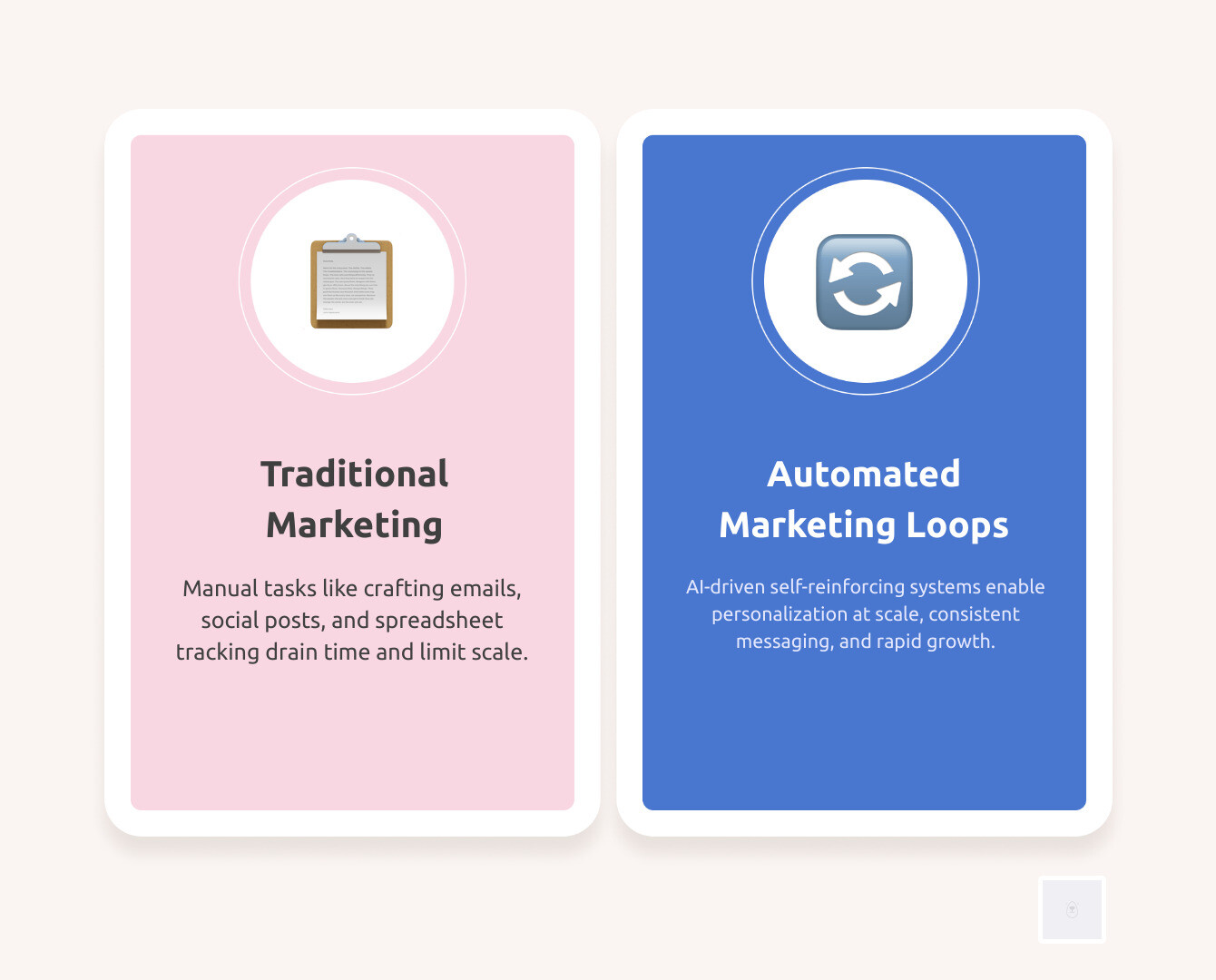
Relying on digital environment, relying solely on traditional marketing methods is like driving a modern highway with a map from the last century. Traditional marketing often means manual, repetitive tasks across many channels, which produces inconsistent messaging and drains resources.
Think of writing individual emails for every customer segment, posting on social media by hand, or tracking lead progress through spreadsheets. That approach eats time and limits your ability to scale and personalize.
Marketing automation is the use of software to handle repetitive marketing tasks. That covers email marketing, social media posting, ad campaigns, lead nurturing, and customer relationship management. The difference is efficiency and scale. Where traditional methods are manual and linear, automation runs complex, multi-channel customer journeys with precision and at a scale that was hard to reach before. Marketing goes from a set of disconnected campaigns to one connected system built on data.
The payoff is real for both businesses and nonprofits. Businesses see better lead generation, higher conversion rates, and a stronger return on investment. Nonprofits build deeper donor relationships, simplify fundraising, and extend their mission’s reach without needing a large team.
When routine tasks run themselves, people can spend their time on strategy, creative content, and genuine human connection. Automation works alongside that effort rather than replacing it.

Personalizing the journey with digital marketing and automation
One of the strongest advantages of digital marketing and automation is delivering personalized customer journeys at scale. Consumers expect relevant, timely interactions, and generic messaging no longer works. Marketing automation uses data from every customer touchpoint, including website visits, email opens, past purchases, and social media engagement, to build a full view of each individual.
That data supports dynamic content that adapts as users behave and choose. Picture a website that changes its layout and product recommendations for a returning visitor, or an email campaign that sends follow-up messages based on whether a recipient opened the previous email or clicked a specific link.
Behavioral triggers make this possible, starting automated workflows based on set actions or inactions. This kind of personalization goes past inserting a first name. It anticipates needs and delivers what a customer wants, sometimes before they realize it. For more on building tailored experiences, see how automation enables Personalized Customer Journeys at Scale.
Good automation also keeps channels coordinated across email, social media, SMS, and web. A customer’s path rarely stays on one platform, so automation keeps interactions consistent and complementary no matter the channel. That gives people one coherent brand experience, cuts friction, and moves them through the sales or donor funnel.
B2B teams stretch that coordination across whole buying groups rather than single contacts, which is the logic behind orchestrating campaigns around named target accounts.
Techniques like progressive profiling let you gather more information about contacts over time, filling out their profiles gradually instead of hitting them with long forms. That steady data collection feeds more precise personalization and builds trust.
Measuring success in digital marketing and automation
The move to digital marketing and automation is about working smarter and with measurable impact, not just faster. One of the most useful features of an effective digital marketing strategy using automation is that it tracks and analyzes performance precisely. You trade guesswork for decisions grounded in data, so you know exactly what works and why.
Attribution reporting, for example, traces conversions and revenue back to specific marketing touchpoints, showing which campaigns and channels perform best. That helps you set budgets and put resources behind the strategies that return the most. Email marketing alone returns an average of $36 for every dollar spent. Automation pushes that further by segmenting audiences and personalizing content, and scheduling sends for optimal engagement.
Beyond direct conversions, you can use engagement scoring to assign values to customer interactions, which helps you identify and prioritize the most promising leads or donors. Conversion path analysis shows the typical journey customers take before converting and points out bottlenecks and chances to improve.
You can also run solid ROI calculations that show the real value automation brings to the bottom line. That insight lets businesses and nonprofits refine their strategies so every marketing dollar works toward the organization’s goals.
Table: Manual Campaign Management vs. AI-Driven Autonomous Execution (2026)
Artificial Intelligence, especially generative AI, is quickly reshaping how marketing automation works. This is not a future concept. AI already acts as a capable copilot across marketing. Generative AI, which creates new content from text and images to videos and code, adds power to existing automation and raises the level of efficiency and personalization.
McKinsey predicts that generative AI will lift marketing productivity by up to 15% of total marketing spend, an estimated USD 463 billion a year. That figure points to how much these technologies can change. More than three out of four CMOs say generative AI will change how marketing operates, given its ability to meet the growing demand for content.
Business demand for content has risen 93% since 2023, and 90% of marketing leaders say content marketing matters more now than ever. Organizations already use GenAI, with 47% using it to brainstorm content ideas, up from 28% in 2023.
AI supports modern marketing automation in several ways:
- Hyper-personalization at Scale: AI studies large datasets to understand individual customer preferences, behaviors, and even emotional cues. Generative AI can then write unique, relevant messages, product recommendations, and even entire content pieces tailored to each person. This goes past basic segmentation toward one-to-one marketing, where content is generated for the context at hand.
- Content Creation and Optimization: Generative AI can quickly produce many versions of marketing copy, email subject lines, social media posts, and ad creatives. Marketers can iterate and test different versions to see what resonates with specific audiences. It also spots content gaps and generates ideas to fill them, which speeds up the whole content supply chain.
- Predictive Insights and Strategy: AI’s analytical capabilities do more than report past performance. AI can find hidden patterns in customer data, predict future trends, and forecast campaign outcomes. That lets you adjust strategy early and improve campaigns before they launch. For businesses looking to bring AI into their marketing automation, platforms like Onepath AI marketing automation can help.
- Workflow Automation and Efficiency: AI can automate decisions inside marketing workflows, such as lead scoring, dynamic audience segmentation, and choosing the best time and channel to send a message. That cuts down manual, low-value work and frees teams for strategy and creativity.
Looking to 2026 and beyond, marketing automation is inextricably linked with emerging AI technologies keep advancing. We expect more capable AI models that can understand nuances in human language and emotion, which leads to more empathetic and effective customer interactions. AI will increasingly act as a strategic partner rather than just an execution tool, helping marketers work through complex data and find new growth opportunities. For more on this topic, read up on how generative AI can boost consumer marketing. In 2026, the edge will go to those who use AI well to drive their marketing automation.
Integrating automation across team silos
One of the biggest problems for growing businesses and organizations is scattered customer data and processes across departments. Marketing, sales, and customer support often work in silos, which creates inconsistent customer experiences, missed opportunities, and internal waste. Marketing automation bridges that gap and brings teams into a shared approach to customer engagement.
A unified customer timeline sits at the center of this. With a marketing automation platform, every interaction a customer has with your brand, from opening an email and downloading a resource to talking with a sales rep and submitting a support ticket, lands in one accessible profile. That full view means every team member, in marketing, sales, or support, has context before they engage a customer.
This shared understanding supports automated lead handoffs. When a prospect meets your qualification criteria, such as a high engagement score or specific content downloads, automation can route that hot lead straight to the right sales rep with their full interaction history. That removes delays and lets sales personalize outreach from the first contact. Sales activity can trigger marketing workflows too. If a rep logs a specific interaction, it might enroll the prospect in a tailored nurture campaign. This two-way sync keeps marketing and sales working together.
Marketing automation also supports closed-loop reporting, where insights from sales and support feed back into marketing. Support tickets, for instance, can trigger retention campaigns or flag common customer pain points, which helps you find content gaps or areas for product improvement.
Shared dashboards give every department a clear view, showing marketing’s effect on sales and customer satisfaction. That shared view is a key benefit of marketing automation, since it keeps every team focused on the same customer-centered goals.
Beyond internal coordination, marketing automation handles multichannel coordination well. You can run complex campaigns across email, social media, SMS, and web while keeping a consistent brand message. A social media ad leads to a landing page, then an email nurture sequence, then a personalized SMS reminder, and automation keeps those touchpoints connected and optimized. That approach improves efficiency and gives customers a journey that feels cohesive and intentional.
Strategic frameworks for nonprofits and growth-stage businesses
Digital marketing and automation help every organization, but nonprofits and growth-stage businesses face particular challenges: limited budgets, smaller teams, and the need to build lasting relationships rather than one-off sales. For nonprofits, the aim is often donor engagement and mission amplification, which calls for its own approach. This is where a framework like HubSpot’s Loop Marketing changes how these organizations connect with their communities.
Traditional marketing funnels, with their linear “awareness to conversion” model, often fall short for nonprofits. Donor journeys are rarely linear. They involve many touchpoints, different levels of engagement, and a strong desire to see impact. HubSpot’s Loop Marketing framework answers that with a continuous, self-reinforcing cycle of engagement built for long-term relationships. It has four stages: Express, Tailor, Amplify, and Evolve.
- Express: Define the mission and message clearly to attract initial interest.
- Tailor: Personalize interactions using donor data to build trust and connection.
- Amplify: Help supporters become advocates who spread the message.
- Evolve: Keep learning from data and feedback to refine strategies and improve impact.
This cyclical approach suits nonprofits well because it supports donor retention, a metric that mattered given the average donor retention rate in 2024 was only 45%. The Loop keeps supporters engaged and turns one-time donors into loyal advocates. And since 80% of donors say they want proof of impact, the “Evolve” stage helps organizations measure and communicate their results, which drives further support. For more on this framework, see HubSpot’s Loop Marketing.
Rolling out marketing automation on a small budget may sound hard for nonprofits, but it works with planning and the right resources. Here are the key strategies:
- Leverage Free and Low-Cost Tools: Many platforms offer free tiers or nonprofit discounts. Look at options for email marketing, CRM, and social media management that fit your budget.
- Utilize Google Ad Grants: Nonprofits can apply for a Google Ad Grant, which gives $10,000 per month in in-kind advertising on Google Search. That reaches potential donors and volunteers with no direct ad spend.
- Focus on Core Automation: Start with the automations that matter most, such as welcome series for new subscribers, automated thank-you emails for donations, and basic lead nurturing sequences.
- Content Repurposing: Get the most out of every piece of content by reusing it across channels. A blog post can become a set of social media updates, an email newsletter segment, and even a video script.
- Community and Volunteer Engagement: Train volunteers to help with content creation, social media management, and data entry, which extends your team’s capacity.
- Data Unification: Even with basic tools, work to centralize donor and supporter data. A unified view is crucial for segmentation and personalization, even if it starts as a simple spreadsheet before you move to a full CRM.
Real examples show what these approaches can do. A small local charity that set up automated thank-you emails and a segmented newsletter saw a 15% rise in repeat donations within a year. Another nonprofit used Google Ad Grants and basic social media automation and doubled its website traffic and volunteer sign-ups.
These results show that effective digital marketing is not only for large corporations. It is within reach for organizations of every size, including those running lean. Americans donated over $557 billion to charity in 2023, so the opportunity is large, and automation helps nonprofits capture their share.
Implementation and overcoming adoption barriers
Setting up digital marketing automation takes careful planning and a clear view of the obstacles. The benefits are clear, but organizations often hit challenges during adoption. Knowing the common barriers and how to handle them makes a successful rollout much more likely.
One of the main challenges is change management. New technology and processes can meet resistance from teams used to older methods. Getting past this takes strong leadership, clear communication about why the change matters, and thorough training. Bring key stakeholders from marketing, sales, and support into the planning early so they buy in and can raise concerns.
Another big hurdle is data unification and cleanliness. Marketing automation needs accurate, integrated data. Many organizations struggle with data scattered across separate systems or with outdated and incomplete records. Before you automate, run a data audit and cleanup. That may mean moving data to a central CRM, setting clear data entry rules, and connecting existing systems. The goal is one source of truth for all customer information.
Here are practical steps businesses and nonprofits can take to start with marketing automation:
- Define Clear Goals: What do you want to achieve? For example, increase lead generation by 20%, improve donor retention by 10%, or cut manual email sending time by 50%. Clear, measurable goals guide your rollout.
- Audit Current Processes: Find repetitive, time-consuming tasks that you can automate. Map your existing customer journeys to spot friction or missed opportunities.
- Choose the Right Platform: Research marketing automation platforms that match your budget, technical skills, and specific needs. Consider how well they scale and integrate. For a full overview, see The Ultimate Guide to Marketing Automation.
- Start Small with Pilot Campaigns: Don’t automate everything at once. Begin with a single high-impact workflow, such as a welcome email series for new subscribers or a lead nurturing sequence for a specific product. Learn from that pilot, refine it, then expand.
- Develop Quality Content: Automation is only as good as the content it delivers. Invest in relevant content that connects with your audience at each stage of their journey. The average internet user spends 395 minutes per day online, so your content has to earn and hold attention.
- Train Your Team: Provide ongoing training and resources so your team can use the new tools well and understand the updated processes.
- Monitor, Analyze, and Optimize: Rollout is not a one-time event. Keep tracking how your automated campaigns perform, review the data, and make decisions that improve workflows and content.
To measure how well your marketing automation is doing, track a specific set of metrics:
- Lead Generation & Conversion Rates: Track the volume and quality of leads from automated campaigns and how many convert into customers or donors.
- Email Marketing Performance: Watch open rates, click-through rates, unsubscribe rates, and conversion rates for automated email sequences.
- Website Engagement: Look at website traffic, bounce rate, time on page, and conversion rates for landing pages driven by automation.
- Customer/Donor Retention: Track churn rates, repeat purchase rates, and donor retention rates to gauge the long-term effect of automated nurturing.
- Customer Lifetime Value (CLV) / Donor Lifetime Value (DLV): Measure the total revenue or donations you expect from a customer or donor over their relationship with your organization. Automation should raise these values.
- Return on Investment (ROI): Calculate the total financial return from your automation investments against the costs.
- Team Efficiency: Quantify the time saved on manual tasks so you can move those resources to strategic work.
By working through these steps and tracking these metrics, businesses and nonprofits can bring in marketing automation, clear the barriers, and get the growth and impact they want.
Frequently asked questions about digital marketing and automation
How does marketing automation differ from traditional marketing?
Marketing automation differs from traditional marketing in efficiency, personalization, and scale. Traditional marketing leans on manual, repetitive tasks, which means slower execution, limited personalization, and trouble managing large volumes of interactions.
Marketing automation uses software to handle those tasks across digital channels, which supports personalized customer journeys at scale, real-time data analysis, and continuous improvement. It moves the focus from manual execution to planning and creative work, which allows more consistent messaging and one coherent customer experience.
What role does generative AI play in 2026 marketing strategies?
In 2026, generative AI works as a marketing copilot that raises productivity and supports deep personalization. It lets marketing teams quickly create large amounts of tailored content, from email copy and social media posts to ad creatives, that connects with individual customers.
Generative AI also helps brainstorm ideas, find content gaps, and improve campaign performance by iterating on different versions at speed. Its ability to analyze complex data and generate predictive insights sharpens marketing strategies, makes campaigns more effective, and reshapes the content supply chain.
Can nonprofits implement automation on a limited budget?
Yes. Nonprofits can run marketing automation on limited budgets with a strategic, phased approach. Useful strategies include free or low-cost automation tools and CRM systems, programs like the Google Ad Grant that offers $10,000 in monthly ad credits, and automating high-impact tasks first, such as welcome email series and thank-you messages.
Reusing content across channels, bringing volunteers into support work, and centralizing data for effective segmentation are further steps that maximize impact without heavy spending.
Conclusion
Scaling your business or growing your nonprofit’s mission today takes both careful strategy and the right technology. Digital marketing and AI automation are no longer optional extras. They are the foundation for steady growth. They personalize customer journeys at scale, break down internal silos, and support decisions grounded in data.
By 2026, autonomous marketing is already here. Organizations that make the shift and build AI and automation into their core strategies will be ready to meet changing customer expectations, allocate resources well, and run efficiently. The edge will go to those who adopt these technologies and learn to use them for deeper engagement, measurable impact, and steady improvement.
Don’t let your organization fall behind. Now is the time to explore and put digital marketing and AI automation to work. Use these tools to connect, engage, and grow.
