Key takeaways
- Contemporary concrete methods deliver aesthetic range and environmental benefits across commercial projects.
- Technologies such as smart concrete and 3D printing improve customization and resilience.
- Low-carbon solutions help commercial buildings lower their carbon footprint.
Concrete is more than a foundation material. It has become a working platform for design, performance, and sustainability in the commercial sector. Builders and property owners increasingly turn to newer concrete techniques to produce spaces that are functional, good to look at, and easier on the environment. Businesses researching advanced installation methods and modern commercial concrete services can start with resources like https://www.keflatwork.com/commercial-concrete-services/ for more information.
Recent advances, from robotics-driven 3D printing to embedded sensor networks, are changing what a slab or a wall can do in office buildings, retail centers, and public spaces. Sustainable mixes, heated flooring, and better finishing methods now support commercial spaces that are flexible, efficient, and pleasant to occupy. The rest of this article walks through the specific technologies worth knowing, with real examples where they exist, so that you can weigh them against your own project.
The combination of durability, efficiency, and design flexibility marks a genuine shift in construction. Concrete used to be chosen for one property: it lasts. Now it is chosen for adaptability and for responsible sourcing as well. As owners and architects plan ahead, the material keeps taking on new roles and offering more tailored options for each commercial brief.
3D printing in concrete construction
3D concrete printing opens up options that older methods make expensive or impossible. Traditional pours depend on labor-intensive frameworks and molds. Printing removes much of that by extruding concrete in precisely planned layers, which lets crews produce customized forms and complex geometry that formwork could not easily match. Entire office structures and pedestrian bridges have already been built this way, using robotic printers that follow a digital model.
The practical payoff shows up in three areas: less waste, faster build times, and lower construction costs on suitable projects. The 3D-printed pedestrian bridge in Nijmegen, Netherlands, is a useful reference point, since it demonstrates that the technology can deliver both sound infrastructure and expressive architecture rather than one at the expense of the other.
There are trade-offs to keep in mind. Printers work best on projects designed for them from the outset, and the supply of experienced crews is still thin in many markets. Treat printing as a strong fit for specific elements and pilot buildings rather than a drop-in replacement for every pour.
Smart concrete technologies
Smart concrete systems place sensors directly inside the material, which changes how a building is maintained and monitored. The embedded sensors report on stress, cracking, and environmental exposure, so facility managers can act on a maintenance need before it turns into a failure. That kind of early warning is the difference between a scheduled repair and an emergency one.
AI-assisted monitoring platforms build on this by turning the raw sensor data into clear alerts and longer-term trends, which helps owners extend building lifespans and use maintenance budgets more sensibly. One example, SlumpAI, applies artificial intelligence to onsite concrete quality assurance, letting crews adjust mixes in real time to hold consistency and strength. These tools carry the most weight in regions where building codes are strict and structures are expected to last for decades.
Eco-friendly concrete solutions
Concrete production carries a heavy carbon load, so the commercial sector is putting real effort into greener options. Low-carbon formulations replace part of the traditional Portland cement with supplementary materials that release less CO2 during production. Some producers go further and fold carbon capture and utilization into the process itself, recycling carbon dioxide waste back into the product.
Companies such as Fortera have launched proprietary methods to capture factory emissions and reincorporate them into new concrete batches, creating a closed loop that cuts overall emissions. For an owner, the appeal is twofold: a lower reported footprint and materials that increasingly count toward green building certifications. Ask suppliers for the specifics on mix substitution rates and any third-party verification, because the environmental claims vary widely from one product to the next.
Advanced finishing techniques
Better finishing methods have pushed concrete well past its industrial reputation and into the visible parts of a building. Polishing produces reflective, low-maintenance floors that suit retail and office settings, while staining and stamping add color and texture that can read like stone or tile at a fraction of the material cost.
These surface treatments hold up against heavy foot traffic and weather, and they let commercial interiors reach an upscale look without sacrificing practicality. The maintenance profile is part of the value: a polished floor asks for less ongoing attention than many carpet or tile alternatives, which matters over the life of a busy space.
Heated concrete flooring
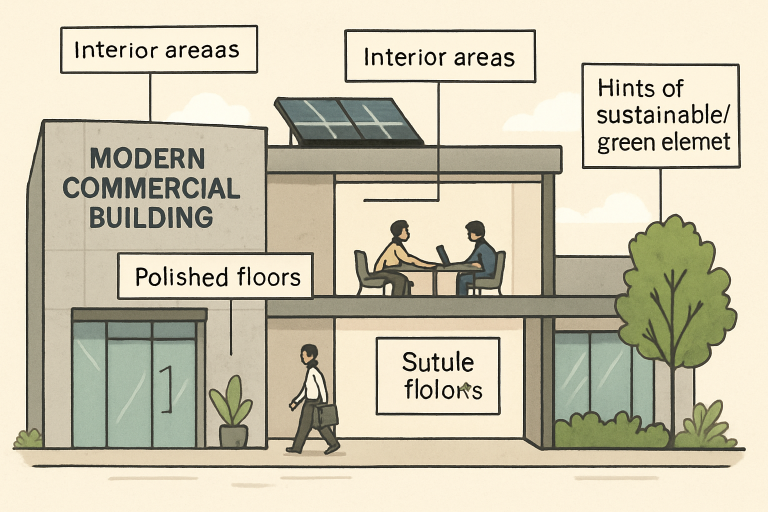
Heated concrete flooring is showing up in more commercial settings. Radiant systems sit beneath the slab and warm the space from the floor up, which produces even, energy-efficient heat with no cold patches. That approach can lower utility costs and raise occupant comfort at the same time. Once limited to service areas, radiant floors now appear in high-traffic lobbies, retail locations, and office corridors, where the clean, uncluttered look and the easy maintenance are as much a draw as the warmth. Providers offer these systems for both new builds and retrofits, so an older space is not automatically excluded.
Case study: Innovation One Campus
The Innovation One Campus in Wauwatosa, Wisconsin, shows how these ideas come together on a real project. This multi-purpose complex uses eco-friendly materials and precast concrete architecture, and it earned both LEED Silver and SITES certification, the first project of its kind in the state to do so.
The development pairs recycled content and low-carbon technology with strong thermal insulation, long-term durability, and meaningful savings on operating costs. It is a practical model for owners who want to balance sustainability with a considered design rather than treating the two as competing goals.
The same case holds at domestic scale, where thermal mass, recyclability and local sourcing support masonry that lasts and looks good.
Being found for this kind of work
Delivering an advanced concrete project is one job. Getting hired for it is another, and that depends on how buyers search and decide. When people need a specialist trade, they look online first: Pew Research Center found that 36% of American adults turn to search engines for information on local businesses, ahead of any other single source. That means a contractor’s visibility in search results and in curated listings often decides who gets the call before any proposal is written.
Reviews reinforce that judgment. Michael Luca, in “Reviews, Reputation, and Revenue: The Case of Yelp.com” (2011), found that a one-star increase in a business’s rating leads to a 5 to 9 percent increase in revenue, an effect concentrated among independent firms rather than established chains. For a specialist concrete company, steady visibility, a listing in a place buyers trust, and a track record they can verify tend to matter more than any single ad campaign.
Where this leaves you
The recent work in concrete moves the commercial sector into a period where technology, environmental sensibility, and design sit together instead of at odds. Whether you use 3D printing for a bold structural element, embed smart sensors for proactive facilities management, or install radiant-heated floors, these methods pay off across the life of a project rather than only at handover.
The practical takeaway is to match the method to the goal. Pilot printing where the design justifies it, specify low-carbon mixes when a certification is in play, and treat finishing and heated floors as choices that lower long-term maintenance and running costs. Bring your supplier the specifics you care about, ask for verified numbers, and let the project brief, not the trend, drive the decision.
