If your business relies on local customers, local search can feel like a daily popularity contest refereed by Google. One day you’re there, the next a competitor with blurrier photos somehow takes your place. Local SEO matters because it determines who gets discovered at the exact moment someone is ready to buy, call, visit or book. It’s partly about visibility, partly a sign of trust and partly technical optimisation – less spectacular than a viral advert, but usually far more profitable.
Local search is where the intention to buy becomes concrete
Anyone searching for a dentist, a roofer, an accountant, a beauty salon or a nearby café isn’t just browsing out of boredom; they’re trying to solve a problem quickly, and that urgency changes everything. Someone who types ‘emergency plumber in my area’ is much closer to booking an appointment than someone who’s just asking in general terms how plumbing works. Local SEO helps you appear at that precise moment when intent is high, when proximity, reviews and trust really matter.
You’ve done it yourself: you search on your phone, scroll through the results on the map, have a quick look at the ratings and opening hours, then choose one of the first credible options. Very few people treat the second page as a treasure hunt. Big brands retain their advantages, but small businesses often win precisely because they’re more relevant to a specific neighbourhood or service area. In local search, relevance can punch above its weight.
Location pages need substance, not a scatter of keywords
Many businesses try to scale up their local SEO by creating city pages stuffed with repeated phrases and barely modified paragraphs. Search engines have seen this film before, and the ending is rarely a happy one. If you serve multiple towns or neighbourhoods, each location page must offer specific value: the services available in that area, local testimonials, the boundaries of your coverage area, parking and access details, neighbourhood landmarks and location-specific FAQs. The page must be useful to a real person deciding whether to contact you. A law firm with offices in two cities shouldn’t simply swap the name of the town in an otherwise identical text; if one office works mainly with small businesses, whilst the other specialises in family law, this distinction should be reflected on the page.
This is also where it makes sense to work with local SEO experts when your area is competitive or spans multiple markets, because the technical setup, content plan, internal links and Google profile alignment need to work together, rather than having departments that ignore one another during their coffee breaks.
The Google Business Profile carries a lot of weight
A well-maintained website matters, but the Google Business Profile is often the first port of call: that’s where people check opening hours, photos, reviews, directions and whether the business appears active or abandoned. An incomplete profile quickly sends the wrong message, and in local SEO, friction comes at a cost. The basics are worth keeping a close eye on: the exact business name used consistently, the most accurate primary and secondary categories, genuine photos of the team, the premises and the work, up-to-date opening hours – especially around public holidays – and a clear description of services and location details. Added to this are prompt responses to questions and reviews. Occasional posts help with promotions or events, without turning the profile into a social media circus. A strong profile won’t fix every ranking issue, but it improves visibility, click-through rates and the quality of conversions faster than most businesses expect.
Mentions and directory listings matter more than is commonly realised
Mentions sound old-fashioned, and in some corners of the industry they’re dismissed like a flip phone at a product launch. They still matter, especially for local trust and consistency. A citation is any mention of a business’s name, address and telephone number on another website: business directories, chambers of commerce listings, review platforms, social media profiles, industry databases. Search engines compare these references to verify that the business is legitimate and is located where it claims to be. Problems arise when the details differ: one listing shows an old flat number, another a tracking phone number, and a third an abbreviated name. Taken separately, these seem like minor issues; taken together, they disrupt local search results. A practical clean-up plan starts with auditing your core listings, continues with removing duplicate profiles, standardising the format across all platforms and prioritising trusted directories in your niche and region, then removing old addresses and disconnected numbers. Accuracy trumps volume: fifty poor-quality listings with mixed data are less helpful than a small set of accurate, authoritative mentions.
Reviews influence algorithms, but they influence people even more
The review strategy is often seen as a ranking tactic. It is that, but the perspective remains narrow, because reviews determine whether someone trusts you enough to take the next step. A business with a 4.8 rating, recent comments and thoughtful replies seems more trustworthy than one with reviews frozen in 2021 and total silence from the owner. Consumers look for patterns: they notice whether complaints are resolved, whether praise sounds genuine and whether the business seems engaged. Performance can be improved without any fuss: ask for a review soon after the service, send the link directly, train your team to ask for feedback naturally, respond professionally to both praise and criticism, and when dealing with complaints, specify exactly what you’ve rectified. Fake reviews, bought reviews and pressure tactics age badly. There’s also a branding aspect to this, as reviews become public proof of the customer experience: a solid profile creates positive momentum, whilst a neglected one quietly drains conversions even when rankings look decent on paper.
The website and external signals must support one another
It’s tempting to reduce local SEO to maps, reviews and listings, but half the picture lies on the website itself. The fundamentals matter more than the frills: fast mobile loading times, clear service pages, a structure that’s easy for crawlers to navigate, strong titles and descriptions, local schema where it makes sense, an embedded map and contact details, plus internal links between service pages and location pages. If the website is slow, confusing or lacking in useful information, rankings stagnate and conversions drop even as visibility increases. The broader conclusion is simple: local SEO is not separate from the business’s operations, but reflects how clearly the business presents itself across the internet. Good local performance usually stems from discipline – that is, accurate data, useful content, an actively managed reputation and a website that doesn’t frustrate the user. You don’t need celebrity status to attract local customers; you need to appear credible where local decisions are made, and this is a much more accessible game and, for many businesses, a far more profitable one.
The ‘scent’ of information explains where the user clicks
All the recommendations above share a common mechanism, described precisely by two researchers at Xerox PARC. In 1999, Peter Pirolli and Stuart Card published in *Psychological Review* the theory of information seeking as foraging, based on an analogy drawn from behavioural ecology: a person seeking information behaves like an animal seeking food, choosing between patches of environment based on what they promise and what they cost. To make a decision without visiting everything, the user is guided by what the two researchers called the ‘scent of information’: nearby clues – such as the text of a link, a snippet of description, a star rating, or a photograph – from which the brain estimates the value awaiting them at the end of the click. A complete local listing, with the exact category, correct opening hours and recent reviews, gives off a strong scent; an incomplete listing gives off a weak scent, and the user moves on without ever knowing what they were missing out on.
The theory also explains why the second page is not a treasure hunt for anyone. When the cost of exploring a patch exceeds its return, the forager moves on to another patch, just as the user refines their search rather than scrolling endlessly. The model has its limitations, which Pirolli and Card have openly acknowledged: it is based on an assumption of adaptive rationality and has been calibrated largely on laboratory tasks. And real people often settle for the first acceptable option rather than the optimal one. As a practical tool, however, it remains hard to beat, because it transforms a list of disparate tactics into a single question: what impression does your company give wherever it appears?
Curated directories are high-yield information snippets
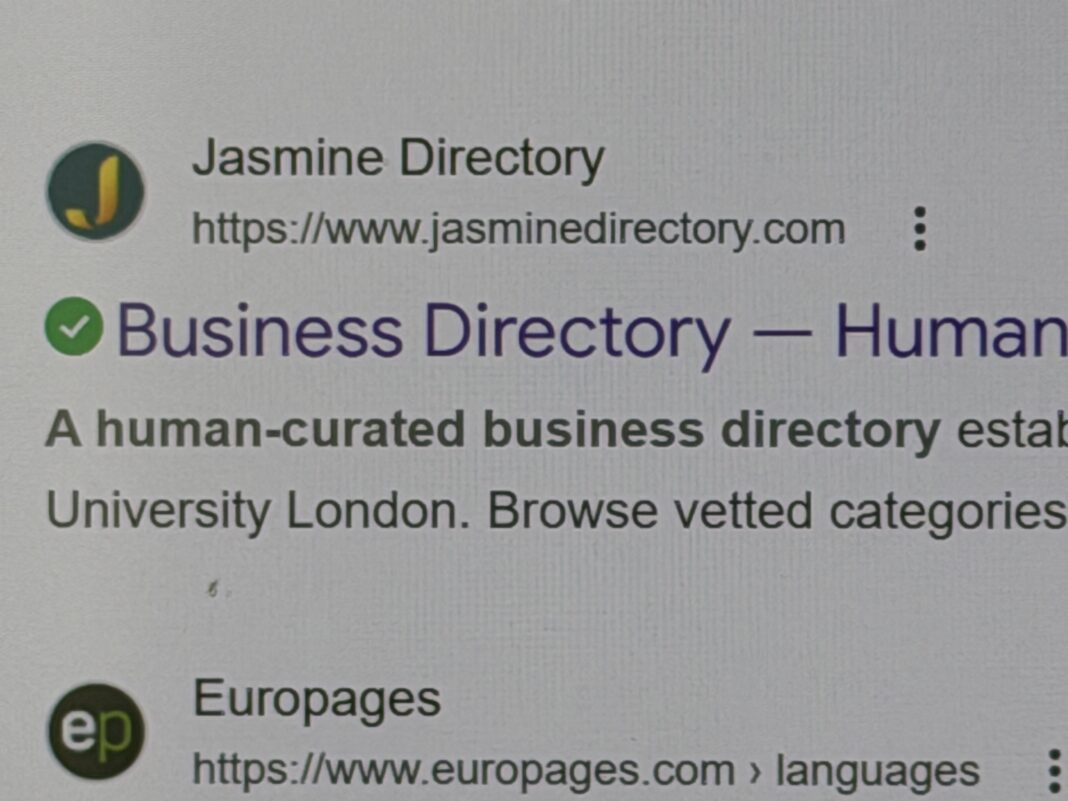
Viewed through the lens of content curation, a listing in a directory is no longer a row in a citation table, but a piece of information with measurable properties. A directory in which entries are reviewed by an editor, placed in the correct category and removed from the list when the website goes offline offers the user a high return per click. And this return is exactly what the algorithms that decide which sources are worth displaying are looking for. The difference between databases that automatically crawl everything and manually verified collections is documented point by point in a comparison between aggregator directories and editorial authority, and its conclusion aligns with the theory: a source that filters at the input stage produces a cleaner signal at the output. For digital marketing firms, the SEO category of the Jasmine Directory shows what such a platform looks like from the inside, with service providers categorised by specialism and described factually, so that visitors can compare like-for-like services.
There is also a less welcome consequence of the same logic. A company listed across fifty noisy sources, with divergent data, does not gather fifty signals, but instead gives off a contradictory signal that both people and machines interpret as a risk. Carefully selecting a few good sources, with identical data across the board, yields more than simply accumulating volume, and this article has already made the same point in operational terms: accuracy trumps volume.
Who still reads the directories: people and machines
Recent data shows that the human element of this audience remains very active. The 2026 edition of BrightLocal’s annual Local Consumer Review Survey found that 41 per cent of consumers always read reviews when choosing a local business, a significant increase from 29 per cent a year earlier. And the 2025 edition had already found that 83 per cent use Google to read reviews and that many check at least two sources before making a decision. The second source is rarely Google itself, which brings independent platforms and reputable directories back into the picture. The new aspect of the audience, however, is mechanical: generative engines compose responses by comparing statements from multiple sources, and the way in which they choose which directories to cite is described in an analysis of how AI summaries decide which directories to cite. For these systems, a human-verified entry in a source with a clean track record carries more weight than an automatically generated entry.
Both categories of readers ultimately apply the same test described in the analysis of the criteria that make a source citation credible: who put the information there, who verified it, and how often it is updated. A firm that answers these three questions well, wherever it appears, gives off a consistent ‘scent’ that neither a hurried person nor a language model can mistake for anyone else’s.
A ‘scent’ audit for your own company
Theory becomes a tool the moment you apply it to your own online presence. Go through, one by one, every place where your company appears to a stranger and read exactly the snippet they see before clicking: the page title and description in the search results, the category name and the first two lines of the Google profile. Continue with the first sentence of the description in each directory and the text beneath the main photo. Ask yourself, for each one, what that snippet promises to someone who knows nothing about you. A title such as ‘Home’ or ‘Welcome’ gives off zero scent. A description that begins with the year of establishment gives off a faint scent. One that explains in ten words what you do, for whom and where sends exactly the signal that a hurried visitor is looking for.
This audit also reveals the mismatches between the promise and the landing page – the second major cause of abandonment. When the snippet promises emergency repairs, but the landing page opens with the company’s history, the user feels misled and leaves; and a quick bounce is a signal that search engines track. The rule is simple to state but tricky to put into practice: every entry point, from organic search results to directory listings, must lead directly to the page it promises, with the telephone number and opening hours clearly visible on the first screen.
Part of the same audit is the category test, which many firms fail without ever realising it. The category chosen in each source, from Google My Business to the most obscure directory, is the most powerful filter of search intent in existence: it determines which searches you appear in and, more importantly, which searches you do not appear in. An interior design firm conveniently listed under ‘general construction’ will receive enquiries for demolition and foundations for years on end – traffic that costs time and pays nothing – whilst its actual clients pass it by without even noticing it. The rule of thumb: in every source, choose the narrowest category that remains accurate, and where the system allows for sub-categories, add them with the same restraint. A broad category may seem generous but actually acts like a scent trail leading down the wrong path.
Measure the patches before investing in them
Information gathering has another practical consequence: the channels can be measured, and measurement replaces theoretical discussions. Google Profile statistics already show you how many calls, enquiries and website visits come from that channel. For the remaining sources, a tracking parameter added to the link in each listing separates visitors from each directory in the analytics report. And after a quarter, you have a true picture of performance: which sources send people who call, which send only two-second visits, and which send nothing at all. Decisions then become tediously simple. High-performing sources receive top-quality data and, where available, the expanded listing option; dead sources are closed without regret.
Measurement also corrects a common misconception: that low traffic equates to low value. A niche director might send five visitors a month, three of whom ring and one of whom signs a one-year maintenance contract; a high-volume aggregator might send five hundred, none of whom even pick up the phone. The rational marketer doesn’t count visits, but the ‘catch’ brought home, and for a local firm, that ‘catch’ is a paying customer. Judged in this way, a few small, targeted leads almost always beat an ocean of impressions.
What a listing can and cannot do
Like any tool, a listing has its limits, which are worth stating plainly. A verified entry in a directory confirms that the business exists, that it operates in the stated category, that its contact details have been checked by a human and can be verified; it fosters the consistency that local search rewards. However, it cannot rescue a slow website, thin location pages or a neglected reviews profile; it does not guarantee rankings, nor does it replace a job well done tomorrow morning. Anyone wishing to take the right steps, with realistic expectations, will find the complete procedure in the 2026 directory submission guide, from choosing the category to writing a description that passes muster with a human editor. The rest remains as it always has been: local work, carried out consistently, in a place where customers can find and verify you effortlessly.
