Key takeaways
- License plate recognition automates vehicle identification, which speeds up parking operations and makes the experience simpler for drivers.
- When paired with artificial intelligence and machine learning, modern systems read plates reliably and adapt to new formats without manual reprogramming.
- Real deployments show measurable gains in efficiency, cost savings, and enforcement accuracy.
Parking management has changed quickly over the past several years, and one technology sits behind much of that shift. License plate recognition, usually shortened to LPR, reads a vehicle’s plate as it arrives and departs, then uses that reading to control access, log activity, and handle billing. Systems built on automatic license plate recognition for secure parking access are becoming a default choice for city infrastructure because they automate work that once demanded a booth, a barrier, and a person to check credentials.
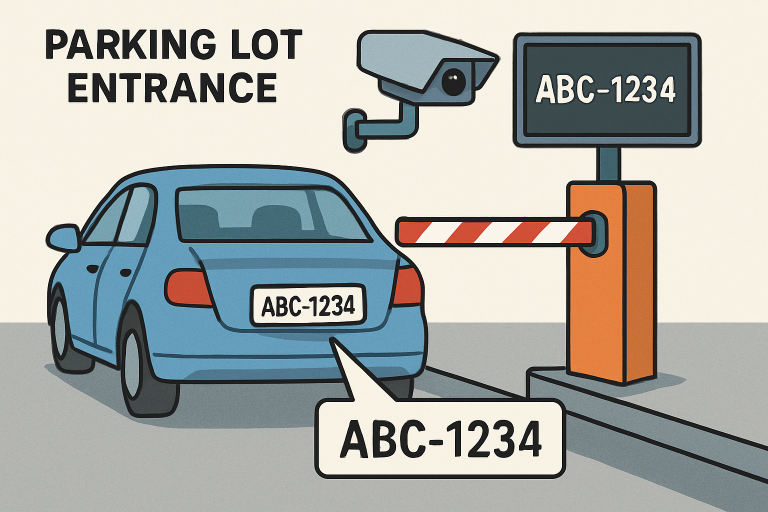
Older access methods relied on paper permits or plastic cards. LPR replaces those with optical technology that identifies a car in the moment it approaches the gate. Authorized drivers pass through without stopping to present anything, which cuts wait times and eases the queues that build up at busy entrances. The same camera feed that grants access also creates a record of every vehicle movement, so operators gain a clearer view of who is on site and when.
Understanding license plate recognition technology
LPR works by combining cameras with optical character recognition software that reads a plate and converts it into text. Identification happens almost as fast as the car crosses the camera’s field of view. The same core method supports several jobs beyond parking access, including toll collection and digital enforcement, so a single installation can serve more than one purpose.
Reliability is one of the technology’s stronger points. Current systems handle a wide range of plate styles and origins, and they hold up in poor lighting, bad weather, and heavy traffic. That consistency lets operators run both large garages and small lots with fewer staff and lower overhead, since the software takes on tasks that used to require constant attention.
It helps to remember that a parking facility is a business people evaluate before they arrive. Many drivers check a location’s listing, hours, and reviews on their phone first. Pew Research Center’s 2011 study of how Americans find local businesses reported that 36% of adults use search engines to look up local businesses, ahead of any other source. A garage that pairs a good online listing with fast, gateless entry meets the expectation those searches create: find it easily, then get in without friction.
Advancements in AI and machine learning
The steady improvement in LPR tracks closely with progress in artificial intelligence and machine learning. Deep learning models now report recognition rates between 95% and 99% in recent research. They learn local plate formats, cope with unusual character combinations, and still read plates partly hidden by dirt, shadow, or rain.
That accuracy shows up in daily operations. An AI-driven system can tell a permitted vehicle from an unauthorized one in a fraction of a second. It also absorbs new plate designs on its own, so managers do not have to schedule labor-heavy updates every time a jurisdiction changes its plates. When regulations shift, the system keeps pace without a rebuild.
Real-world applications and benefits
LPR is not a lab concept. Colleges, airports, hospitals, and city parking authorities run it to automate enforcement and tighten operations. Texas A&M University offers a clear example: its modernized parking setup uses LPR to manage more than 36,000 spaces.
Mounting LPR cameras on enforcement vehicles and at entry and exit points has replaced manual permit checks, and the time and cost savings are substantial. An officer no longer walks a lot comparing hangtags to a printed list; a camera pass reads every plate and flags the exceptions.
Many operators have moved to gateless access built on LPR. Removing barriers, tickets, and physical permits lets traffic flow more naturally, cuts the maintenance tied to mechanical gates, and leaves drivers with less to fumble with. The result is a smoother arrival and departure with fewer moving parts to break.
Enhancing security and compliance
Security stays near the top of any parking operator’s priorities, and LPR gives them a practical preventive tool. Because the system logs every entry and exit, a facility can locate a vehicle of interest quickly, whether the goal is enforcing parking rules or assisting law enforcement.
Real-time monitoring surfaces rule violations and unauthorized cars as they happen, which narrows the window for theft or fraud. Reporting from the New York Times has documented how both private operators and public agencies use LPR to watch security at critical infrastructure sites.
Constant monitoring improves compliance and frees security staff to concentrate on genuine alerts rather than routine checks, so their time goes where it matters most.
Challenges and considerations
The technology brings real trade-offs. Privacy is the most pressing, since a system that reads every plate is also collecting a continuous stream of vehicle data. Any operator that runs LPR needs written policies covering how long data is kept, who can see it, and how it is protected. Holding the balance between convenience and confidentiality is what keeps public trust intact, and trust is worth protecting: the 2025 Edelman Trust Barometer found business to be the most trusted of the four major institutions it measures, at 62%, and the only one rated as both competent and ethical. Careless data handling puts that standing at risk.
Cost is the other barrier. Cameras, software, and ongoing support add up, and the bill lands hardest on smaller operators. Those upfront figures are usually recovered over time through lower staffing costs, more accurate enforcement, and reduced upkeep on aging gate hardware, but the initial outlay is still a genuine hurdle worth planning for.
Future prospects
LPR keeps advancing. Near-term developments include tighter links with mobile payment apps, digital permitting, and live analytics dashboards. As recognition grows more accurate, the same infrastructure can support dynamic pricing, congestion management, and parking experiences tuned to individual drivers.
Gains in machine learning and cloud computing should push costs down while making systems easier to scale. That trend puts LPR within reach of mid-size and small operators who were once priced out, so a neighborhood lot can run the same tools as a downtown garage.
License plate recognition has already reshaped how parking works, giving drivers a faster arrival and operators a clearer, cheaper way to run their sites. AI and machine learning make the reads more accurate and the systems more adaptable to messy real conditions, while automated fee calculation and quicker entry keep busy facilities moving. If you manage parking, the practical next step is straightforward: pair a reliable LPR install with clear data-retention rules and an accurate public listing, so drivers can find you easily and get in without a wait.
