
Your jawbone shapes far more of your daily life than most people notice until something goes wrong. It supports eating, speaking, and the natural contours of your face, and it does this quietly, every day, without asking for attention. If you have ever researched concerns like pain under ear behind jaw bone left side, you already have a sense of how quickly jaw discomfort can eat into your quality of life.
Caring for the jawbone is about more than oral comfort or how you look. When it deteriorates, the effects reach into nutrition, communication, and self-confidence. A strong jaw makes ordinary activities possible, which is why good dental habits and preventive care pay off over a lifetime rather than a single dental visit.
When it is speech rather than chewing that falters, the question moves to the specialists who treat communication breakdowns, whose work covers the same everyday functions from another angle.
Changes in the jawbone can also flag deeper health problems early. Preventive dental care and attention to the jaw help you avoid long-term complications in both your mouth and the rest of your body. Once you understand how the jaw connects to these everyday functions, you can act on small concerns before they turn into large ones.
That is the same reasoning behind early bite evaluations for children, where an orthodontist watches how the teeth and jaws are developing while the growth pattern can still be guided.
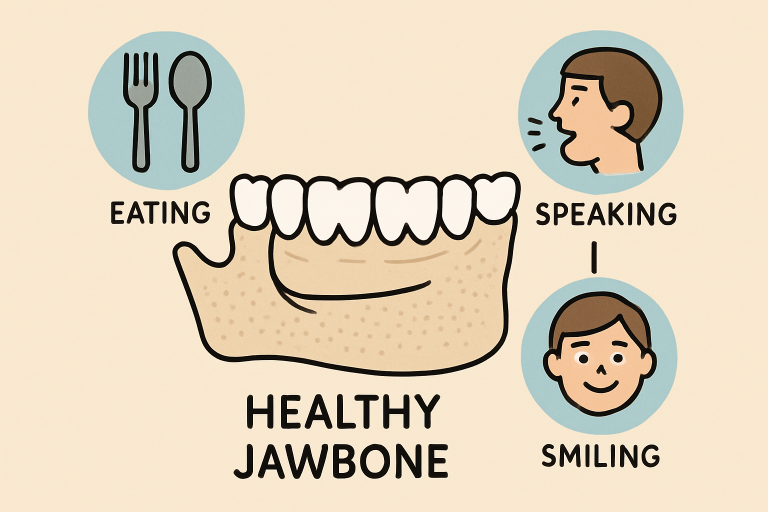
Chewing and digestion
The jawbone is the foundation your teeth stand on, and it lets you chew thoroughly and comfortably. Chewing starts digestion. It breaks food into pieces your body can absorb and reduces the digestive discomfort that comes from swallowing food that is barely broken down.
According to Champaign Dental, a weakened jawbone can bring pain while chewing, trouble eating certain foods, and a higher risk of indigestion or nutritional deficiencies. When chewing hurts, people tend to skip the foods that take more effort, and many of those foods are the healthiest ones. Over months, that quiet avoidance narrows your diet in ways you may not connect back to your jaw.
Speech clarity
A healthy jawbone keeps your teeth in stable alignment, and that alignment matters for pronouncing words and sounds clearly. When the bone deteriorates, teeth shift or fall out, and speech patterns change with them. Words can come out slurred, muffled, or mumbled. That can cause embarrassment and real friction in conversation. Jaw problems do not stay confined to the dentist’s chair. They follow you into meetings, phone calls, and everyday exchanges with the people around you.
Facial appearance
The jawbone supports the lower face, giving structure to your jawline and cheeks. As bone density drops, whether through tooth loss or osteoporosis, the face can start to sag or look sunken.
The result often reads as premature aging, which can chip away at self-esteem and make people pull back from social life. For many of us, how the face looks is tied closely to how confident we feel, so protecting the jawbone helps you keep a fuller, more youthful look for longer.
Oral health
Beyond holding teeth in place, the jawbone stabilizes them against the constant pressure of chewing and biting. Bone loss makes teeth more likely to shift or loosen, and that opens the door to further tooth loss, gum disease, and infection. Gaps left by missing teeth collect bacteria, which raises the risk of inflammation and decay.
As remaining teeth drift out of line, cleaning them well gets harder, and the odds of more problems climb. According to the Mayo Clinic, dental implants can help preserve the jawbone after tooth loss by supplying the stimulation the bone would otherwise lose.
Much of that cascade is avoidable, which is where preventative dental care proves its worth: routine examinations catch shifting teeth and gum trouble while they are still small.
Overall health
Jaw health ties into wider conditions such as osteoporosis, which lowers bone density across the whole skeleton rather than in the jaw alone. Research has found that the state of the bone in the jaw can be an early sign of skeletal problems that may later show up as height loss or fractures, especially in women after menopause.
Routine dental x-rays earn their keep twice over. They track your oral hygiene, and they can catch subtle changes that hint at more serious issues elsewhere in the body, often before you feel any symptoms.
Common causes of jawbone deterioration
- Tooth loss. When teeth are missing, the jawbone gets less stimulation and can resorb, or shrink, over time.
- Periodontal disease. Gum disease can advance past the soft tissue to damage the bone that supports your teeth, weakening the structure and causing bone loss.
- Osteoporosis. Lower bone density in the jaw leaves it open to fractures and structural loss.
- Poor nutrition. Too little calcium and vitamin D undermines jaw strength, an issue for older adults and anyone with dietary restrictions.
- Smoking and alcohol. Both are linked to slower bone healing and reduced density, which can speed up jawbone decline.
Strategies for maintaining jawbone health
- Keep up good oral hygiene. Regular brushing, flossing, and dental visits are your first defense against the gum disease and tooth loss that accelerate jawbone deterioration.
- Eat for your bones. A balanced diet with enough calcium and vitamin D protects bone density and jaw strength.
- Drop harmful habits. Quitting smoking and limiting alcohol slows bone density loss and supports healing.
- Treat teeth grinding. Getting help for bruxism guards the jawbone against excessive wear and fractures.
- Consider dental implants. For missing teeth, implants keep the jawbone stimulated and help prevent further bone loss.
Choosing a dentist you can trust
Prevention only works if you actually see a dentist, and finding one you trust is its own small hurdle. Most people now start online. Pew Research Center found that Americans looking for information about local businesses turn to the internet ahead of any other source, with 36% using search engines to research local services. That behavior applies squarely to dental care, where you want a practice near you with a track record you can check.
Reviews carry real weight here, because you cannot judge a dentist’s work in advance the way you might sample a restaurant. Robert Cialdini’s principle of social proof explains part of the pull: people work out what is correct by seeing what others think is correct, which is exactly what ratings and reviews let you do. Read the written comments rather than the star average alone, look for practices that explain their approach in plain language, and give weight to curated listings and directories that vet the businesses they include. A dentist who is easy to find, clearly described, and consistently recommended is usually one worth a first appointment.
A practical takeaway
Your jawbone underpins the daily basics: eating well, speaking clearly, and facing people with confidence. The good news is that the steps that protect it are ordinary and within reach. Brush and floss, keep your dental appointments, eat enough calcium and vitamin D, cut back on smoking and heavy drinking, and address grinding or missing teeth before the bone starts to go. Start with one thing this week, whether that is booking a checkup or fixing a habit you have been putting off. Small, steady care now is what keeps the jaw doing its quiet work for decades.
