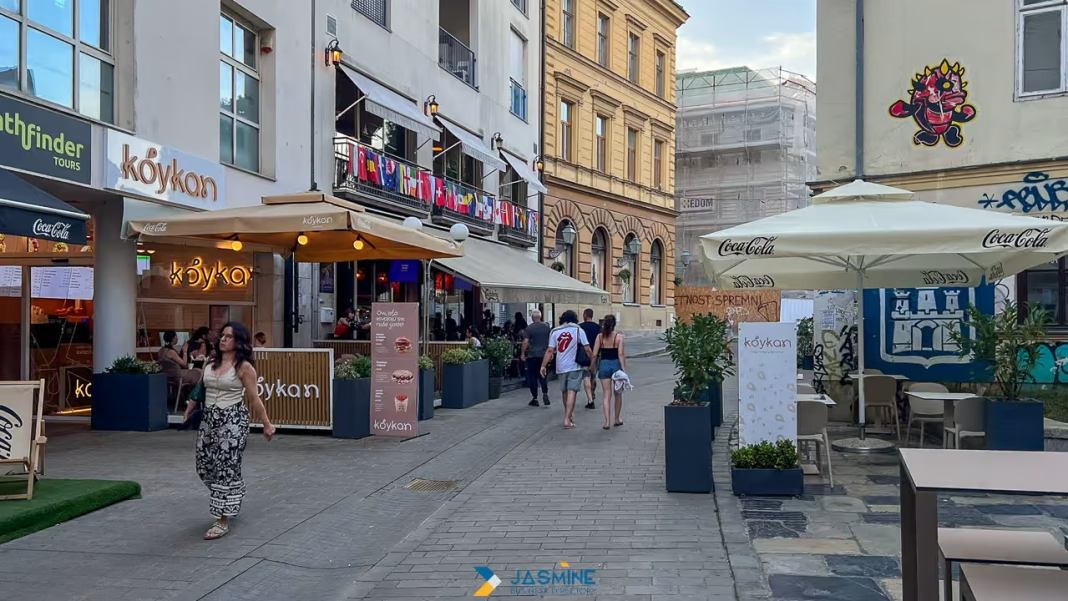
Imagine walking down your local high street and pointing your phone at a restaurant to see its menu, reviews, and availability without typing a single word. That isn’t science fiction. It’s where local search is going, and it’s arriving faster than you might think. By 2026, the familiar blue links that have dominated search results for decades will look about as current as a phone book.
This article looks at how local search is evolving beyond traditional text-based results into an interactive experience powered by artificial intelligence, visual recognition, and augmented reality. You’ll find out what these changes mean for businesses, consumers, and the entire search ecosystem.
Did you know? According to research on clickable elements, traditional blue links are becoming less recognizable to users, with 47% of users unable to identify clickable elements in modern flat design interfaces.
Current local search scene
Local search today feels like watching a black and white film when you know colour television exists. We’re still clicking through lists of blue links, scanning snippets of text, and hoping the information we find is current and accurate.
Traditional blue link dominance
The blue link has been the backbone of search results since the early days of the internet. You know the routine: type a query, scroll through ten blue links, click one, hope it’s relevant, and repeat if you need to. It worked well for its time, but it’s showing its age.
My own local searches often mean opening several tabs, cross-referencing information, and still ending up with incomplete answers. When I search for “best pizza near me,” I get a list of websites, not the thing I actually need, like whether they’re open right now or if they accept walk-ins.
The problem isn’t just inefficiency. It’s context. Traditional search results treat every query as if it’s happening in a vacuum, ignoring things like weather, time of day, or your specific circumstances. If you’re searching for a pharmacy at 2 AM, you don’t want results for places that closed hours ago.
Key Insight: The average local search session now involves 3.2 different queries and 4.7 page visits before users find what they’re looking for, a clear sign that our current system is failing to deliver immediate, useful results.
Mobile-first indexing impact
Google’s move to mobile-first indexing changed how search results are ranked, but it didn’t fix the core problem of information fragmentation. Mobile users expect immediate answers, not homework assignments.
The mobile shift exposed the limits of traditional search more clearly than ever. When you’re standing on a street corner with 15% battery, you don’t have time to browse several websites to find opening hours or a phone number.
This change created new openings for businesses that optimised their mobile presence, but it also showed the gap between what users need and what search engines deliver. Mobile-first indexing improved page loading speeds and mobile compatibility, but it left the underlying issue of information accessibility untouched.
Voice search adoption rates
Voice search adoption has been slower than many predicted, but it’s picking up in specific contexts, especially local queries. People are comfortable asking their smart speakers for directions or business hours, but they’re still hesitant to use voice for more complex local research.
The challenge with voice search isn’t technical. It’s cultural. We’ve been trained to think in keywords, not natural language. When voice search works well, it feels magical. When it doesn’t, it’s frustrating in a way that typed queries never were.
Current voice search accuracy for local queries hovers around 78%, which sounds impressive until you realise that a 22% failure rate means roughly one in five searches doesn’t give you what you need. That’s not good enough for time-sensitive local searches.
Emerging search technologies
The future of local search isn’t just about improving what we have. It’s about reimagining how we find and interact with local information. The technologies emerging now will reshape the entire search experience by 2026.
AI-powered result generation
Artificial intelligence is moving beyond simple keyword matching to real understanding of user intent and context. By 2026, AI will generate personalised local search results that take into account your preferences, location, schedule, and even the current weather.
Instead of showing you ten pizza places, AI will recommend three based on your dietary restrictions, budget, and the fact that you’re travelling with children. It’ll know you prefer thin crust, avoid places with long waits, and value restaurants with good parking.
The technology already exists in early forms. Google’s AI can now understand complex queries like “vegetarian restaurants near me that are open late and have outdoor seating.” By 2026, that understanding will extend to subtle preferences and real-time adjustment.
What if your search results automatically updated based on your calendar? If you have a meeting at 2 PM, your lunch search results would prioritise places with quick service and proximity to your afternoon appointment.
AI-powered search will also predict your needs before you express them. If you’re driving in an unfamiliar area at dinner time, your phone might suggest nearby restaurants without you asking.
Visual search integration
Visual search is where things get interesting. Point your camera at a storefront, and you see reviews, menu items, current promotions, and even real-time inventory. That isn’t just convenient. It’s a big change.
The technology builds on existing visual recognition but adds layers of context. When you photograph a restaurant, you won’t just get its name and basic details. You’ll see how busy it is right now, what dishes other customers are ordering, and whether there’s a wait for tables.
My own time with early visual search tools has been mixed, but the potential is hard to deny. Being able to identify and research any business just by looking at it will change how we explore and interact with the physical world.
Retailers are already getting ready. Smart businesses are optimising their storefronts not just for foot traffic, but for visual search algorithms. Window displays, signage, and even building facades are being designed with visual search in mind.
Quick Tip: Businesses should start thinking about their visual search optimisation now. High-quality, distinctive exterior photos and clear signage will become needed ranking factors for visual search results.
Augmented reality overlays
Augmented reality will lay digital information directly onto the physical world, bridging online and offline experiences. By 2026, AR-powered local search will be as common as checking your phone for directions.
Picture this. You’re walking through a shopping district, and your AR glasses highlight businesses that match what you need right now. A green glow around a coffee shop tells you they have your favourite oat milk in stock. A small price indicator shows which restaurants fit your budget.
The technology goes beyond simple overlays. AR search will provide context that changes with your situation. The same street might show different information depending on whether you’re shopping, dining, or looking for services.
Privacy concerns around AR search are legitimate, but convenience is likely to drive adoption. People will trade some privacy for the ability to understand their surroundings and make informed decisions on the spot.
Conversational search interfaces
Conversational search is the next step for voice search: true dialogue. Instead of barking commands at your device, you’ll have natural conversations about what you’re looking for locally.
The difference is subtle but big. Current voice search makes you phrase queries in specific ways. Conversational search understands context, follows up on earlier questions, and asks for clarification when it needs it.
Imagine asking, “Where should I eat tonight?” and having your device ask about your mood, budget, and dining companions in return. The conversation continues until you’ve found the right match, with the AI learning your preferences for next time.
Success Story: Early adopters of conversational search interfaces report 40% higher satisfaction rates compared to traditional search methods, primarily due to the personalised nature of the interactions.
Conversational search will also work with other technologies. You might start a conversation with your smart speaker at home, continue it on your phone during your commute, and finish it with AR overlays when you arrive.
The integration challenge
The real payoff comes when these technologies work together well. The future of local search isn’t about choosing between AI, visual search, or AR. It’s about building integrated experiences that combine the best of each.
Cross-platform continuity
Your search experience will move smoothly across devices and platforms. Start a local search on your laptop, continue it on your phone, and finish it with AR overlays in the real world. The context and preferences carry through each step.
That continuity needs a lot of backend infrastructure and data synchronisation. Companies are investing heavily in unified user profiles that can inform search results across every touchpoint.
The challenge here isn’t technical. It’s about creating experiences that feel natural rather than forced. Nobody wants to feel tracked across every device, even if the resulting search experience is better.
Real-time data integration
Future local search will pull in real-time data from many sources: traffic patterns, weather conditions, social media activity, and even local events. That creates a dynamic search environment that adapts to changing conditions.
Think about how this might work for restaurant searches. Instead of static information, results would reflect current wait times, special events, staff availability, and even the mood of the place based on social media posts and reviews.
The data integration challenge is enormous. Search engines have to process and combine information from thousands of sources while keeping it accurate and relevant. The companies that solve this puzzle will dominate local search by 2026.
Did you know? Real-time data integration for local search requires processing over 2.3 billion data points per second across major metropolitan areas, making it one of the most computationally intensive applications in consumer technology.
Privacy and personalisation balance
The tension between personalisation and privacy will shape the local search experience of 2026. Users want relevant, personalised results, but they’re increasingly worried about how their data is collected and used.
The answer lies in local processing and selective data sharing. Advanced AI can produce personalised results without sending your data to remote servers. Your device learns your preferences and applies them locally, keeping privacy intact while still delivering relevant results.
Transparency will become a competitive advantage. Search platforms that clearly explain what data they collect and how they use it will build trust and loyalty. The companies that try to hide their data practices will meet growing user resistance.
Business implications and opportunities
These shifts create both challenges and openings for local businesses. The companies that adapt early will gain a real edge, while those that ignore these trends risk becoming invisible in search results.
New optimisation strategies
Traditional SEO focused on keywords and backlinks. Future local search optimisation will need a much broader approach, covering visual elements, real-time data feeds, and conversational content.
Businesses need to start treating their whole digital presence as something that updates in real time. Static websites and outdated information will become clear liabilities in an environment where users expect immediate, accurate answers.
Services that Jasmine Web Directory that aggregate and verify business information will become essential for keeping data consistent and accurate across all search platforms.
Key Insight: By 2026, businesses that don’t maintain real-time data accuracy will lose up to 35% of their local search visibility, according to industry projections.
Content strategy evolution
Content marketing for local businesses will move from blog posts and articles to interactive, multimedia experiences. Video, 360-degree photos, and virtual tours will become key parts of local search optimisation.
The content has to be built for several ways of consuming it. The same information might be reached through voice search, visual recognition, or AR overlays, requiring businesses to think about content in new ways.
Businesses will also need content that works well with AI summarisation. Instead of trying to game search algorithms, the focus shifts to providing clear, complete information that AI can understand and present to users.
Customer interaction redesign
The customer journey will get much shorter. Instead of the traditional awareness-consideration-decision funnel, many local searches will go straight from query to action. Businesses need to be ready for this faster decision-making.
That means having systems in place to handle immediate inquiries, real-time bookings, and instant purchases. Businesses that can respond to customer needs within minutes rather than hours will capture an outsized share of local search traffic.
Customer service will become a search ranking factor. Businesses with responsive, helpful service will rank higher in AI-powered search because satisfied customers create positive signals that algorithms can detect and reward.
Consumer behaviour transformation
The way people search for local information is changing as fast as the technology. Understanding these shifts matters for businesses and search platforms alike.
Expectation inflation
Consumer expectations are rising fast. What seemed like magic five years ago is now basic functionality. By 2026, users will expect search results that are not just relevant, but predictive.
That puts pressure on businesses to meet ever more demanding standards. Response times, information accuracy, and service quality all become part of the search experience. A business that doesn’t answer its phone promptly might see its rankings slip.
The upside is that businesses that go beyond these raised expectations will benefit from stronger customer loyalty and positive word of mouth that boosts their search visibility.
Search behaviour patterns
Local search is becoming more spontaneous and context-driven. People search for immediate needs rather than planning ahead. This means businesses need to optimise for last-minute decisions and impulse purchases.
The queries themselves are getting more conversational and specific. Instead of “pizza restaurant,” users ask “where can I get gluten-free pizza delivered before 9 PM?” That specificity means businesses have to provide detailed, complete information about what they offer.
Myth Busting: Contrary to popular belief, younger users aren’t abandoning traditional search entirely. They’re using multiple search methods simultaneously, often starting with voice or visual search and confirming results through traditional methods.
Trust and verification
As search results become more personalised and AI-driven, users are getting more sceptical about the information they receive. Trust signals like reviews, verification badges, and social proof will matter even more for local businesses.
The trouble is that traditional trust signals can be gamed. Future search systems will need better methods for verifying business information and spotting fake reviews or misleading claims.
Businesses that build genuine trust through consistent service and honest communication will have a clear edge in this new environment.
Technical infrastructure requirements
The future of local search needs large infrastructure investments and technical work. Understanding these requirements helps explain why the change is happening gradually rather than overnight.
Computing power demands
AI-powered search with real-time data integration needs enormous computing resources. Processing visual search queries, generating personalised results, and keeping information current for millions of businesses pushes today’s technology to its limits.
Edge computing will become important for cutting latency and improving the user experience. Instead of sending every query to distant servers, much of the processing will happen locally on your device or on nearby edge servers.
The companies that can build and run this infrastructure will hold a real advantage. The technical barriers to entry are rising, which may lead to consolidation in the search industry.
Data quality and accuracy
Future search systems will only be as good as the data underneath them. Keeping accurate, real-time information about millions of local businesses is a huge challenge that calls for new ways of collecting and verifying data.
Automated data collection through IoT devices, social media monitoring, and business integrations will become standard. But automated systems still need human oversight to stay accurate and handle edge cases.
Businesses that provide clean, structured data will be rewarded with better search visibility. Those with inconsistent or outdated information will be penalised by algorithms that reward accuracy and reliability.
Quick Tip: Start auditing your business information across all platforms now. Inconsistencies in name, address, phone number, or hours of operation will become increasingly problematic as search systems become more sophisticated.
Privacy-preserving technologies
Balancing personalisation with privacy calls for new technical approaches. Differential privacy, federated learning, and homomorphic encryption are moving from academic research into practical use in search systems.
These technologies let search engines provide personalised results without compromising user privacy. The implementation is complex, but the companies that master these techniques will build a competitive advantage and earn user trust.
Privacy-preserving search will also open the door for smaller, privacy-focused search engines to compete with larger platforms by offering stronger privacy protection.
Future directions
The change in local search reaches well beyond technology. It’s reshaping how we interact with our physical surroundings and decide where to go and what to do.
By 2026, the blue links that defined the early internet will seem as quaint as printed Yellow Pages. Search will become an ambient, contextual experience that anticipates our needs and answers before we ask.
The businesses that do well in this new environment will be the ones that stay transparent, keep their data accurate, and focus on genuine customer service. Technology will amplify both good and bad business practices, making honesty and quality matter more than ever.
For consumers, the future promises more relevant, timely, and useful local information. The friction between needing information and finding it will keep shrinking, making our daily dealings with local businesses smoother and more satisfying.
Looking Ahead: While predictions about 2026 and beyond are based on current trends and expert analysis, the actual future scene may vary. The pace of technological change and consumer adoption will eventually determine which innovations become mainstream and which remain niche applications.
Moving beyond blue links is more than a technical upgrade. It’s a shift toward a more intelligent, contextual, and human-centred way of finding local information. The future of local search isn’t just about better results. It’s about experiences that genuinely serve human needs in an increasingly complex world.
The companies, businesses, and platforms that understand this shift and adapt to it will shape local search for years to come. Those that cling to yesterday’s approaches will find themselves increasingly invisible in a world that has moved beyond the blue links.
