
For multi-brand groups, SE Visible by SE Ranking is the platform to start with among AI visibility tools: it doesn’t meter engines, so each brand is audited on identical terms, with the stored answer behind each number. The reason is the meter. Skip any vendor’s headline price and find the unit it counts (project, prompt, engine, location): that unit multiplies when a group runs eight brands instead of one. In October 2025, McKinsey’s analysis found a brand’s own sites often make up only 5 to 10 percent of the sources AI search references, so no group can audit its flagship and extrapolate. One caveat: multi-country brands are set up market by market for now; multi-country projects are planned. Below: the four questions a portfolio AI visibility audit raises, and six platforms that answer them.
This is for marketing and search leads at a house of brands, PE-backed roll-up, or multi-brand retail, hospitality, or B2B group. The brand portfolio: 4-15 brands across 2+ countries, a central team setting standards, brand teams owning content, and an AI visibility owner with budget. Not single-brand teams or agencies.
What a portfolio needs from AI visibility tools before the audit:
- Same engines and method for every brand
- Per-brand, per-market baselines with the answer behind them
- Rivals benchmarked per brand, siblings kept separate
- A meter that scales with brand count
- Access that maps to brand teams
- A roll-up via Looker Studio, API, or export
On October 14, 2026, I checked every vendor’s pricing and product pages, kept AI visibility tools meeting at least four needs, and filed each under the question it answers best, at that day’s prices.
What do AI visibility tools actually meter across a brand portfolio?
AI visibility tools all meter something, and the six platforms below each count a different unit: projects, prompts, checks, locations, or a plan allowance. The “Metered by” column predicts what auditing eight brands costs relative to one.
Follow the incentive: a vendor gains each time you add its unit. “Not metered” is your headroom.
| # | Platform | Metered by | Not metered | Brands and markets | Starts at |
| 1 | SE Visible by SE Ranking | Plan allowance | Engines, models, users | Multiple brands; market per project | Plans on site |
| 2 | Ahrefs Brand Radar | Checks per prompt, platform, location, update | Domains in index | Any indexed brand | $50/mo |
| 3 | LLMrefs | Prompts, keywords | Projects, seats, engines | Unlimited projects | $79/mo |
| 4 | Semrush | Prompts; brand-performance domains | Engine list | Product lines on Enterprise AIO | $199/mo |
| 5 | Promptwatch | Projects, prompts, models | Country-level tracking | 1, 2, or 5 projects | $95/mo |
| 6 | Gauge | Prompts, locations | Domains, competitors | One location on Growth | $599/mo |
Monthly list prices of these AI visibility tools, vendor pages, October 14, 2026.
What is an AI visibility audit when you run more than one brand?
An AI visibility audit is a dated review of how often and in what context each brand appears in AI answers. Portfolios add two jobs: identical engines and prompts per brand, and rivals split from siblings, so baselines stay comparable across the group.
Menlo Ventures found US AI users average 3.0 assistants, up from 2.2, and Gemini use rose from 36% to 58% in 2026. One engine per brand makes an AI search visibility audit a sample.
1. SE Visible
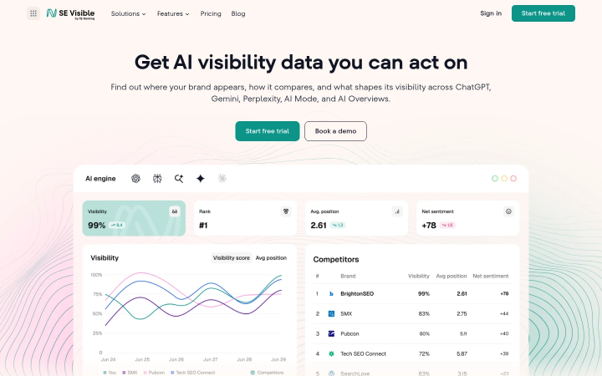
Checking sibling brands in AI answers by hand means separate sets of screenshots that never line up. As an AI visibility platform, SE Visible by SE Ranking shows each brand’s standing in answers from ChatGPT, Gemini, Google AI Mode, and Google AI Overviews.
Why it works for multi-brand teams: Each brand is tracked on the same engines, none sold as add-ons or split by model tier, so a cross-brand AI visibility audit compares like with like. Each baseline opens into the answer text, with engine, market, and date.
Standout feature: AI competitor analysis by topic and engine: suggested competitors’ visibility, share of voice, and average position sit beside yours, with change on every column. Top-mentioned brands per topic, beyond your list, show where a sibling becomes the rival.
Pros:
- Opens each metric into the unedited answer it came from
- Tracks multiple brands in one platform, with unlimited users
- Sets markets by country, city, or region, tracking daily by default
- Feeds Looker Studio, the API (on all plans), or CSV and XLSX exports
Cons:
- Multi-country projects are planned; for now, multi-market brands are set up market by market
- Custom access control is coming; no per-brand permissions yet
- In-app report building is still developing
- Scope is AI visibility; SE Ranking covers rank tracking, keyword research, and site audits
Pricing: Plans are on visible.seranking.com, all with every tracked engine and API access, plus a free trial.
The incentive check: Most AI visibility tools meter a unit that multiplies with brands; SE Visible leaves engines off its meter. If you need each brand audited on the same terms, give SE Visible’s competitor analysis view a try on two brands sharing a category.
How do you audit brand visibility on LLMs across a whole brand portfolio?
To audit brand visibility on LLMs across a portfolio, map first, then meter: benchmark every brand and rival once, pick the brands and markets worth tracking, then run prompt monitoring from a shared prompt library. Markets differ: 49.6% of working-age people in France have used generative AI, against 24.7% in Japan as of June 2026.
In December 2011, Google extended hreflang to multi-region sites so each page could declare its market. The pattern rhymes, but answers have no hreflang, so you observe markets instead.
2. Ahrefs Brand Radar
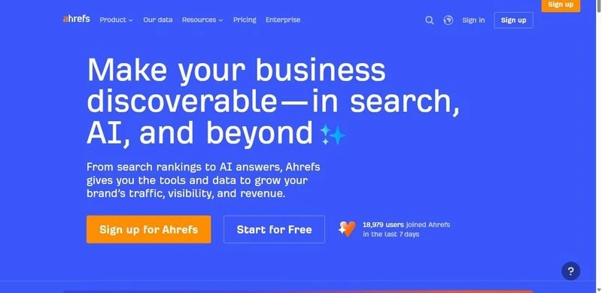
Why it works for multi-brand teams: Ahrefs Brand Radar’s AI Visibility Index searches any brand, product, or category with no setup and no domain cap, so you can benchmark the portfolio and rivals before tracking anything.
Standout feature: The meter is public. In Custom Prompts, each prompt uses one check per platform, location, and update, and Claude costs eight checks per update. That’s a multi-brand AI search audit priced in one line.
Pros:
- Searches 475M+ prompts, with history back to 2025
- Reports mentions, citations, AI share of voice, and impressions
- Adds Claude to ChatGPT, Gemini, and others in Custom Prompts
Cons:
- Re-tests index question sets monthly on a 90-day reporting window
- May cover low-search-volume sub-brands thinly
Pricing: Custom Prompts start at $50/mo; the AI Visibility Index is $199/mo.
The incentive check: The no-setup index is the invitation; checks are the meter. Let the index pick which brands deserve prompts.
3. LLMrefs
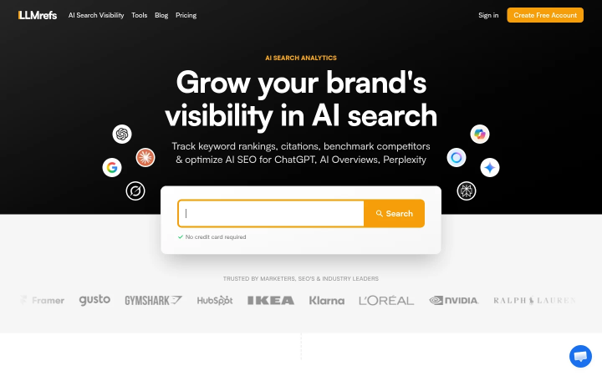
Why it works for multi-brand teams: LLMrefs doesn’t meter projects or seats, so each brand gets its own project under one subscription, and a twelfth brand splits the prompt allowance further.
Standout feature: Tracking starts from keywords. Import SEO keyword lists, and LLMrefs generates fan-out prompts, aggregates answers per keyword, and filters results by engine and country. For LLM monitoring, it reuses your SEO keyword work.
Pros:
- Unlimited projects and team members
- Includes ChatGPT, Gemini, Claude, Copilot, and more at no extra fee
- Offers AI citation tracking, CSV export, and API access
Cons:
- Updates each keyword at least weekly, so it reads trends
- Tracks generated prompts rather than your own fixed list
Pricing: $79/mo for 500 prompts (labeled limited-time), 7-day free trial.
The incentive check: A vendor that won’t meter projects wants every brand under one account. Fine for small sites read weekly; thinner for a daily-moving flagship.
How do you conduct competitive analysis in generative AI visibility when your own brands share a category?
AI competitor analysis sets rivals per brand and flags sibling brands: two of your brands splitting a prompt is cannibalization. Run AI citation tracking per engine, repeatedly: the AI traffic gap between ChatGPT and Gemini shrank from more than 22x to 8x between October 2025 and January 2026.
4. Semrush
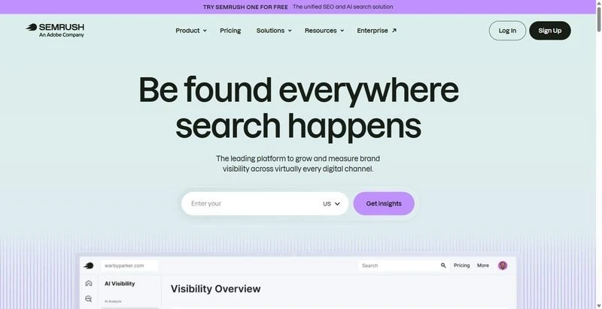
Why it works for multi-brand teams: Groups already on Semrush add AI visibility tools to existing contracts, and Enterprise AIO tracks product lines for global multi-product teams.
Standout feature: Competitor Research shows the prompts where rivals get cited and your brand doesn’t, and the AI Visibility Score is benchmarked against your competitor median.
Pros:
- Covers ChatGPT, Gemini, Perplexity, SearchGPT, AI Mode, and AI Overviews
- Reports share of voice, sentiment, and narratives across 68,000+ location-language combinations
- Offers white-label reporting via a report add-on
Cons:
- Starter lists one domain for AI brand performance, refreshed weekly
- Portfolio-scale configuration sits in Enterprise AIO, priced on request
Pricing: Starter, the first SEO + AI Search plan, $199/mo (50 daily prompts), Pro+ $299/mo (100), Advanced $549/mo (200, API); Enterprise AIO custom.
The incentive check: A suite vendor meters prompts inside SEO plans, so AI visibility rides on contracts the group already holds. Its self-serve plans fit product lines on one domain; separately owned brand domains point to Enterprise AIO.
How do you operationalize AI visibility data across brand teams?
The central team owns the method, the prompt library, and the roll-up; each brand team owns its findings and fixes. Before LLM monitoring goes live, settle three things: who sees which brand, which markets each team reads, and where the roll-up lands.
Engine mix splits by market: in April 2026, Claude drove 0.0186% of website traffic in the US and 0.0054% in the UK, so AI visibility tools must give regional teams their own read.
5. Promptwatch
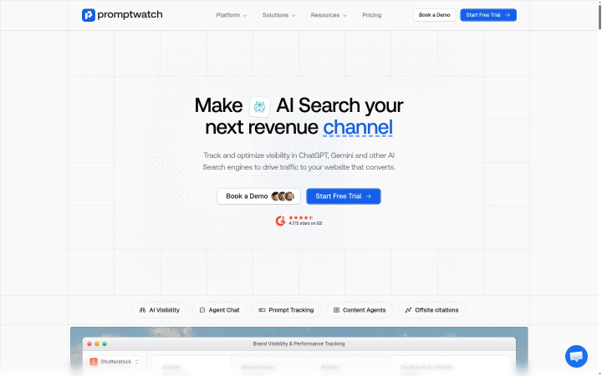
Why it works for multi-brand teams: Promptwatch maps brand count straight onto plan tier; Business adds state and city tracking for retail or hospitality brands, plus audit logs.
Standout feature: Each plan picks four models from OpenAI, Perplexity, Google, Claude, Gemini, Meta, DeepSeek, and Grok, scraped daily from the engines’ interfaces. Prompt monitoring’s engine set becomes a budget line.
Pros:
- Opens MCP and API from Essential up
- Adds Shopping Insights and Ads Radar on Business
- Connects Search Console, Slack, WordPress, Webflow, and Framer
Cons:
- Four models per plan, so engines compete
- Five projects on Business; city tracking is Business only
Pricing: Essential $95/mo (1 project, 50 prompts), Professional $245/mo (2, 150), Business $579/mo (5, 350); 7-day trial on the first two.
The incentive check: A project meter rewards consolidation: the vendor gains when you add brands, you gain when sub-brands share a project. Decide the grouping, then the plan.
6. Gauge
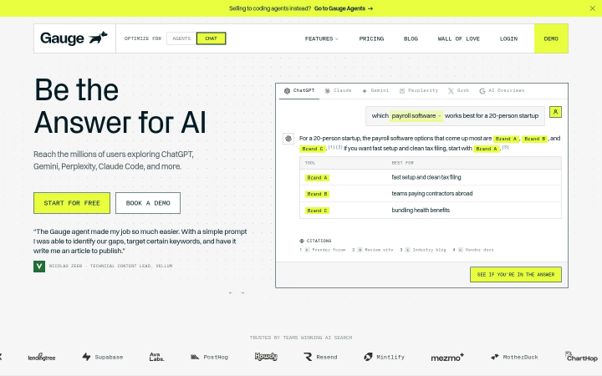
Why it works for multi-brand teams: Gauge’s Growth plan leaves domains and competitors uncapped, so every brand and rival fits one plan, with GA4 and Search Console linked.
Standout feature: 600 prompts run daily across ChatGPT, Google AI Overviews, AI Mode, Gemini, Perplexity, and Microsoft Copilot, about 108,000 answers a month. Visibility gaps become 18 publish-ready articles monthly; Claude or Grok switch on with your own API key.
Pros:
- Includes five seats and exports
- Publishes to Webflow, Framer, Sanity, and GitHub
- Pairs tracking with a content engine
Cons:
- Growth covers one location; more need Enterprise
- Claude and Grok are billed by the provider
Pricing: Growth $599/mo with a 1-week free trial; Enterprise is custom.
The incentive check: Gauge meters the market rather than the brand and sells content beside tracking. It suits a one-country portfolio whose teams want drafts. Five markets means an Enterprise conversation.
Which setup fits your brand portfolio?
Pick AI visibility tools by what your brand portfolio multiplies. Engines and evidence: start with the platform that keeps engines off the meter. Brands, markets, or prompts: match the vendor’s meter to your shape.
- Same engines and answer-level evidence, every brand: SE Visible.
- Every rival benchmarked first: Ahrefs Brand Radar’s index.
- Small sites, read weekly: LLMrefs.
- Product lines already on Semrush: Semrush Enterprise AIO.
- City-level reads, retail or hospitality: Promptwatch Business.
- One market, drafts wanted: Gauge.
What changes for practitioners: run one audit of every brand on identical terms, and log each vendor’s meter. Likely within two quarters, and I’ll score it in public: vendors repackage by market.
If you need one evidence standard across the group, give SE Visible a try and see how it reads your flagship beside your smallest brand. Classic rankings on Google and other search engines sit with SE Ranking, its sister platform; read side by side, the two show how each brand in the portfolio performs across search.
AI visibility audit FAQ for multi-brand teams
Can ChatGPT do an AI visibility audit for you?
Not on its own. ChatGPT answers one prompt at a time and keeps no dated baseline. Answers shift by run, engine, and market, so for a portfolio, AI visibility tools rerun the same prompts across engines on a schedule and store every answer.
What role does sentiment analysis play in AI visibility tools?
Sentiment analysis shows how AI answers frame each brand. Across a portfolio, it catches what mention counts hide: a premium brand described like its value-line sibling, or one brand typecast in a way that limits another. Useful AI visibility tools split it by engine.
How often should you rerun a portfolio audit?
Rerun the full audit quarterly, plus after a launch, rebrand, or acquisition. Baseline every brand once, then keep flagships on always-on LLM monitoring, daily or weekly by vendor, so each review has a running record. Acquisitions matter most: the new brand arrives without a baseline.
