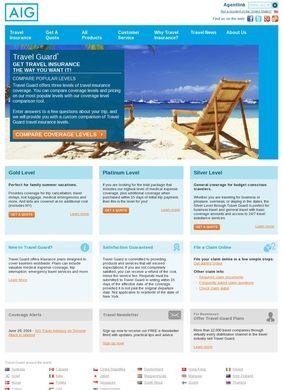
Someone books a two-week trip, puts down a nonrefundable deposit, then starts wondering what happens if a parent lands in hospital the week before departure, or if a hurricane closes the airport, or if a suitcase vanishes on a connection in another country. That worry is the reason Travel Guard exists, and the site is built around answering it before the money is already spent. The plans are sorted by how much protection a traveler wants and how much they are willing to pay, which keeps the choice from turning into guesswork.
Three tiers of coverage for different trip types
There are three named tiers. Deluxe sits at the top and is aimed at longer international trips and higher-value bookings. Preferred is the middle option, pitched at most standard vacations and families, and it carries the broadest general coverage. Essential is the budget line, built mainly for domestic trips where someone wants a floor of protection without paying for extras they will never use. Alongside those, Travel Guard sells Rental Vehicle Damage Coverage for people who would rather skip the counter upsell at the car desk, and Annual Plans for travelers who take enough trips in a year that buying one policy at a time stops making sense.
The coverage categories are spelled out clearly enough that a reader can match them to their own fears. Trip cancellation and interruption cover the deposit if plans collapse. Medical expense and emergency evacuation coverage handles the scenario that scares people most, getting hurt or sick far from home where a hospital bill or an air ambulance can run into serious numbers. Baggage reimbursement covers lost or delayed luggage. And Travel Guard runs 24/7 emergency assistance, a line to call when a traveler is stuck somewhere at an hour when nothing else is open. This isn't a name someone would dig up buried in a business directory between a dozen look-alike agencies; the depth of the plan lineup makes clear the company is built around insurance specifically.
Comparing plans side by side
This is where the site does more than list products. Travel Guard puts a plan comparison tool up front, so the tiers can be read side by side instead of on separate pages, and it lays out the specific benefit amounts under each one. Pricing is framed as roughly five to seven percent of the total trip cost, scaling with the value of the trip and the age of the traveler, which is a useful anchor for anyone trying to guess in advance what a policy will run before they enter any details.
Trip-specific guides and traveler resources
Beyond the plans themselves, the content is organized around the kinds of trips people take. There are guides for cruises, business travel, adventure trips, and ski trips, each of which carries its own risks and its own reasons to insure. That grouping matters, because a cruise cancellation and a ski injury are not the same problem, and the coverage that suits one is not the coverage that suits the other.
Help organized by traveler profile
The site also sorts help by who is traveling. Families, seniors, students, and pregnant travelers each get their own resources, and those pages tend to reflect the questions that group actually asks. On top of that there are destination guides, travel safety information, and a stack of educational articles and FAQs. It reads as an insurer that expects visitors to arrive uncertain and to need some teaching before they buy, more of a classroom than a plain checkout for people who already know exactly what they want.
Global reach and insurance backing
Reach is worth noting. Travel Guard is built primarily for US residents, and it also serves a set of international markets including Canada, Hong Kong, Singapore, and the UAE, among others. That footprint tells you the product is aimed at travelers moving across borders as much as at domestic getaways, which lines up with the emphasis on medical and evacuation coverage far from home.
AIG Travel ownership and claims reliability
The structure behind the brand is worth knowing about. Travel Guard is the travel insurance arm of AIG Travel, part of one of the larger insurance groups in the market, and that backing is the quiet fact that underpins whether a policy will actually pay when the claim comes in. An adventurous traveler and a cautious family planner will both find a version of Travel Guard shaped for them, and the tiered pricing means the cautious planner is not forced to buy the adventurer's policy.
What stands out across the whole thing is how much of the material is trip-shaped instead of policy-shaped. The trip-type guides, the traveler-specific pages, and the destination content all sit next to the plan comparison, so the coverage details and the practical planning advice live in the same place. A person can walk in worried about one specific thing, a missed cruise, a medical bill abroad, a delayed bag, and find both the plan that covers it and a page explaining how that kind of trip tends to go wrong.