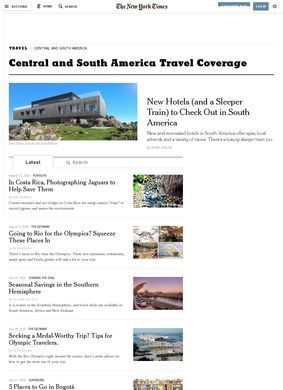
Every guide on this page comes with a byline, which is the fact that shapes how much weight it deserves. The New York Times Travel Guides: South America is a curated hub, not a crowd-sourced ledger, and everything gathered here was written by the paper's own correspondents and travel writers before it landed in one place for the region.
That editorial thread runs through the whole thing. Where a lot of destination sites pull in whatever fills a slot, this one collects reporting that already ran under the paper's masthead: dispatches from Rio de Janeiro, Buenos Aires, Lima, Santiago, and smaller stops that rarely get their own dedicated page.
The scope is Central and South America together, so a reader planning a trip through the isthmus and down the Andes finds both halves under a single roof. The New York Times Travel Guides: South America treats the two as one continuous field of interest, which suits how people actually travel the region.
What you actually get is a mix of formats. There are the "36 Hours in..." city guides, which compress a weekend into a tight, walkable sequence of meals, neighborhoods, and small detours. There are longer features that sit a destination inside its history and culture instead of reducing it to a checklist. And there are the practical layers on top: where to sleep, where to eat, how to move around once you land. The New York Times Travel Guides: South America keeps these types side by side, so a planner can shift from inspiration to logistics without leaving the page.
The New York Times Travel Guides: South America works as an index into that body of work. Rather than reading like a single monolithic article, it points outward to the individual pieces, so a person researching Patagonia can follow one trail and someone fixed on Colombian coffee country can follow a different one.
How the New York Times Travel Guides: South America earns a reader's trust
Trust is the whole game with travel writing, because the reader is about to spend money and vacation days on someone else's say-so. The value here is that the recommendations carry the reporting standards of the newsroom behind them. A hotel that makes the cut, a restaurant that gets named, an itinerary that gets endorsed: these passed through editors, not an affiliate feed. The New York Times Travel Guides: South America carries that provenance quietly, and it is the single biggest reason to prefer it over the churn of anonymous listicles.
A search for outside reviews of the guide itself, separate from the paper's general reputation, comes up empty on the review platforms travelers usually check; there is nothing to weigh there one way or the other, so the newsroom's editorial standards are what a reader is actually trusting.
That distinction counts for more here than it does with most travel content, which exists to sell a booking. The New York Times Travel Guides: South America reads as journalism first, so the writer's incentive is to get the place right, not to move a reservation.
The 36 Hours format and what it does well
The "36 Hours" series is the clearest example of the paper's approach applied to a single city. It picks a real constraint, a weekend, and builds around it. The result is a route a traveler can genuinely follow: Friday evening here, Saturday morning there, a specific cafe with a specific reason attached. The sequencing is deliberate, and it assumes the reader would rather be handed a plan than a menu of loose options.
For a first-time visitor to a place like Buenos Aires or Lima, that structure does heavy lifting. It answers the paralysis of an unfamiliar city by making decisions on the reader's behalf and explaining the logic. The New York Times Travel Guides: South America surfaces these city-by-city, so the format becomes a way of scanning the region one manageable weekend at a time.
The trade-off is honest to name. Thirty-six hours is a snapshot, not a full survey, and a reader with two weeks in a country will outgrow it fast. It is a starting shape, and the guides around it are meant to fill in what the weekend view leaves out.
Depth beyond the itinerary
Where the format guides stop, the longer journalism picks up. The New York Times Travel Guides: South America pulls in features that treat a destination as a place with a past, its politics, its food traditions, the reasons a neighborhood looks the way it does. That context is what separates a trip you understand from a trip you merely photograph.
This is the part that rewards a slower reader. Someone who wants to grasp why Santiago feels different from Bogota, or how a coastal town shifted over a generation, will find writing that sits with the question instead of rushing past it. The New York Times Travel Guides: South America gives that reader room to think before booking a single thing.
The material also spans a real range of traveler types. A luxury-minded reader and a shoestring backpacker are both served, because the underlying reporting was never written to a single budget. The New York Times Travel Guides: South America inherits that breadth from the section it belongs to.
One caveat worth setting expectations around: this is a curated collection, and the region is enormous. Coverage skews toward the destinations the paper has sent writers to, so major cities and well-trodden circuits are richer here than remote corners. A traveler headed somewhere genuinely off the map may find the shelf thinner than they hoped.
There is also the ordinary reality of any archive of published journalism. Some pieces are recent and some are older, and a restaurant praised a few years back may have changed hands. The historical and cultural writing ages gracefully; the specific listings reward a quick second check before a reader builds a night around them.
None of that undercuts the core proposition. The New York Times Travel Guides: South America is a reading resource, a place to absorb a destination and gather ideas, and on that measure it holds up. It is stronger as a source of judgment and narrative than as a live booking engine, and it never really pretended otherwise.
The New York Times Travel Guides: South America also benefits from simply being part of a much larger travel section. A reader who starts with Peru can slide sideways into the paper's guides for other regions without leaving the same editorial voice, which makes it a natural home base for someone whose plans are still loose across continents.
For the traveler still deciding between countries, that connective quality is the quiet strength. The New York Times Travel Guides: South America does not force a commitment before the reader is ready. It lets curiosity wander and hands over well-reported material at each stop along the way. Someone weighing a Peru trip against an Argentina trip can read both in the same sitting and let the writing tilt the decision, which is a gentler way to plan than committing to a route first and researching it after.
Set against the wider field of destination sites, the ceiling here is high and the floor is respectable. The writing is the product, and the writing is good. The New York Times Travel Guides: South America will feel familiar to anyone who already reads the paper, and it extends that same reliability to the specific work of choosing where to go and what to do once you are actually on the ground in the region.
The reader best served by The New York Times Travel Guides: South America is the trip-planner in the daydreaming stage, someone with a rough sense of the region but no locked itinerary yet. Start with a "36 Hours" guide for whichever city is pulling at you, read the longer feature attached to that same country next, and cross-check any specific hotel or restaurant against a current source before you book it.