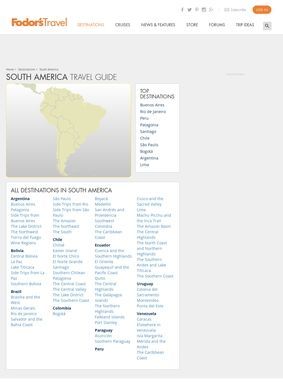
Fodor's is an American travel media brand that runs a website of destination guides, trip-planning articles, and travel news covering most of the world, South America included. If you are mapping out a route through Peru, Chile, Argentina or Brazil, the site sits in the same family of resources you probably grew up seeing on a shelf: full-color guidebooks with a recognizable spine. The web arm carries that history forward as free content, and the print and ebook guides still sell through retail channels like Amazon under the familiar "Fodor's [Destination]" naming.
Destination guides organized by region
The content model is straightforward. Destinations are organized by continent and country, so a traveler heading south of the equator can drill from the region down to a specific city and pull up hotel and restaurant suggestions, sightseeing notes, and practical travel tips. Layered on top of the plain guides are the editorial recommendation lists the brand is known for. "Fodor's Choice" flags the places the editors single out, and the annual "Go List" and various "Best of" roundups push readers toward destinations the team is promoting in a given season. For someone who wants a curated shortlist instead of an endless scroll of options, that editorial filtering is the real draw.
Alongside the guides sit news and trip-idea articles. These range from itinerary suggestions to service pieces on how to handle a particular kind of trip, and they are the part of the site that changes most often. A reader researching Patagonia or the Amazon basin is likely to find a mix of evergreen guide pages and more timely articles, which is a reasonable way to keep a large travel site from going stale. How deep the South America coverage runs compared to the brand's stronger North American and European material is the open question, and it is worth checking the actual country pages before leaning on them.
Audience of leisure travelers and planners
The audience here is easy to picture: the general leisure traveler who wants a second opinion before spending a week and a fair amount of money on a destination they have never seen. Trip planners piecing together a multi-country route, and readers deciding which physical guidebook to buy before they fly, both land in the same place. That breadth is a strength, since one site can carry a first-timer from a vague "somewhere in South America" idea to a concrete list of neighborhoods and day trips. It is also a limit: a resource pitched at everyone stops short of the on-the-ground detail a specialist regional forum or a local operator can provide.
Legacy of Fodor's print guidebooks
The print line is not a side note here. Titles such as "Fodor's New York City," "Fodor's Bahamas," and "Fodor's Best Road Trips in the USA" are still produced and sold, and the editorial voice on the website is recognizably the same one that fills those books. So the online recommendations come from an established travel-publishing operation with a house style, not an anonymous content farm assembled overnight.
It cuts both ways, though. A guidebook publisher's instinct is broad coverage of the destinations that sell books, which historically skews toward the United States, the Caribbean, and Western Europe. South America has never been the center of gravity for that kind of catalog. So while the brand's credibility as a travel authority is genuine, a traveler should confirm that the specific country or city they care about gets more than a thin overview page. The strength of the name does not guarantee equal depth everywhere the site claims to reach.
Checking Amazon reviews of individual titles
The Amazon side of things gives a small window into how the individual guides land with buyers. Product reviews on specific titles skew generally positive, with strong individual ratings on some volumes. That is encouraging as far as it goes, but those are reviews of one book at a time, tied to how well a particular edition served a particular trip. They say little about the website as a whole, and nothing about how current the free online pages happen to be. A five-star rating on a New York City edition tells a Peru-bound reader almost nothing, since the two are researched, written, and updated by different hands on different cycles.
On the reputation of Fodor's as a web destination, there is not much to go on. Sitejabber lists Fodor's Travel at 3.0 stars, but that rests on only three reviews, far too small a sample to read much into. Trustpilot has the brand listed with a single review and no settled aggregate score. No BBB, Google, Yelp, or Glassdoor presence surfaced in a search. For a name this old and this widely recognized, the near-absence of consolidated third-party feedback about the web operation is a little surprising, and it means a reader cannot lean on crowd sentiment the way they could with a newer site that lives or dies by its ratings.
Does Fodor's reputation guarantee accuracy?
A travel-recommendation site trades on trust, and that is the underlying question here. When someone books a hotel in Cusco or picks a restaurant in Buenos Aires off a "Fodor's Choice" tag, they are trusting that the pick is current and honestly chosen. Brand equity earns that trust up to a point, but decades of print history do not automatically transfer to whether a given web page was updated this year or three years back. The pedigree is not in question; whether a specific page is current is what a traveler still has to check.
Access to the live site was another wrinkle worth flagging. Automated attempts to load the homepage were blocked, so the exact section layout and whatever planning tools are on offer could not be confirmed firsthand for this write-up. A publisher of this size will have the standard footer pages, and there is no reason to think otherwise, but nothing about the present-day navigation can be asserted from direct inspection here.
None of that is disqualifying for a brand with this much history, but it means a reader is judging Fodor's on reputation and pedigree rather than anything measurable directly today. As a starting point for planning a South American trip, Fodor's brings a credible editorial voice, a recognizable recommendation system, and a back catalog of guides that many travelers already trust. That puts it ahead of a generic aggregator that scrapes listings with no human judgment behind them, and it is the reason the curation itself is the actual product on offer.
Assessing regional depth and recency
Where a careful traveler should slow down is on regional depth and recency. The guides are only as good as their last update, and a region that has never been the brand's commercial strong suit is exactly where a stale page is most likely to hide. Two travelers can have very different experiences of the same site depending on whether their destination is one the editors cover intensively or one they treat as a checkbox. Fodor's has the pedigree to be a first stop for South America research, but whether the country page in front of you reflects the ground as it stands now, or a snapshot from several editions back, is the doubt that no amount of brand history settles on its own.