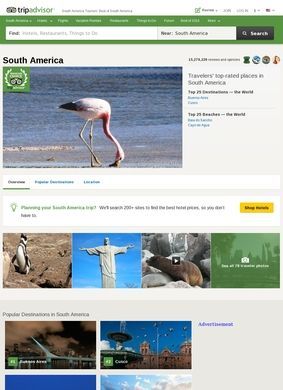
Sugarloaf Mountain alone carries 57,081 user reviews on this platform, and Iguazu Falls pulls in another 45,811 at a 4.9-star average. Those numbers say a lot about what TripAdvisor: South America has become. It is a place where the volume of ordinary travelers doing the rating becomes the product itself, a continent's worth of hotels, restaurants and landmarks filtered through people who actually went. For anyone weighing a trip to Rio or Cusco, that scale is the whole point.
Hotel ratings paired with nightly prices
The South America coverage maps to the cities most visitors put on a list: Sao Paulo, Rio de Janeiro, Buenos Aires, Lima, Bogota, Santiago, Cusco, Cartagena, Curitiba and Gramado. Each of those funnels into the same three layers that run across TripAdvisor: South America, where to sleep, where to eat and what to go see. The hotel layer is the one with the most teeth, because it pairs a star rating with a real nightly price you can sort against. The Santa Teresa Hotel in Rio shows a range of roughly 147 to 652 dollars a night depending on dates and room, and the Hotel Colline de France sits at a clean 5.0. Pricing filters let a traveler set a ceiling and work down, which is the difference between idle browsing and an actual shortlist.
Sorting restaurants by cuisine and cost
Restaurants get sorted by cuisine and by price tier, so a search in a given city can be narrowed to Japanese, Italian or a steakhouse before a single menu is opened. In a region where dining ranges from churrascarias to ceviche counters, that filtering does real work for someone with two free nights and no local fixer. The reviews underneath each listing are written by diners rather than the kitchens, and that is the line TripAdvisor: South America keeps walking, the establishments do not write their own copy here.
Attractions ranked by review volume
Attractions are split into categories a traveler recognizes on sight: museums, parks, beaches and historic sites. The review counts attached to the headline draws are not decoration. When a single mountain cable car gathers tens of thousands of opinions at close to five stars, the signal is strong enough to plan around. Smaller sites gather far fewer opinions, and TripAdvisor: South America does not pretend otherwise, which is part of why the aggregate feels usable instead of stage-managed. A reader can tell the difference between a landmark with fifty thousand verdicts and a cafe with twelve.
Traveler photos versus marketing images
Photo galleries sit alongside the listings, and they tend to be traveler-shot rather than glossy. On TripAdvisor: South America the source of a photo makes a difference for a destination like Gramado or Cartagena, where a marketing image and a phone snapshot from last month can tell two very different stories about a pool, a view or a breakfast spread. The galleries are uneven by nature, generous for the famous places and sparse for the obscure ones, which is honest in its own way.
Trip planner and cruise inventory
Beyond the listings, TripAdvisor: South America carries a trip planner that stitches chosen hotels, meals and sights into something resembling an itinerary, plus cruise listings for travelers approaching the continent by water, which is a real route for the southern coast and the Amazon. The cruise inventory is a reminder that the platform is trying to cover the whole shape of a trip, well past the nights in a city. Whether a given traveler uses the planner or just keeps tabs open is a matter of temperament, but the scaffolding is there.
Forums reveal the logistical questions
The travel forums on TripAdvisor: South America are the quieter strength. This is where peer advice lives, the questions about whether a Cusco altitude day is worth building in, how to handle the bus from Buenos Aires, what a realistic Iguazu day looks like from the Brazilian side versus the Argentine one. Aggregated star ratings tell a reader what people thought; the forums tell a reader why, and they catch the specific, awkward, logistical questions that a five-star average flattens out. For trip planning at the research stage, that back-and-forth is often more valuable than the scores.
How user reviews fund the platform
It is worth being clear-eyed about how the machine is fed. TripAdvisor: South America runs on user-generated reviews aggregated from millions of travelers, and it makes its money through hotel and restaurant partner referrals. That dual nature is the thing to hold in mind. The reviews are crowd-sourced and large enough that no single voice dominates, while the booking links and partner placements are a commercial layer sitting on top of that crowd. A careful user reads the volume and the spread of ratings first and treats the referral path as a convenience instead of a recommendation.
Pricing transparency reduces booking risk
The pricing transparency is the feature on TripAdvisor: South America that earns the most trust. A nightly rate shown next to a rating, with filters to cut the field, lets a traveler reason about value instead of guessing. The Santa Teresa range is a good illustration, because it shows that a single property can swing by hundreds of dollars across the calendar, and seeing that swing on the page is what stops a booking from feeling like a gamble. Restaurants get the same treatment through price tiers, coarser than a hotel rate but enough to separate a special-occasion dinner from a quick lunch.
Balancing research tool with booking funnel
Where TripAdvisor: South America asks for some judgment from the user is in reconciling its two roles at once, research tool and booking funnel. The same listing that aggregates thousands of independent verdicts also wants to route a reservation through a partner. Neither cancels the other out. The trick a seasoned traveler learns is to mine the reviews and the forums hard at the research stage, then decide separately where to actually book, whether that is the partner link or a direct call to the property. The post-trip review submission closes the loop, turning each visitor into the next visitor's data point, which is how a place like Sugarloaf reaches fifty thousand opinions in the first place.
What TripAdvisor: South America does best is reduce the cost of being wrong. A traveler with no contacts in Lima or Santiago can arrive at a defensible shortlist of hotels in a price band, a handful of restaurants by cuisine, and a ranked set of attractions, all backed by review counts large enough to mean something. The platform serves leisure and business travelers at every stage, from the first idle search to the comparison of two near-identical hotels to the review left after returning home. For South America specifically, where a first-time visitor faces real distances between Cartagena and Cusco and Buenos Aires, that breadth across ten major destinations is the practical case for keeping the site open in a tab.
Coverage varies by destination size
The honest limit is the one common to any crowd-rated platform. Counts can be gamed at the margins, tastes differ, and a 4.7 from fifty thousand people still leaves room for a bad night. The depth of TripAdvisor: South America coverage is uneven, dense around Rio and Buenos Aires and far lighter in the smaller towns, so a traveler heading somewhere obscure leans more on the forums and less on the star average. None of that undoes the core value. It just means the tool rewards a reader who weighs the numbers instead of swallowing them.
The final decision sits with the person planning the trip. TripAdvisor: South America hands over the raw material, the prices, the ratings, the photos, the forum threads and the itinerary scaffolding, in quantities that no single guidebook can match. A traveler who reads the spread of ratings instead of a single headline score walks away with a shortlist built on tens of thousands of firsthand verdicts, and for a continent this large that is the strongest argument the site offers.