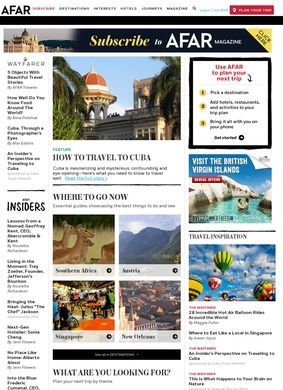
Where does a curious traveler go when the usual top-ten lists and hotel-booking funnels start to feel hollow? AFAR is one answer, and a fairly distinctive one. Started in 2009 and run out of San Francisco, it is a travel media outlet that pairs a quarterly print magazine with a steady stream of online editorial. The audience it writes for is clear from the tone: people with money to spend and a preference for trips that mean something beyond a beach selfie. That focus on experiential, off-the-obvious-path travel shapes nearly everything on the site.
Destinations organized by theme
The structure rewards a reader who likes to browse. Destinations is the backbone, with coverage spanning Africa, Asia, Europe, the Caribbean, Oceania, and a run of U.S. state-by-state guides for people planning closer to home. Alongside that sits Trip Ideas, which sorts inspiration by theme instead of geography: art and culture, food and drink, family travel, LGBTQ travel, outdoor adventure, road trips, sustainable travel, and train journeys each get their own collections. It is a smart way to organize, because most people start a trip with a feeling, a craving for good food or a long drive, before they ever settle on a map point.
Hotels get their own section
Hotels gets its own dedicated section, and this is where AFAR shows its editorial muscle. There are reviews, themed roundups, and a recurring feature called Hotels We Love that reads more like a critic's pick than a sponsored placement. The Tips and News area is the practical counterweight to all the dreaming: air travel news, packing and gear advice, visa guidance, and a feed of travel deals. "Deals" sections on travel sites often turn into affiliate noise, but pairing them with genuine reporting on airline changes and entry requirements gives this one a reason to exist.
Expanding beyond the magazine
Then there is Journeys, a set of themed guided itineraries that tries to move you from reading to actually going. Beyond the written word, AFAR has built out a fuller media presence than the typical travel publisher bothers with. Three podcast series run under the banner: Unpacked, Travel Tales, and View From Afar, each taking a different angle on how and why people travel. A free daily newsletter, Daily Wander, keeps a steady line open to readers who want a small dose without committing to the magazine. Video content rounds it out, and the print edition remains available by subscription or as a gift, which tells you the physical magazine is still treated as a real product, not a relic.
Who should read AFAR?
Independent travelers who plan their own trips and want better source material than a search engine provides will find AFAR useful. So will trip planners and people in the travel trade who need destination intelligence with some editorial spine to it. The writing quality is the selling point here, and it holds across the sections I clicked through. AFAR is not trying to be a booking engine or a price-comparison tool, and it does not pretend to be one, which keeps the editorial honest.
Checking app store ratings
The reputation picture outside AFAR's own channels is modest. The AFAR Magazine app carries a cumulative 3.3 out of 5 on Apple's App Store across 41 user reviews, a soft middle score that puts the app experience behind the website in terms of user satisfaction. A consumer aggregator called DigitalProductsDP puts its DigitalScore at 83 percent, though the sample behind that figure is not disclosed. No ratings turned up on Google, Trustpilot, Yelp, the BBB, or Tripadvisor. That absence is not damning for a publisher rather than a service business, but it does mean the app store is the main place outside voices have weighed in, and that they were lukewarm.
Contact information stays limited
Contact transparency is one area where the site comes up short. The landing page surfaces no phone number and no physical address. What you get instead is a row of social links, Instagram, Twitter, Facebook, Pinterest, YouTube, and LinkedIn, plus subscription and customer-service forms tucked into the navigation. For a media brand this is fairly normal, since readers rarely need to phone an editor, but anyone dealing with a subscription billing question would have to dig a little to find the right form. It is a minor friction, not a red flag, and a quick scan of the footer or the subscribe section usually surfaces what you need.
Weighing strengths against weaknesses
AFAR delivers on its promise. The breadth of destination coverage, the thematic trip collections, the hotel criticism, and the podcast and newsletter extensions add up to a publication that respects its reader's curiosity. The app rating and the buried contact options are worth noting, and neither one undermines the core product, which is the writing. If the voice in the Daily Wander newsletter connects, the print subscription is the natural next step.