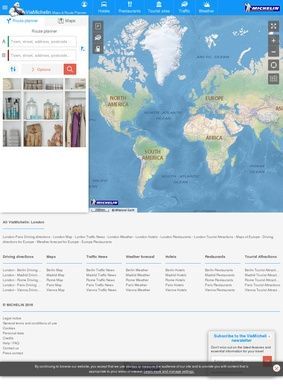
ViaMichelin is the Michelin group's online mapping and route-planning service, covering Europe and, in patches, the wider world. It grew out of the same company behind the tyres and the restaurant guide, and the site puts all three lineages to work: maps and atlases for countries like the UK, France, Italy, and Hungary, city maps for London, Paris, Rome, Budapest, Berlin, Madrid, and Vienna, and a route planner that quietly folds in the Michelin Guide's restaurant picks.
The core of ViaMichelin is the journey. Plug in a start and a destination and the tool calculates a route, but the interesting part is how many ways it will do that.
What ViaMichelin puts on the map
The service reaches past plain point-to-point directions. It carries traffic news, service-station listings, hotels, restaurants, and tourist attractions organized by city, plus a newsletter and a ViaMichelin Magazine for people who treat travel planning as reading rather than a chore. The site language on offer is English (International), which signals the audience it is aimed at.
Taken together the pieces form a travel workspace rather than a single-purpose map, and the sections lean on each other: a route pulls in fuel and toll numbers, a destination pulls in places to eat and sleep.
The mapping side is the oldest part of the offering. ViaMichelin publishes maps and atlases at country level and detailed city maps for the major European capitals, the kind of cartography the Michelin name has sold on paper for over a century, now delivered on screen. For a traveller who wants to see a city laid out before arriving, that long habit of map-making is a genuine edge over services that treat the map as an afterthought to the search box.
The newsletter and the ViaMichelin Magazine sit at the softer end, aimed at people who read around a trip before taking it. They point at an intention to be a place for planning and inspiration instead of a tool someone opens and closes in ten seconds.
Five ways to plan a route
Route calculation is where ViaMichelin is strongest. A user can plan for a car, a motorcycle, a bicycle, or on foot, and then choose the kind of route: Michelin recommended, quickest, shortest, a Discovery option that favours scenic and tourist roads, or an Economic one tuned to burn less fuel and dodge tolls. Up to six stages can be strung together, which turns the planner from a two-point tool into something that can map a multi-stop trip.
That spread of options is the genuine draw. The Discovery and Economic settings in particular do something most mapping tools skip, treating a drive as a choice about scenery or cost instead of only shaving minutes. For a road trip across several countries, being able to add stops and switch the optimisation is the feature that makes ViaMichelin worth opening.
The choice of travel mode widens the appeal again. A cyclist and a pedestrian each get routes shaped for them, not a driving line with the car quietly stripped out, and a motorcyclist is handled as a distinct case of its own. Set against the six-stage limit, this makes ViaMichelin usable for planning a whole touring holiday instead of a single commute, which is exactly the trip where the scenic routing pays off.
Fuel, tolls, and real-time traffic
Alongside the route, ViaMichelin breaks down what the journey will cost. A sample calculation puts fuel at around 49 euros and tolls at roughly 18, which is the sort of concrete number a driver planning a long trip actually wants before setting off. Real-time road traffic information rides on top, so the estimate reflects current conditions instead of an idealised empty road.
This cost breakdown is one of the more practical things the site does. Fuel-and-toll math is exactly the calculation people fudge or skip when planning, and having ViaMichelin surface it, tied to the specific route and the current traffic, saves a driver from guessing.
The supporting listings back this up. Service stations along a route, traffic news, and the live conditions feed all point at the same user, the person about to spend real hours in a car who wants to know where to refuel and what to avoid. It is the logistical layer a paper map never had, and the service folds it into the same plan instead of parking it on a separate page.
The Michelin selection for stays and tables
The other half of the service is booking. ViaMichelin handles accommodation and restaurant reservations for both the journey and the destination, and its trump card here is the Michelin selection, the restaurant and hotel picks carried over from the Michelin Guide. That connection is the thing no rival mapping service can copy, and it lets the planner steer a traveller past any random restaurant near the route toward ones the Guide has already vetted.
Whether a given traveller wants that is a fair question, since Michelin's picks skew toward a particular kind of dining. For someone who does, though, having the Guide's selections wired directly into the route planner is a real advantage, and it is the clearest reason to choose ViaMichelin over a generic map.
Tourist attractions listed by city sit alongside the hotels and restaurants, so the destination end of a trip is as covered as the journey. A person planning a weekend in Rome or Vienna can line up where to eat, where to sleep, and what to see in one pass, all filtered through the same Michelin lens, with service stations and traffic feeding back into how they get there.
The app and how it is received
ViaMichelin also ships a free mobile app for iOS and Android, with GPS navigation, 3D maps, voice guidance, and community traffic alerts, so the planning done on the desktop follows the driver into the car. On paper that is a complete package, matching the website's route intelligence to turn-by-turn guidance on the road.
The community traffic alerts are the feature that keeps any navigation app current, since crowd-sourced reports catch jams and hazards faster than an official feed. Whether ViaMichelin has the user base to make those alerts dense enough is a fair question for a service up against the giants of phone navigation, and it may be part of what the mixed reviews are reacting to.
Outside opinion on the app is where the picture gets cloudy. On the Apple App Store the navigation app carries user ratings and reviews, but the sentiment reads as mixed and no clean aggregate score surfaces. JustUseApp puts a safety score of 50.7 out of 100 on it, drawn from an analysis of 298 user reviews, which lands squarely in middling territory.
The website fares better on trust checks: Scamadviser rates viamichelin.com as legit and safe, citing a high Tranco ranking, and Sitejabber shows a perfect five stars, though from only two reviews, a sample too small to mean much. Trustpilot records that 379 people have reviewed ViaMichelin, but the actual rating did not surface, so the volume is visible and the verdict is not.
Put those signals together and they refuse to resolve into a clean number. A large review count on one platform with no visible score, a perfect but tiny sample on another, a clean bill from a safety checker, and a middling app score make a picture that is broadly reassuring on trust and genuinely uncertain on day-to-day satisfaction. This is clearly not a dubious site; whether its tools please the people who actually use them is the part the evidence will not confirm.
Contact is the weaker point. No phone number, email, or physical address turns up on the homepage or the FAQ, and there is no obvious contact page from the front of the site, so a user with a problem has little clear route to a human. For a free tool run by a large company that is not unusual, but it does mean the relationship is one-way. On balance ViaMichelin is a genuinely capable planner, strongest on routing options, cost breakdowns, and the Michelin-vetted places to stop, and shakier on the app experience and on being reachable.
The routing and cost tools alone justify using the site; the mixed app reviews and the middling safety score are reason enough to keep expectations for the mobile version in check.